Garnet Hertz:
Marginalia from the University of California Irvine
This is a timeline of what I did at Ape City as a student between September 2003 and November 2009. Non-student activities (Postdoctoral Scholar, 2010 / Research Scientist, 2011) are not listed here.
Last updated: 03 November 2010
SUMMARY:
- I completed a Ph.D. in the Visual Studies Program in the Departments of Film & Media Studies / Art History on November 11th 2009. Mark Poster, Peter Krapp, Cecile Whiting and Robert Nideffer were my committee members, and the title of my dissertation was "Methodologies of Reuse in the Media Arts: Exploring Black Boxes, Tactics and Archaeologies." (Abstract: This research investigates what motivating factors drive contemporary media artists to use obsolete information technology hardware and electronics in their work, and articulates what they accomplish by reusing and repurposing outdated communication devices. Three themes of reuse are proposed and explored through the examination of works by artists Reed Ghazala, Natalie Jeremijenko, Tom Jennings and Paul DeMarinis and through conversations with theorists Geert Lovink and Jussi Parikka. Reuse is explored as a method of uncovering the concealed mechanisms of consumer electronics, tactical reuse is developed as a tactical method for political change, and archaeological reuse is expatiated as a historiographical intervention.)
- I completed an M.F.A. in Arts Computation Engineering on September 14th 2005.
- I completed the Emphasis in Critical Theory while at UC Irvine.
Between 2003 and 2006, coursework at UCI was taken from:
- Antoinette LaFarge
- Beatriz da Costa
- Bill Tomlinson
- Cecile Whiting
- Chris Dobrian
- David Reinkensmeyer
- Ed Dimendberg
- Elizabeth Guthrie
- Felicity Scott
- Gabriele Schwab
- John Crawford
- Mark Poster
- Nanette Fornabai
- Paul Dourish
- Peter Krapp
- Robert Nideffer
- Simon Penny
- Wolfgang Iser
A reverse chronology is listed below. Previous coursework is also listed.
Fall 2009
- Finished dissertation. Filed completed dissertation and all related doctoral paperwork on November 11th 2009.
- Advised senior undergraduate students for Informatics 148.
- Received official written confirmation that doctoral degree was complete.
- Received official written confirmation that Critical Theory Emphasis (completed in 2005) was complete.
- Courtesy appointment as Artist in Residence in Laboratory for Ubiquitous Computing and Interaction (under Paul Dourish).
- Hired as Postdoctoral Scholar at the Institute for Software Research, UC Irvine to complete OutRun project. Appointed as Assistant Director of Computer Game Science Laboratory.
- Hired as Adjunct Assistant Professor in the Media Design Program of the Art Center College of Design.
Winter 2009
- Writing dissertation. Expect to be finished complete dissertation draft by end of quarter.
- Teaching four (4) Lab Sections (language: Java) for University Studies 12: Computer Games as Technology, Art & Culture.
Fall 2008
- Writing dissertation.
- Complete academic job market materials at http://conceptlab.com/teaching/.
- Complete post-doc project proposals at:
- Win Oscar Signorini Award (Milan, Italy) for Master's Thesis project.
- Teaching four (4) Discussion Sections for University Studies 12: Computer Games as Technology, Art & Culture.
- USC Demo, Interactive Media Division.
Summer 2008
- Writing dissertation.
- Given lab space by Paul Dourish at UCI in the Laboratory for Ubiquitous Computing and Interaction (LUCI).
- Guest lecture: University of Saskatchewan (Canada) in the Department of Art & Art History.
- Work featured in Moscow International Film Festival in Moscow, Russia.
Spring 2008
- Writing dissertation.
- Teaching four (4) Discussion Sections for University Studies 12: Computer Games as Technology, Art & Culture.
- Participated in HASTAC II at University of California Irvine and University of California Los Angeles.
- Presented at 4th Annual Graduate Student Forum on Interdisciplinary Research @ UCI.
- Awarded Pedagogical Fellowship through UC Irvine. This includes training incoming teaching assistants at UCI, workshops on course design, pedagogy, mentoring, job talks, tenure, etc.
Winter 2008
- Writing dissertation.
- Teaching four (4) Discussion Sections for University Studies 12: Computer Games as Technology, Art & Culture.
- Presented at CAA2008, the College Art Association's 96th Annual Conference in Dallas - Fort Worth Texas.
Fall 2007 - (Completion and Approval of Prospectus)
- Complete prospectus. Prospectus submitted December 31st 2007. Approved.
- Teaching four (4) Discussion Sections for University Studies 12: Computer Games as Technology, Art & Culture.
Summer 2007
- Work on prospectus.
- Work on grant proposals.
- Sponsored to attend the Text Encoding Seminar & Workshop at UC Santa Barbara. Seminar led by Julia Flanders and Syd Bauman, hosted by the UC Transliteracies Project and the UCSB Early Modern Center, with funding from the National Endowment for the Humanities. Directed by Alan Liu.
Spring 2007 - (Doctoral Exams and Advancement to Candidacy)
- Written and oral exams. Written exams on 21/23/25 May 2007. Oral exam scheduled for 05 June 2007, 2pm. HIB 136. Core members: Mark Poster, Peter Krapp, Ed Dimendberg. 4th member: Cecile Whiting. External member/referee: Bill Tomlinson. Advancement to candidacy.
- Researching New Media Theory & McLuhan. Directed by Mark Poster. Bibliography at conceptlab.com/uci/phd/, with notes posted to conceptlab.com/notes/ when complete.
THEME #1: FOUNDATIONS OF NEW MEDIA - April 16th 2007
- Borges (1941) The Garden of Forking Paths
- Bush (1945) As We May Think
- Turing (1950) Computing Machinery and Intelligence
- Weiner (1954) Men, Machines, and the World About
- Sutherland (1963) Sketchpad: A Man-Machine Graphical Communication System
- Ascott (1964) The Construction of Change
- Nelson (1974) Computer Lib / Dream Machines
- Berners-Lee et al. (1994) The World-Wide Web
THEME #2: MCLUHAN & NEW MEDIA - April 23rd 2007
- Innis (1947) Minerva's Owl, in (1951) The Bias of Communication, pp 3-32.
- Innis (1949) The Bias of Communication, in (1951) The Bias of Communication, pp 33-60.
- McLuhan (1964) "Understanding Media: The Extensions of Man".
- McLuhan, "Media and Cultural Change," in Essential McLuhan, pp. 89-96.
- McLuhan & McLuhan (1988) Laws of Media: The New Science.
- Kroker (1984) Technological Humanism: The Processed World of Marshall McLuhan, in (1984) Technology and the Canadian Mind: Innis/McLuhan/Grant, pp 52-86.
- Kroker (1984) Technological Realism: Harold Innis' Empire of Comunication, in (1984) Technology and the Canadian Mind: Innis/McLuhan/Grant, pp 87-124.
- Moulthrop (1991) You Say You Want a Revolution? Hypertext and the Laws of Media -
- Bolter & Grusin, "Remediation: Understanding New Media"
THEME #3: POSTER & NEW MEDIA - April 30th 2007
- Poster (2006), "Information Please"
- Poster (2001), "What's the Matter with the Internet"
- Poster (1995), "The 2nd Media Age"
- Poster (1990), "The Mode of Information"
THEME #4: NEW MEDIA THEORY - May 7th 2007
- Enzensberger (1970) Constituents of a Theory of the Media
- Baudrillard (1972) Requiem for the Media
- Winner (1986) Mythinformation
- Nichols (1986) The Work of Culture in the Age of Cybernetic Systems
- Manovich (2002) The Language of New Media
- Manovich (2003) New Media from Borges to HTML
- Teaching two (2) Discussion Sections and two (2) Lab Sections (language: Java) for University Studies 12: Computer Games as Technology, Art & Culture.
- Presented at the third annual UCI Graduate Student Forum on Interdisciplinary Research.
- Exhibited at The Dutch Electronic Art Festival: DEAF07. Rotterdam, NL.
Winter 2007
- Researching Protocinematic Technologies. Directed by Ed Dimendberg. Bibliography at conceptlab.com/uci/phd/, with notes posted to conceptlab.com/notes/ when complete.
KEY TEXTS:
- Abel (ed), "Encyclopedia of Early Cinema"
- Braun, "Picturing Time: The Work of Etienne-Jules Marey (1830-1904)"
- Burch, "Life to Those Shadows"
- Ceram, "Archaeology of the Cinema"
- Crary, "Modernity and the Problem of the Observer"
- Crary, "Techniques of the Observer. On Vision and Modernity in the Nineteenth Century"
- Elsaesser, "Early Cinema: Space, Frame, Narrative"
- "Film Before Film" (VHS Video, 1986), Kino Video
- Gunning, "An Aesthetic of Astonishment: Early Film and the [In]Credulous
Spectator" in Viewing Positions, ed. Linda Williams (New Brunswick:
Rutgers, 1995)
- Gunning, "The Cinema of Attractions: Early Film, Its Spectator and the
Avant-Garde"; in Early Film ed. Thomas Elsaesser and Adam Barker
(British Film Institute, 1989)
- Gunning, "Vienna Avant-Garde and Early Cinema",
http://www.sixpackfilm.com/archive/veranstaltung/festivals/earlycinema/symposion/symposion_gunning.html#1
- Gunning, "Phantasmagoria: The Technology of the Moving Picture
as a Model for Human Perception",
http://cri.histart.umontreal.ca/Grafics/colloques/domitor/Resume-conferenciers/Gunning.htm
- Gunning, "Illusions Past and Future: The Phantasmagoria and its
Specters", http://www.mediaarthistory.org/Programmatic%20key%20texts/pdfs/Gunning.pdf
- Gunning, "From Kaleidoscope to the X-Ray: Urban Spectatorship, Poe, Benjamin
and Traffic is Souls (1913)" in Wide Angle, Vol. 19, no. 4, pp. 25-63.
- Musser, "The Emergence of Cinema: The American Screen to 1907 (History of the American Cinema, Vol 1)"
- Stafford, "Devices of Wonder: From the World in a Box to Images on a Screen" (Getty Trust Publications: Getty Research Institute for the History of Art and the Humanities)
SUPPLEMENTAL TEXTS:
- Burch, "To the Distant Observer: Form and Meaning in Japanese Cinema"
- Ernst, "Dis/continuities"
- Hankins & Silverman, "Instruments and the Imagination". Princeton, New Jersey: Princeton University Press, 1995
- Huhtamo, "From Kaleidoscopomaniac to Cybernerd"
- Huhtamo, "Time Travelling in the Gallery"
- Marvin, "When Old Technologies were New. Thinking About Electric Communication in the late Nineteenth Century". New York & Oxford: Oxford University Press, 1988.
- Manovich, "The Language of New Media" (MIT 2002)
- Manovich, "An Archaeology of a Computer Screen"
- Zielinski, "An Anarchaeology of Hearing and Seeing Through Technical Means"
- Zielinski, "Media Archaeology"
- Zielinski, "Deep Time of the Media"
- Zielinski, "Audiovisions. Cinema and Television as Entr'Actes in History". Amsterdam: University of Amsterdam Press, 1999.
- Completion of French language exam.
- Teaching four (4) Discussion Sections for University Studies 12: Computer Games as Technology, Art & Culture.
- Exhibited in San Luis Obispo (California) with Casey Reas, Simon Penny, Peter Cho.
- Lectured at University of California Digital Arts Research Network "Epicenter" event at UC Riverside.
- Exhibited and lectured at InterAccess Electronic Media Arts Centre, Toronto, Canada.
- Lecture at Concordia University (Montreal, Canada). Talk supported by Concordia's Intermedia Cyberarts Program in conjunction with Hexagram, CIAM, CDA, and UC Irvine.
Fall 2006
- Researching Theories of Media Change. Directed by Peter Krapp. Bibliography at conceptlab.com/uci/phd/, with notes posted to conceptlab.com/notes/ when complete.
KEY TEXTS
- Akrich & Latour, "A Summary of a Convenient Vocabulary for the Semiotics of Human and Nonhuman Assemblies"
- Akrich, "The De-Scription of Technical Objects"
- Bijker & Law (eds), "Shaping Technology / Building Society - Studies in Sociotechnical Change" (Section intros: "Do Technologies Have Trajectories?", "Strategies, Resources, and the Shaping of Technology", "What's Next? Technology, Theory and Method", and "Postsript: Technology, Stability, and Social Theory")
- Bijker, "The Social Construction of Fluorescent Lighting, or How an Artifact Was Invented in Its Diffusion Stage"
- Carlson, "Artifacts and Frames of Meaning: Thomas A. Edison, His Managers, and the Cultural Construction of Motion Pictures"
- Chapman, "Comparitive Media History"
- Chun, "Did Somebody Say New Media?"
- Duguid, "Material Matters: Aspects of the past and futurology of the book", from The Future of the Book (Duguid, ed.) - http://www2.parc.com/ops/members/brown/papers/mm.html
- Feenberg, "Transforming Technology: A Critical Theory Revisited"
- Foulger, "The Processes of Media Invention and Evolution." http://evolutionarymedia.com/papers/hammerAsMedium.htm
- Galloway, "Protocol: How Control Exists After Decentralization"
- Gartner Inc., "Hype Cycle Special Report for 2005"
- Gartner Inc., "Hype Cycles for the Media Industry, 2005"
- Gartner Inc., "Understanding Gartner's Hype Cycles, 2005"
- Gitelman, "Always Already New: Media, History, and the Data of Culture"
- Gitelman, "New Media, 1740-1915 (Media in Transition)"
- Gitelman, "Scripts, Grooves, and Writing Machines"
- Jenkins (2006), "Convergence Culture"
- Kuhn, "The Structure of Scientific Revolutions"
- Latour, "Where Are the Missing Masses? The Sociology of a Few Mundane Artifacts"
- Law & Callon, "The Life and Death of an Aircraft: A Network Analysis of Technical Change"
- Liu (2004), "The Laws of Cool: Knowledge Work and the Culture of Information"
- Lovink, "My First Recession: Critical Internet Culture in Transition"
- Moore, G. E. (1965), "Cramming More Components Onto Integrated Circuits" - http://download.intel.com/research/silicon/moorespaper.pdf (also see http://www.intel.com/technology/mooreslaw/index.htm)
- Rogers, "Diffusion of Innovations, 5th Edition"
- Smith & Marx (eds.), "Does Technology Drive History? The Dilemma of Technological Determinism"
- Sterling (2005), "Shaping Things (Mediaworks Pamphlets)"
- Thorburn & Jenkins (eds.) "Rethinking Media Change. The Aesthetics of Transition"
- Winston, (1998). "Media Technology and Society : A History : From the Telegraph to the Internet." Routledge.
SUPPLEMENTAL TEXTS
- Bijker, "Of Bicycles, Bakelites, and Bulbs: Toward a Theory of Sociotechnical Change (Inside Technology)"
- Basalla, "The Evolution of Technology"
- Heidegger, "The Question Concerning Technology"
- Hughes, "The Evolution of Large Technological Systems", in The Social Construction of Technological Systems: New Directions in the Sociology and History of Technology, Wiebe Bijker (ed)
- MacKenzie, "Knowing Machines: Essays on Technical Change (Inside Technology)"
- Rajagopal, "Imperceptible Perceptions in Our Technological Modernity"
- Chapman (2005), "Comparative Media History: An Introduction: 1789 to the Present"
- Gartner Inc., "Hype Cycles for Collaboration and Communication, 2005"
- Gartner Inc., "Hype Cycles for Networking and Communications, 2005"
- Gartner Inc., "Hype Cycles for PC Technologies, 2005"
- Gartner Inc., "Hype Cycles for Telecommunications, 2005"
- Teaching two (2) Discussion Sections and two (2) Lab Sections (language: Java) for University Studies 12: Computer Games as Technology, Art & Culture.
- Lecture at CalIT2.
- Won honorable mention at Vida 9.0. (Madrid, Spain).
Summer 2006
- Received scholarship to attend SECT2006 at the University of California Humanities Research Institute.
- Worked on the Transliteracies Project with Alan Liu at UCSB. Wrote on MySpace and its impact on online reading.
- Participated in Technospheres: Futures of Thinking, the Third Annual Seminar in Experimental Critical Theory at the University of California Humanities Research Institute.
- Awarded Emulex Fellowship from CalIT2.
Spring 2006 - (Last quarter of doctoral coursework)
- VIS STD 296 [Course #35029] - DIRECTED READING (Peter Krapp)
- 07 April 2006 -- MCLUHAN / BOLTER & GRUSIN
- Laws of Media: The New Science - Marshall McLuhan
- Understanding Media: The Extensions of Man : Critical Edition - Marshall
McLuhan
- The Gutenberg Galaxy: The Making of Typographic Man - Marshall
McLuhan
- Remediation: Understanding New Media -- Jay David Bolter, Richard Grusin
- 21 April 2006 -- SCHIVELBUSCH / NYE
- The Railway Journey: The Industrialization of Time and Space in the 19th
Century - Wolfgang Schivelbusch
- American Technological Sublime - David E. Nye
- Electrifying America: Social Meanings of a New Technology, 1880-1940 -
David E. Nye
- Disenchanted Night: The Industrialization of Light in the Nineteenth
Century - Wolfgang Schivelbusch
- 05 May 2006 -- ZIELINSKI / GITELMAN
- Deep Time of the Media : Toward an Archaeology of Hearing and Seeing by
Technical Means (Electronic Culture: History, Theory, and Practice) -
Siegfried Zielinski
- Audiovisions : Cinema and Television as Entr'actes in History (Amsterdam
University Press - Film Culture in Transition) - Siegfried Zielinski
- New Media, 1740-1915 (Media in Transition) - Lisa Gitelman
- 19 May 2006 -- MARVIN / HANKINS & SILVERMAN / STAFFORD & TERPAK / THORBURN
- When Old Technologies Were New : Thinking About Electric Communication in
the Late Nineteenth Century - Carolyn Marvin
- Instruments and the Imagination -- by Thomas L. Hankins, Robert J.
Silverman
- Devices of Wonder : From the World in a Box to Images on a Screen (Getty
Trust Publications: Getty Research Institute for the History of Art and
the Humanities) -- Barbara Maria Stafford, Frances Terpak, Isotta Poggi
- Rethinking Media Change : The Aesthetics of Transition (Media in
Transition) - David Thorburn
- 02 June 2006 -- CRARY / FLUSSER
- Suspensions of Perception: Attention, Spectacle, and Modern Culture
(October Books) - Jonathan Crary
- Techniques of the Observer: On Vision and Modernity in the 19th Century
(October Books) - Jonathan Crary
- Writings (Electronic Mediations) - Vilem Flusser
- HISTORY 200C [Course #28599] - FOUCAULT (Mark Poster) - Mon 04:00-06:50pm KH126 - Course Website
- Paul Rabinow, ed., The Foucault Reader
(Pantheon)
- Michel Foucault, Discipline and Punish
(Pantheon)
- Michel Foucault, The History of Sexuality, Vol.1
(Pantheon)
- Michel Foucault, Society Must Be Defended
(Picador)
- Michel Foucault, Abnormal (Picador)
- Graham Burchell, et al, eds., The Foucault Effect
(University of Chicago)
- Michel Foucault, The
Hermeneutics of the Subject (Palgrave)
- Michel Foucault, "Different Spaces" (Electronic
Reserve)
- Gilles Deleuze, "Postscript
on Control Societies" (Electronic Reserve)
- VIS STD 293A [Course #35005] - PRACTICUM (Cecile Whiting) - Tue 03:00-05:50 HIB90 - Course Website
This seminar is designed to apply theoretical and methodological insights (explored in VS 291 and VS 292) to a research paper on a specific topic in Visual Studies.
- Presented at Paul Dourish's research group at UCI.
- Presented at UCSD's Interdisciplinary Computing and the Arts 2006 Lecture Series.
- Exhibited and lectured at STRP Festival in Eindhoven Netherlands.
Winter 2006
- VS292, VISUAL STUDIES AND HISTORIOGRAPHY (Felicity Scott) [Tu 2:00- 4:50p]
This core seminar in historiography will examine a series of fundamental texts and methodological questions from the disciplines of Art History and Film Studies. In addition to addressing the history and historiography of these disciplines, and the institutional and cultural contexts of canonical writings and debates on visual artifacts, the seminar will also provide the occasion to evaluate the status of these texts within contemporary scholarship in Visual Studies.
- Introduction: Histories of Art, Histories of Vision
- Riegl and the Vienna School
- Riegl, "The Main Characteristics of the Late Roman Kunstwollen" (1901), in The Vienna School Reader, ed. Christopher Wood (New York: Zone Books, 2000): 87-103.
- Riegl, "The Modern Cult of Monuments: its Character and its Origin" (1903), Oppositions 25 (Fall 1982): 21-51.
- Margaret Iversen, "Riegl and the Aesthetics of Disintegration," in Kunst und Kunsttheorie, ed. Peter Ganz (Wiesbaden: Herzog August Bibliothek, 1991): 439-451.
- Hayden White, "The Historical Text as Literary Artifact," in Tropics of Discourse: Essays in Cultural Criticism (Baltimore: Johns Hopkins University press, 1978): 81-99.
- Iconology
- Erwin Panofsky, "The Concept of Artistic Volition," Critical Inquiry 8 (1981): 17-34.
- Erwin Panofsky, "Introduction," in Meaning in the Visual Arts (New York: Doubleday, 1955): 26-54.
- Erwin Panofsky, "Style and Medium in the Motion Pictures," in Three Essays on Style, ed. Irving Lavin (Cambridge: MIT Press, 1995): 91-125. [First published in Critique 1, no. 3 (January-February 1947): 5-27.
- Thomas Y. Levin, "Iconology and the Movies: Panofsky's Film Theory," The Yale Journal of Criticism 9, no. 1 (1996): 27-55.
- Social Bases of Art
- Meyer Schapiro, "The Social Bases of Art," (1936) in Worldview in Painting--Art and Society (New York: Braziller, 1999): 119-128.
- Meyer Schapiro, "The Nature of Abstract Art," (1937) in Modern Art: 19th and 20th Centuries (New York: George Braziller, 1979): 185-211.
- Meyer Schapiro, "Architecture Under Capitalism," Grey Room 06 (Winter 2002): 70-80.
- Meyer Schapiro, "Race, Nationality and Art," Art Front (March 2 1936): 10-12.
- Thomas Crow, "Modernism and Mass Culture in the Visual Arts," in Modern Art in the Common Culture (New Haven: Yale University Press, 1996): 233-266.
- Kracauer and Warburg
- Siegfried Kracauer, "Photography" (1927) and "The Mass Ornament" (1927), trans. Thomas Y. Levin, in The Mass Ornament: Weimar Essays, ed. Thomas Y. Levin (Cambridge: Harvard University Press, 1995): 47-63 and 75-88, respectively.
- Philippe-Alain Michaud, Aby Warburg and the Image in Motion (New York: Zone Books, 2004): 67-90, 229-291.
- VS925 - MEDIA THEORY AND HISTORY (Mark Poster) [Wed 4:30-7:30 pm] (Course Website)
- Marshall McLuhan, Understanding Media (MIT Press)
- Mark Poster, ed., Jean Baudrillard: Selected Writings (Stanford UP)
- James Der Derian, The Virilio Reader (Blackwell)
- John Johnston, ed., Friedrich Kittler: Essays (G and B Arts International)
- Jay Bolter and Richard Grusin, Remediation (MIT Press)
- Wendy Chun and Thomas Keenan, eds., New Media, Old Media (Routledge)
- FRENCH 97 - FUNDAMENTALS OF READING (Guthrie) [TuTh 12:30- 1:50p]
Designed primarily for students interested in acquiring a solid reading knowledge of French, and to facilitate the understanding and translating of French texts dealing with a variety of disciplines.
- Exhibited at Latitude 53 in Edmonton, Canada.
- Participated in Information Exchange: UC DARNet Annual System-Wide Gathering at UCLA.
- Demonstration and guest lecture for Lisa Naugle's class at UCI.
- Demonstration and guest lecture for Beatriz da Costa's EECS129 class at UCI.
- Attended "New Media, Technology and Humanities" at UCI.
- Interviewed by Georgina Born from University of Cambridge (UK).
Fall 2005
- VS 291: VISION & VISUALITY - Ed Dimendberg (Personal Profile)
- This seminar will survey a variety of theories of vision and visuality in order to forge new analytic tools for the study of visual artifacts and experiences. Because the seminar will examine these issues from the perspectives of both Art History and Film Studies--two disciplines that, despite their shared interests, consist of different methodogical traditions and theoretical trajectories--the optical paradigm of the binocular will serve as the ruling metaphor for the course. The readings have been grouped around the major debates that characterize the emerging discipline of visual studies. Our seminar discussions are intended to address the binocular parallax implicit in such a course--between Art History and Film Studies, between objects and processes, between high art and popular culture, between modernity and post-modernity, between male and female, and so forth--in the hopes of establishing a stereopsis whereby separate fields of study, objects of vision, historical perspectives, gendered positions, and so forth, become deeper, more dimensional, more alive.
- Readings:
- Althusser, "Ideology and Ideological State Apparatuses"
- Bal & Bryson, "Semiotics and Art History"
- Barthes, "Myth Today"
- Benjamin, "The Work of Art in the Age of Its Technological Reproducibility"
- Burnett, "The Brain Sees, but Does the Mind Understand?"
- Crary, "Modernity and the Problem of the Observer"
- Doane, "Film and Masquerade"
- Foucault, "Panopticism"
- Herbert, "Visual Culture / Visual Studies"
- Irigaray, "This Sex Which is Not One"
- Ivins, "Prints and Visual Communication"
- Krauss, "Welcome to the Cultural Revolution"
- Lacan, "Of the Gaze"
- Marx, "The German Ideology"
- Merleau-Ponty, "Eye and Mind"
- Mirzoeff, "What is Visual Culture"
- Mitchell, "Showing Seeing: A Critique of Visual Culture"
- Mitchell, "What Do Pictures Want?"
- Mulvey, "Visual Pleasure and Narrative Cinema"
- Potts, "Sign"
- Potts, "The Phenomenological Turn"
- Sartre, "The Look"
- BIO, ART AND THE PUBLIC SPHERE - Course Website - Beatriz da Costa (Personal Website)
- This course aims to provide an introduction to the field of research and production currently referred to as "BioArt." Students will be presented with
examples, theoretical background readings as well as hands-on activities in this area. Although artists have traditionally always been engaged with changes
and depiction of "nature," BioArt, which includes the use of biological matters as part of artistic production and context creation, is relatively young.
Over the past 20 years, biotechnology has revolutionized the pharmaceutical industry, the agricultural industry and the field of animal and human medicine. As such, its impacts on human life are tremendous. Biotechnology implementations direct areas such food production and consumption, global trade agreements, human and animal reproduction, environmental concerns as well as biosecurity and biodefense. The Human Genome Project, as well as other International Genome Initiatives stimulated the merging of computational research with areas of the life sciences.
A major component of this class is the five-day hands-on workshop conducted by the arts and science research group "SymbioticA" at the University of California Irvine. The workshop is mandatory for all ACE students enrolled in this course (all other ACE courses will be canceled for the week). Studio Art and
other students are strongly encouraged (and invited!) to participate in the workshop as well but may opt out if scheduling doesn"t allow for participation.
Alternatives for class participation and involvement will be determined on a case-by-case basis. In addition to the workshop, a one-day conference under
the same thematic will be hosted at UCI on October 17th.
For workshop and conference updates please refer to this website:
http://www.publicsphere.parasitelab.net/.
A total of three class sessions (first half of class meeting time) will be team-taught with Women's Study Professor Kavita Philip.
- My photographs of the Symbiotica Workshop can be seen at http://www.conceptlab.com/photos/symbiotica2005/
- Readings:
- Eugene Thacker, "Biomedia" - Electronic Mediations Series, Minnesota Press, 2004.
- Michael Warner, "Publics and Counterpublics" "Public Culture 14(1): 49-90, Duke University Press, 2002.
- Daniel J Kevles, "Out of Eugenics" "The Code of Codes: Scientific and Social Issues in the Human Genome Project, edited by Daniel J. Kevles and Leroy Hood, Harvard University Press, 1992.
- Dorothy Nelkin, "The Social Power of Genetic Information" " The Code of Codes: Scientific and Social Issues in the Human Genome Project, edited by Daniel J. Kevles and Leroy Hood, Harvard University Press, 1992.
- Evelyn Fox Keller, "Nature, Nurture, and the Human Genome Project" " The Code of Codes: Scientific and Social Issues in the Human Genome Project, edited by Daniel J. Kevles and Leroy Hood, Harvard University Press, 1992.
- Emily Martin, "The Egg and The Sperm: How science has constructed a romance based on stereotypical male-female roles" "Signs: Journal of Women in Culture and Society 1991, vol.16, no.3.
- Donna Haraway, "FemaleMan meets Oncomouse" - Modest-Witness, Second-Millennium: Femaleman Meets Oncomouse : Feminism and Technoscience, (Chapter 2), Routledge, 1996.
- Michael Hardt & Antonio Negri, "Biopolitical Production" -Empire (Chapter 1.2), Harvard University Press, 2000.
- Kavita Philip, "Seeds of Neo-Colonialism: Reflections on the Ecological Politics in the New World Order" "CNS, 12 (2), June 2001.
- Michael Hardt, "Common Property" Be Creative, Online Project, 2003.
- Michel Foucault, "Right of Death and Power over Life""Foucault Reader, edited by Paul Rabinow, 1984; [Article originally from "History of Sexuality, Volume I"].
- Michel Foucault, "Society Must Be Defended," Lectures at the College de France, 1975-1976, Chapter Eleven.
- Michel Foucault, "The Birth of Biopolitics" " Ethics: Subjectivity and Truth, (edited by Paul Rabinow), New Press, 1997.
- Paul Rabinow & Nikolas Rose, "Thoughts on the Concept of Biopower Today."
- Richard Lewontin, "The Triple Helix: Gene, Organism, Environment" "Harvard University Press, 2001.
- VS 295: CRYPTOGRAPHY: THE MEDIA HISTORY OF SECRECY - Peter Krapp (Course Website, Course Noteboard)
- The secret has been called one of mankind's greatest achievements, a foundational act of culture. Arguably, all social intercourse is based on a teleological ignorance about the other - even the most intimate human relations presuppose an incalculable degree of mutual concealment. Beyond dissimulation, hiding, or imitation (of which animals are also capable), the epistemology of the secret grants access to a secluded realm of knowledge that mediates intersubjectivity between revelation and concealment. Without a concept of the secret, there would be no feelings of guilt nor shame, neither interest in, nor respect for, the other. But this knowledge of concealment also hides itself: the division of knowledge, not imaginary access to its totality, forms the core of media as social systems. Moreover, real power begins where secrecy begins; this has never been more true than for information society since the Cold War.
From the earliest radio transmissions and interceptions to the commercial union of military technology and entertainment in television, and from the proto-computers of Bletchley Park to data mining on the Internet, media history can be told as the history of secret intelligence, defining the reality of the past century and a half. We will examine technologies of the sign from software engineering as information hiding to the split screens of our divided attention, concealment from Turing games to anonymous use of the Internet, and data integrity from espionage to signal intelligence. We will discuss stories and theories about secrecy, concealment, and deception, including the successes and failures of cryptology in espionage, covert action, and counterintelligence; the development of tradecraft techniques; the use and abuse of deception and secret intelligence; and portrayals of secret intelligence in books and movies. In so doing, this seminar will survey the media technology of the secret in history, cinema, and literature, with special attention to the often irreconcilable demands of privacy, security, trust in data integrity, freedom of speech, and human rights.
- Readings:
- Baran, Paul. "On Distributed Communications: IX. Security, Secrecy, and Tamper-Free Considerations," RM-3765-PR (August 1964)
- Berkowitz, Bruce, and Allan Goodman. "Covert Action in the Information Age." Best Truth. Yale University Press 2000, 124-149.
- Bok, Sissela. "Approaches to Secrecy," Secrets. The ethics of concealment and revelation. New York: Pantheon 1982 [BJ1429.5 B64], 3-14.
- Bok, Sissela. "Military Secrecy," Secrets. The ethics of concealment and revelation. New York: Pantheon 1982 [BJ1429.5 B64], 191-209.
- Bok, Sissela. "Secret Societies," Secrets. The ethics of concealment and revelation. New York: Pantheon 1982 [BJ1429.5 B64], 45-59.
- Booth, Alan R.: "The Development of the Espionage Film," Wesley K. Wark ed: Spy Fiction, Spy Film and Real Intelligence. London: Frank Cass 1991, 136-160.
- Brugioni, Dino. Photo Fakery: The History and Techniques of Photographic Deception and Manipulation. Dulles, VA: Brassey"s 1999 [TR148.B78], 3-56.
- Cohen, Tom. Hitchcock's Cryptonymies. Minneapolis: University of Minnesota 2005 [PN1998.3.H58 C62], 1-94.
- Derrida, Jacques. "Freud and the Scene of Writing," Yale French Studies 48 (1973), 74-117.
- Derrida, Jacques. "Scribble (Writing/Power)," Yale French Studies 58 (1979), 116-147.
- Derrida, Jacques. "The Purveyor of Truth," The Post-Card: From Socrates to Freud and Beyond. Chicago: University of Chicago Press 1987, 411-96.
- Ekstein, Rudolf and Elaine Caruth, "Keeping Secrets," Peter Giovacchini ed., Tactics and Techniques in Psycho-analytic Therapy. New York: Science House 1972, 200-215.
- Horn, Eva. "Knowing the Enemy: The Epistemology of Secret Intelligence," Grey Room 11 (2003), 58-85.
- Kittler, Friedrich. "Cold War Networks or Kaiserstr. 2, Neubabelsberg." Wendy Chun & Tom Keenan, eds. Old Media, New Media: Interrogating the Digital Divide. New York: Routledge 2005, 181-196
- Kittler, Friedrich. "On the history of the theory of information warfare," in Timothy Druckrey (ed), Facing the future. ARS ELECTRONICA 98. Boston: MIT Press 1999, 173-177.
- Kittler, Friedrich. "The History of Communications Media." Kunst im Netz, Graz 1993, 66-81.
- Lacan, Jacques. "The Seminar on 'The Purloined Letter'," Yale French Studies 48 (1973), 39-72 ("Séminaire sur 'La Lettre volée'," Écrits. Paris: Seuil 1966, 11-61).
- Laqueur, Walter. "The Causes of Failure." A World of Secrets. The Uses and Limits of Intelligence. New York: Basic Books 1985, 255-292.
- Levy, Stephen. Crypto: How the Code Rebels Beat the Government - Saving Privacy in the Digital Age. New York: Penguin 2001.
- Lewis, Jonathan E. Spy Capitalism: Itek and the CIA. New Haven: Yale University Press 2002 [JK468.I6 L47], 1-78 & 219-272.
- Lowenthal, Mark. Intelligence: From Secrets to Policy. New York: CQ Press 2003 [JK468.I6 L65], 40-74.
- Marin, Louis. "The Logic of Secrecy." Cross-readings. Atlantic Highlands, NJ: Humanities Press 1998 [PN98.S46.M37613], 195-204.
- Poe, Edgar Allan. "The Purloined Letter," Tales. Parallel text, original English and French translation, "La Lettre volée," by Charles Baudelaire (Mozambook.net, 2001).
- Saul, John Ralston. Voltaire's Bastards: The Dictatorship of Reason in the West. New York: Vintage 1992, 266-317.
- Schneier, Bruce. Secrets and Lies: Digital Security in a Networked World. Indianapolis: Wiley 2004.
- Shannon, Claude. "Communication theory of secrecy systems," Bell Technical Journal 28 (October 1949), 656-715.
- Siegert, Bernhard. Relays. Literature as an Epoch of the Postal System. Stanford University Press 1999, 108-204.
- Simmel, Georg. "The Sociology of Secrecy and of Secret Societies," American Journal of Sociology 11 (1906): 441-498
- Singh, Simon. The Code Book: The Evolution of Secrecy from Mary, Queen of Scots to Quantum Cryptography. New York: Doubleday, 1999.
- Presented at IEEE International Conference on Sensors, California Institute for Telecommunications and Information Technology.
- Participated in BioTech Art Workshop with Symbiotica at UC Irvine.
- Exhibited at the Walter Phillips Gallery (Banff Centre, Canada).
Summer 2005
- Exhibited at Ars Electronica (Linz, Austria).
- Exhibited at ArtBots 2005 in Dublin, Ireland.
Master's Overview
Thesis Committee members
- Simon Penny, Professor of Arts and Engineering, Director: Arts Computation Engineering Program, Personal Website (Chair)
- Mark Poster, Professor of History, Director: Film Studies, Personal Website, Bibliography
- Antoinette LaFarge, Assistant Professor Studio Art, Personal Website
- David Reinkensmeyer, Associate Professor of Mechanical, Aerospace & Biomedical Engineering, Personal Website, Biomechatronics Laboratory
Thesis/Project Summaries
Spring 2005
- ART STU 240 - Graduate Projects (Antoinette LaFarge)
- Production of Masters Thesis
- HUM260C - Critical Theory Workshop (Gabriele Schwab, Bio & Publications)
- ARTS 279 - Graduate Internship (Robert Nideffer)
- Presented at the conference "Defense: Models, Strategies, Media" at UCI, sponsored by UCI's Visual Studies, Humanities Center, and Critical Theory Institute.
- Exhibited at the Beall Center for Art & Technology.
Winter 2005
- ARTS 271 - INTERACTIVE INSTALLATION & PERFORMANCE DESIGN (Simon Penny)
- HUM 270C - DELEUZE & GUATTARI (Nanette Fornabai, Personal Website)
- In this course we will begin by examining some of the challenges made by Deleuze and Guattari to Freud, Lacan and Saussure, and to a lesser extent Marx, by identifying the hierarchical and paranoid logic of their models of meaning identification. Then we will select a few conceptual constructions that permit Deleuze and Guattari to propose the productive means to think, desire, and act in ways that led Foucault to call their work a manual for everyday political action as well as an "Introduction to Non-Fascist Life." In our selections from the two-volume co-authored Capitalism and Schizophrenia, we will address some of the more familiar Deleuze and Guattari theoretical constructs, such as bodies without organs, deterritorialization, and schizoanalysis, while our specific trajectories through Deleuze and Guattari's texts will focus mainly on the notions of multiplicities (as productive juxtapositions to classes, masses, and "the people"), affect (with a digression into select readings by Spinoza and Bergson in order to map perception and sensation in transition), and fields (with an exploration into Deleuze and Guattari's consistent borrowings from sociological and scientific thought).
- Readings:
- Gilles Deleuze and Felix Guattari, Anti-Oedipus (Minneapolis: University of Minnesota Press, 1983).
- Gilles Deleuze and Felix Guattari, A Thousand Plateaus (Minneapolis: University of Minnesota Press, 1987).
- Sigmund Freud, The Ego and the Id (NY: WW Norton, 1960)
- Sigmund Freud, Introductory Lectures on Psycho-Analysis (NY: WW Norton, 1966)
- Sigmund Freud, General Psychological Theory (NY: Macmillan, 1963)
- Sigmund Freud, The Freud Reader (NY: Norton, 1989)
- Sigmund Freud, The Schreber Case (NY: Penguin, 2003)
- Karl Marx and Friedrich Engels, The Marx-Engels Reader (NY: Norton, 1978)
- Karl Marx and Friedrich Engels, Economic and Philosophic Manuscripts of 1844 (NY: International Publishers, 1964)
- Karl Marx, Capital, Volume I (NY: Penguin, 1990)
- Ferdinand de Saussure, Course in General Linguistics (NY: McGraw Hill, 1966)
- Jacques Lacan, Ecrits (NY: Norton, 1977)
- Jacques Lacan, The Four Fundamental Concepts of Psycho-Analysis (NY: Norton, 1981)
- Jacques Lacan, The Seminar of Jacques Lacan: Book III " The Psychoses, 1955-1956 (NY: Norton, 1993)
- Friedrich Nietzsche, A Nietzsche Reader (NY: Norton, 1988)
- Friedrich Nietzsche, On the Genealogy of Morals (NY: Vintage Books, 1989)
- Antonin Artaud, Artaud Anthology (San Francisco: City Light Books, 1965)
- Sigmund Freud, The "Wolfman" and Other Cases (NY: Penguin, 2003)
- Elias Canetti, Crowds and Power (NY: FSG, 1984)
- Fran"ois Jacob, The Logic of Life (NY: Pantheon Books, 1982)
- Antonin Artaud, "To Have Done with the Judgment of God."
- Henri Bergson, Creative Evolution (NY: Dover Publications, 1998)
- Baruch Spinoza, The Ethics (Indianapolis, IN: Hackett Publishing, 1992)
- Henri Bergson, Matter and Memory (NY: Zone Books, 1991)
- Maurice Merleau-Ponty, The Visible and the Invisible (Evanston, IL: 1968)
- Pierre Clastres, Society Against the State (NY: Zone Books, 1987)
- Michel Serres, The Birth of Physics (Manchester: Clinamen Press 2000)
- Jacques Monod, Chance and Necessity (NY: Knopf, 1971)
- Presentation on Jacques Monod's "Microscopic Cybernetics", as described in Chance and Necessity (NY: Knopf, 1971) p62-80.
- HUM 270B - EMERGENCE IN CULTURE AND EMERGENCE IN ART (Wolfgang Iser, Biography, Bibliography)
- We shall spotlight basic ideas in the currently prominent pronouncement regarding the formation of culture. After having traced the key-concepts we shall subject them to a critical assessment in order to find out the features that allow for a conception of culture.
The speculations about origins will be confronted with the changes to be observed in the formation of culture, which continually generates its own constantly shifting organization. This makes culture - as the artificially produced human habitat - into an emergent phenomenon. Conceiving of culture as an emergent phenomenon is apt insofar as it is not an appearance of something other than itself to which it can give presence. As a self-transforming phenomenon, it reveals its infrastructure as a recursively operating movement of input and output, which makes recursion into the mainspring of emergence.
If culture emerges out of a continual recursion between humans and their environment, then self-transformation becomes its anthropological hallmark. Humans live by what they produce, which highlights an important facet of the conditio humana: humans appear to be the unending performance of themselves.
This program will be contrasted by analyzing strategies of literature that are responsible for emergence. We shall focus primarily on Beckett's short stories in order to trace how negation and negativity generate an ever-growing 'endlessness.' In addition, we shall elucidate the networking operation in the novel out of which meaning, experience, communication etc. emerge.
The course aims at sketching a grammar of emergence, which is understood as a counter-concept to creation.
- HUM 260A - CRITICAL THEORY WORKSHOP: PSYCHOANALYSIS, RACE AND CULTURE - Contemporary issues of colonialism, racism and sexism from a psychoanalytic perspective (Gabriele Schwab, Bio & Publications)
- Readings:
- Christopher Lane, ed., The Psychoanalysis of Race, Columbia UP, 1998
- Ann Pellegrini, Performance Anxieties: Staging Psychoanalysis, Staging Race, Routledge, 1997
- Eugene Victor Wolfenstein, Psychoanalytic -Marxism: Groundwork, NY: The Guilford Pr.
- Sander Gilman, Freud, Race and Gender, Princeton: Princeton UP, 1993
- Gayatri Spivak, In Other Worlds: Essays in Cultural Politics, Routledge 1988
Fall 2004
- ARTS 270 - ACE INTERDISCIPLINARY THEORY SEMINAR: MACHINE ART AND THE AESTHETICS OF BEHAVIOR, FROM CYBERNETICS TO ARTIFICIAL LIFE (Penny)
- This class seeks to give an overview of the history of cultural practices involving behavior and machines over the last half century, with reference to precedents reaching back centuries. This class does not focus on "new media art" in the sense of computer graphics, video, animation, and web/net practices because such practices are image-centered. Nor will it focus on electronic music and sound. Instead, this class will explore practices in which technologies perform, or manifest behaviors, or interact with each other and with humans. This practice has a long history, but has as yet been poorly historicised, presumably because its inherent interdisciplinarity and innovativeness made it too complex for art historians to attempt.
- Penny, Simon - Modernism and the Machine
- Burnham, Jack - Beyond Modern Sculpture
- Kluver, Billy - The Great Northeastern Power Failure
- Ihnatowicz, Edward - Cybernetic Art, a personal statement
- Ascott, Roy - Behaviorist Art and the Cybernetic Vision
- Pask, Gordon - A comment, a case history and a plan. In Cybernetics, Art and Ideas.
- Shanken, Edward - The House That Jack Built - Jack Burnham's Concept of "Software" as a Metaphor for Art.
- Bense, Max - The Projects of Generative Aesthetics
- Cohen, John - Technology and the Arts.
- Noll, Michael - The Digital Computer as Creative Medium
- Cohen, Harold - How to Draw Three People in a Botanical Garden
- Krueger, Myron - Responsive Environments
- Krueger, Myron - The Artistic Origins of Virtual Reality
- McGough, Laura - Envisioning Our Machine Future
- Kac, Eduardo - Foundation and Development of Robotic Art
- Penny, Simon - Towards an Aesthetics of Behavior
- Rokeby, David - The Construction of Experience: Interface as Content
- Dinkla, Soke - From Participation to Interaction
- Mateas, Michael - Expressive AI
- Penny, Simon - Agents as artworks and agent design as artistic practice
- Dayton, Linea - Interactive Fiction: Past Present and Future
- Whitelaw, Mitchell - Breeding Aesthetic Objects: Art and Artificial Evolution
- Whitelaw, Mitchell - Metacreative Engines: artificial life and the edge of art
- ART STU 230 - GRADUATE CRITIQUE (Nideffer)
- ART STU 260 - GRADUATE RESEARCH SEMINAR (LaFarge)
- A seminar with an emphasis on developing effective and creative research methods, focusing research goals, building and refining a research bibliography, and developing a writing method, style, voice, and visual format appropriate to the particular topic.
- Readings:
- Edward Tufte - Envisioning Information
- Mark Lombardi - Global Networks
- Walter Benjamin - Arcades Project
- Oulipo Compendium
- Tacita Dean - Selected Writings
- Catherine Lord - Space, Site, Intervention
- George Orwell - Politics and the English Language
- R. Bringhurst - Elements of Typographc Style
- T. Kalman, J.A. Miller, K. Jacobs - Good History, Bad History
- HUM 260A - CRITICAL THEORY WORKSHOP: PSYCHOANALYSIS, RACE AND CULTURE - Historical Foundations and Contemporary Rewritings: Freud, Fanon and Mbembe (Gabriele Schwab, Bio & Publications)
- Readings:
- Sigmund Freud, Civilization and its Discontents
- Sigmund Freud, Totem and Taboo
- Frantz Fanon, The Wretched of the Earth, NY: Grove Press, 1963
- Frantz Fanon, Black Skin White Masks, NY: Grove Press, 1967
- Achille Mbembe, On the Postcolony, Berkeley/LA: U of California Pr., 2001
- Exhibited at Siggraph 2004.
Spring 2004
- MAE250 BIOROBOTICS (David Reinkensmeyer, Personal Website, Biomechatronics Lab, Class Website)
- ARTSTU 277 / ENGR 270 / IN4MATX 270 - UBIQUITOUS COMPUTING AND INTERACTION (Paul Dourish, Personal Website, Class Website, Text: Where the Action Is: The Foundations of Embodied Interaction (Dourish))
- Weiser described ubiquitous computing as the "third age" of computing. The first age, the age of mainframes, used one computer to serve the needs of many people, while minimizing interaction requirements by separating the computer from the peple as much as possible. The second age, the age of personal computing, gives each user a computer of their own, with which they interact through standard mechanisms such as mice, keyboards, and displays. In the third age, the age of ubiquitous computing, one user is served by tens, hundreds, or even thousands of small computational devices, carried, worn, or embedded into the world around us.
Ubicomp, then, poses a new set of challenges for interaction and interaction design. HCI design practice has typically focused on cognitive processes, individual users, and limited channels for interaction; in ubicomp, the world is the interface, and so we need to understand not just how people cognitively experience interactive graphical interfaces, but how they experience and interact with the world around them.
In this class, we'll focus on the challenges of interaction with computation enbedded in the world, some of the opportunities and solutions that have been explored, and some conceptual frameworks that we can use to understand them. This will involve looking at various topics in how people interact with, in, and through the everyday world from different perspectives:
- The technology of the enhanced physical world: middleware for the context-aware and location-based applications, context-aware computing, interaction models and design, infrastructure for ad hoc device coalitions.
- The phychology of the enhanced physical world: knowledge in the head and in the world, affordances, distributed cognition.
- The anthropology of the enhanced physical world: new technologies and cultural practice, narratives of modernity, technology, myth, and ritual.
- The philosophy of the enhanced physical world: phenomenology, the relationship between meaning and practice, Heidegger's model of equipment, Wittgenstein on ordinary language.
- ARTSTU 278 / ENGR 278 / IN4MATX 278 - ACE THESIS RESEARCH (Penny, Personal Website)
- ARTSTU 270 / ENGR 274 / IN4MATX 274 - REAL SPACE INTERACTION (Microcontrollers) (Beatriz da Costa and Chris Dobrian)
- Exhibited at the Beall Center for Art & Technology.
- Guest lecture at UCSD in Ben Benjamin's ICAM101 / VIS140 class.
Winter 2004
- ARTSTU 270 / ENGR 274 / IN4MATX 274 - REAL SPACE INTERACTION (Microcontrollers) (Beatriz da Costa,
Class Website)
- ARTSTU 277 / ENGR 270 / IN4MATX 270 - VIRTUAL IDENTITY (Antoinette LaFarge)
- Final paper: Beyond Flickering Signifiers: Frissonic Value and Shifting Boundaries in the Context of Contemporary Hybridity
- SHIFTING BOUNDARIES OF HUMANITY: VARIABILE, ABSTRACTED, NON-HUMAN
- THE SKUEOMORPH OF THE VIRTUAL
- ENCOUNTERING THE POSTHUMAN AND THE HISTORY OF THE HYBRID
- MORI AND ROBOTIC DESIGN: THE PSYCHODYNAMICS OF THE UNCANNY VALLEY
- FRISSONICS OF THE FLICKERING SIGNIFIER: CONTEMPORARY HYBRID ENCOUNTERS
- CONCLUSION: FRISSONIC ENCOUNTERS WITH THE POSTHUMAN
- Assigned readings from: Alex Blumberg, Micheal Heim, Erik Davis, Donna Haraway, Gary Kates, Henry Jenkins, N. Katherine Hayles, Sherry Turkle, Julian Dibbell, Allucquere Rosanne Stone, Keith Johnstone, Cameron Bailey, Tara McPherson, Jeffrey A. Ow, Peter Weibel, Shannon McRae.
- HUM 270 - THEORIES OF TECHNOLOGY & CULTURE - (Mark Poster, Personal Website, Class Website)
- Final presentation: On Embodiment: Posthumanism, Computationalism and Definitions of Intelligence (in Powerpoint and HTML formats)
- Final paper: Skeuomorphs of Virtuality: Contemporary Embodiment Beyond Posthumanism
- "The concrete is not a step towards anything: it is how we arrive and where we stay." (Varela)
- GROUNDWORK: POSTHUMANISM, SKEUOMORPHS AND VIRTUALITY
- THE EYES OF CONTEMPORARY EMBODIMENT
- Eyes of Embodiment: Bodily Practices
- Eyes of Embodiment: Language and Cognition
- Eyes of Embodiment: Science
- Eyes of Embodiment: Art
- THIRD ORDER CYBERNETICS, UNSKEUED
- HOW WE WERE ALWAYS HYBRID
- CONTINUITY OF THE EXTERNALLY REFERENT
- CONCLUSION
- Readings:
- Mark Poster, What’s
the Matter with the Internet? (Minnesota)
- Jean Baudrillard, Selected
Writings (Stanford)
- T. Adorno
and M. Horkheimer, Dialectic of Enlightenment (Continuum)
- Sherry Turkle,
Life on the Screen (Simon
and Schuster)
- Rey
Chow, Primitive Passions (Columbia UP)
- Lynne Joyrich, Re-Viewing Reception:
Television, Gender, and Postmodern Culture (Indiana Press, 1996)
- Friedrich Kittler, Literature,
Media, Information Systems (G & B Arts International)
- Lev Manovich,
The Language of New Media (MIT
2002)
- Martin Heidegger, The Question Concerning Technology
(Harper)
- Walter Benjamin,
"The Work of Art in the Age of Mechanical Reproduction"
- Donna Haraway, “Cyborg
Manifesto”
- Felix
Guattari, "Machinic Heterogenesis"
- GSR Research Position with Beatriz da Costa (Personal Website) developing several projects, including a custom PIC microcontroller-based camera / LED display system.
Fall 2003
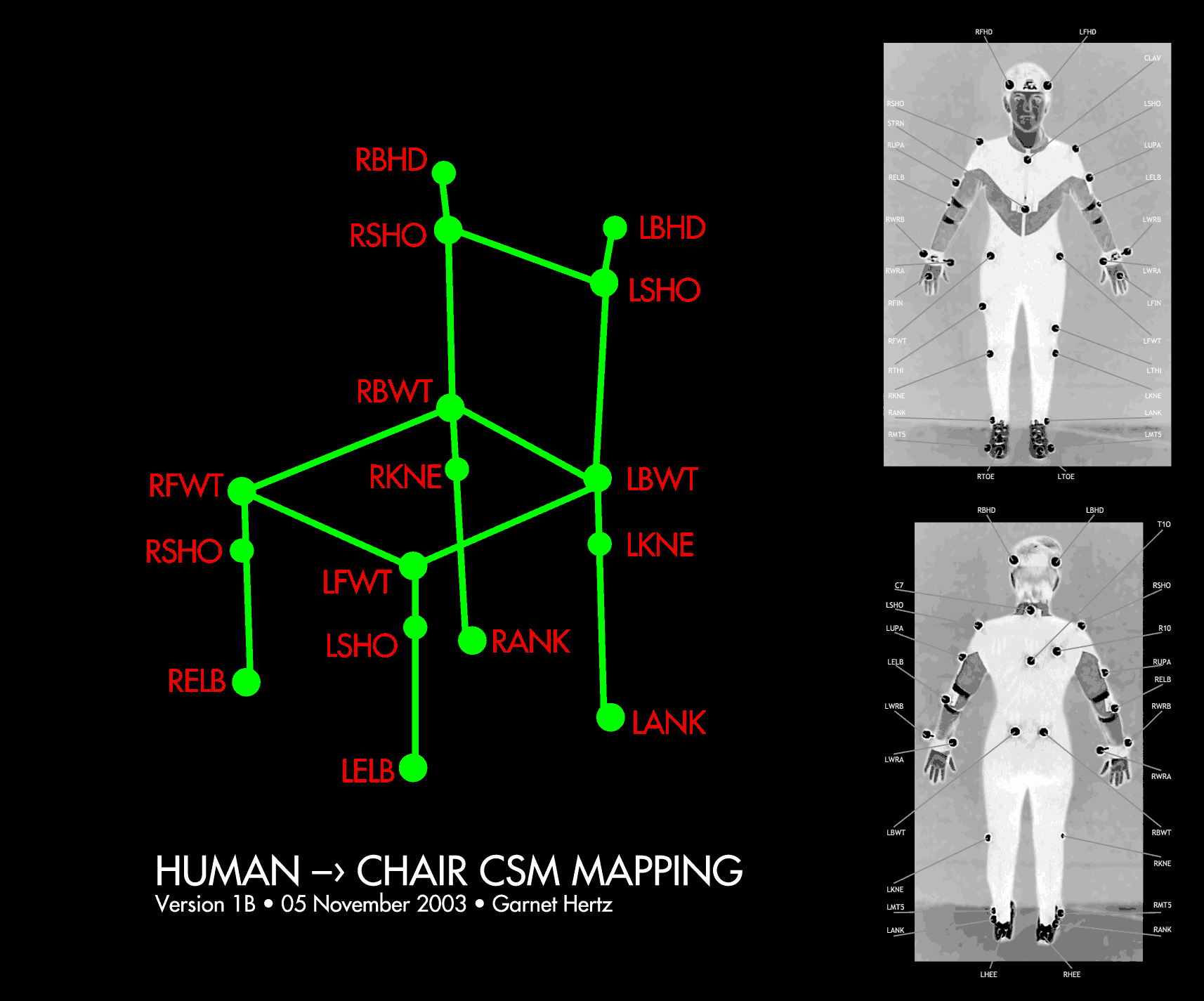
- ARTSTU 277B / DANCE 265 / ENGR 277 / IN4MATX 277 / - MOTION CAPTURE (John Crawford, Class Website)
- ARTSTU 277A / DRAMA 199 / ENGR 277 / IN4MATX 277 - AUTONOMOUS CHARACTERS (Bill Tomlinson, Class Website)
- Autonomous Police Character Behavior Sketch (PDF Document - Garnet Hertz & Ulrik Christensen)
- Final Project/Character Title: "Chanteuse: The Queen of the Autonomous Character Lounge" (Garnet Hertz & Ulrik Christensen)
- ARTSTU 270A / ENGR 270 / IN4MATX 270 - COMPUTATIONALISM AND DISCOURSES IN EMBODIMENT (Simon Penny, Personal Website)
- Paper - Exploring the Uncanny Valley: Frissonic Systems and the Artificial
- Readings:
- Foucault, Michel - Discipline and Punish
- Agre, Philip - Computation and Embodied Agency
- Luria, A R - The Making of Mind
- Hutchings, Edwin - Navigation as Computation
- Dreyfus, Hubert - Merleau-Ponty's Phenomenology of Embodiment
- Kirsch, David - Intelligent Use of Space
- Uexkull, Jakob von - A Stroll Through the Worlds of Animals and Men
- Ramachandran - Notes on Phantom Limb
- Searle, John - Minds, Brains and Programs
- Brooks, Rodney - Intelligence Without Representation
- Harnad, Stephen - The Symbol Grounding Problem
- Turing, A M - Intelligent Machinery
- Csordas, Thomas - Embodiment and Cultural Phenomenology
- Johnson, Mark - Embodied Reason
- Loren, L and Dietrich, E - Merleau-Ponty, Embodied Cognition
- Norman, Donald - Affordance, Conventions and Design
- Varela, Francisco - Autopoesis and a Biology of Intentionality
- Shademr, R and Holcomb, H - Neural... Motor Memory
- Sharkey, N and Ziemke T - Life, Mind and Robots
- Harvey, Inman - Robotics: Philosophy of Minds Using a Screwdriver
- A math class of questionable origin and direction.
Notes related to residency/paperwork
- 2003 : 152 days (Aug 3rd 2003 initial entry)
- 2004 : 345 days (on 2005 taxes, estimated 20 days in Canada, based on US entry June 26 2004)
- 2005 : 325 days (total 40 days abroad)
- Canada (SK): June 25 to July 08 = 15 days
- Ireland: July 11 to July 19 = 8 days
- Germany (& Austria): Aug 28 to Sept 07 = 11 days
- Canada (Banff): Sept 11 to Sept 16 = 6 days
- * M.F.A. in Arts Computation Engineering conferred: September 14th 2005.
- 2006 : 350 days (15 days abroad)
- Canada (Edmonton): February to 13 to 18 = 5 days
- Netherlands: March 19 to 28 = 10 days
- 2007 : 350 days (15 days abroad)
- Canada (Toronto / Montreal): Jan 28 to Feb 5 = 9 days
- Netherlands: April April 6-11 = 6 days
- * Ph.D. advancement to candidacy: June 13th 2007
- 2008 : 357 days (8 days abroad)
- Canada (SK): September 9th through 16th 2008 = 8 days
- 2009 : 361 days (4 days abroad)
- Canada (SK / Z-Axis): July 23rd through 26th 2009 = 4 days
- * Ph.D. "individual" completion/filing date: November 10th 2009
- * Ph.D. "group" commencement date / end of quarter: December 11th 2009
- * Ph.D. completed in 4 years and 52 days (Sept 19 2005 - Nov 10 2009)
- 2010 : 351 days (14 days abroad)
- Korea (ISMAR): October 11th through 17th 2010 = 7 days
- Denmark (NEXT): August 29th to September 4th 2010 = 7 days
- 2011 : (38 days abroad)
- Germany (Transmediale): February 1st through 7th 2011 = 7 days
- Canada (RIP Banff): July 5th through 17th 2011 = 13 days
- Denmark (NEXT): August 23rd to September 3rd 2011 = 12 days
- Canada (ACADIA): October 12th to 17th 2011 = 6 days
- 2012 : (23 days abroad, leap year of 366 days)
- China & Korea (Beijing, Changwon & Seoul): April 26th through May 12th 2012 = 17 days
- Sweden (HUMLab Umea): December 3rd - 8th 2012 (May) = 6 days
- 2013 : (37 days abroad)
- Montreal (Sight + Sound): May 23-27 2013 = 5 days
- Saskatoon (MoSo): June 10-16 2013 = 7 days
- Moscow & Ekaterinburg (Moscow Art Week & NCCA): Sept 15-27 = 13 days
- Santiago (Artek & Santiago Makerspace): Aug 30 - Sept 10 = 12 days
- 2014 : (x days outside of USA, x days inside USA, x days inside Canada)
- Shanghai & Shenzhen (Xin Che Jian & Seeed): April 2-13 = 12 days
- Manchester (FutureEverything): March 26 - April 1 = 7 days
- Vancouver MOVE (ECUAD): July 10th 2014
- After this date, in Canada with the exception of:
- (Vancouver, to/from Saskatoon (ECUAD): July 16-18 = 3 days)
- Malmo & Copenhagen, to/from Vancouver (MU & ITU): Sept 29 - Oct 4 = 6 days
- Point Roberts, to/from Vancouver: Nov 1 = 1 day in USA
- Point Roberts, to/from Vancouver: Dec 20 = 1 day in USA
- 2015 : (x days outside USA, 19 days inside USA)
- In Canada with the exception of:
- NYC (New School): Feb 5-10 2015 = 6 days
- Los Angeles (UC Irvine & Art Center): Feb 12 - Feb 18 2015 = 7 days
- Seattle & Los Angeles (UC Irvine): May 13-18 2015 = 6 days
CRITICAL THEORY EMPHASIS WORKSHEET
HUM270/Poster (Fall 2003) - Enrolled as HIST291, CTE petition for HUM270 equiv successful.
HUM270/Iser (Winter 2005)
HUM270/Fornabai (Winter 2005)
HUM260ABC/Schwab (2004 - 2005)
Mini-Seminar: Lebensztejn (Winter 2004: 02/07,09,10/2005)
Mini-Seminar: Miller (05/24,25,26/2005)
Wellek Lecture: Achille Mbembe (Fall 2004)
Official written confirmation of completion: Fall 2009.
Cipher, do not decipher. Work over the illusion. Create illusion to create an event. Make enigmatic what is clear, render unintelligible what is only too intelligible, make the event itself unreadable. Accentuate the false transparency of the world to spread a terroristic confusion about it, or the germs or viruses of a radical illusion - in other words, a radical dissillusioning of the real. Viral, pernicious thought, corrosive of meaning, generative of an erotic perception of reality's turmoil.
Baudrillard, The Perfect Crime