Garnet Hertz - http://conceptlab.com
(Updated 2023 January 25)
---------------------------------------- CURRENT / UPCOMING
----------------------------------------
[NEW MIT PRESS BOOK] This is the biggest news in the universe, ever - or at least as far as I'm concerned: my new book
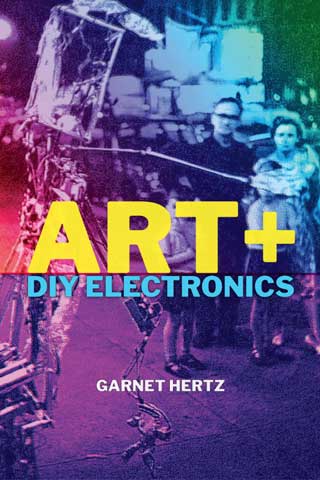
Art + DIY Electronics (Garnet Hertz, 2023, MIT Press) is now available for order! Here's the blurb: "A systematic theory of DIY electronic culture, drawn from a century of artists who have independently built creative technologies. Since the rise of Arduino and 3D printing in the mid-2000s, do-it-yourself approaches to the creative exploration of technology have surged in popularity. But the maker movement is not new: it is a historically significant practice in contemporary art and design. This book documents, tracks, and identifies a hundred years of innovative DIY technology practices, illustrating how the maker movement is a continuation of a long-standing creative electronic subculture. Through this comprehensive exploration, Garnet Hertz develops a theory and language of creative DIY electronics, drawing from diverse examples of contemporary art, including work from renowned electronic artists such as Nam June Paik and such art collectives as Survival Research Laboratories and the Barbie Liberation Front. Hertz uncovers the defining elements of electronic DIY culture, which often works with limited resources to bring new life to obsolete objects while engaging in a critical dialogue with consumer capitalism. Whether hacking blackboxed technologies or deploying culture jamming techniques to critique commercial labor practices or gender norms, the artists have found creative ways to make personal and political statements through creative technologies. The wide range of innovative works and practices profiled in Art + DIY Electronics form a general framework for DIY culture and help inspire readers to get creative with their own adaptations, fabrications, and reimaginations of everyday technologies." The book ships March 30th 2023!
"This was so fun to read, especially for an academic book. Hertz's punk/hacker/kludge perspectives provide a truly fascinating and valuable ride through the history of the DIY scene. Read it and be inspired!" - Mitch Altman, Hacker and Inventor; Cofounder, Noisebridge Hackerspace
"In this groundbreaking study, Hertz argues that the DIY electronic artists who 'kludge' their own technologies constitute an important artistic countercultural practice that is an urgent response to the escalating failures of our technological infrastructures." - Tina Rivers Ryan, Curator, Buffalo AKG Art Museum; Co-curator of Difference Machines: Technology and Identity in Contemporary Art
"A 'DIY Native' who has been perverting technological correctness since 1996, Hertz is the ideal guide for connecting art and DIY culture. This book is a treasure trove of ideas and a joy to read." - Edward Shanken, Professor, UC Santa Cruz; author of Art and Electronic Media
[New Students!] Happy to be examining Mohammed Ali as a doctoral student at RMIT in the School of Design in Melbourne, Australia.
[New Students!] Happy to be serving as a doctoral committee member for Arielle Cerini in her a doctoral work in Electronic Arts in The School of Humanities, Arts, and Social Sciences at Rensselaer Polytechnic Institute (RPI).
[New Students!] Happy to be advising Kimia Gholami as a graduate student at Emily Carr University, and is expected to graduate Spring 2022.
Kimia explains: "I am an Industrial design graduate from the University of Tehran, where I mainly focused on product development during my studies.
I am currently pursuing a Masters in Interaction design at Emily Carr University of Art + Design. My graduate work focuses on exploring the potentials Interaction design in investigating the more-than-human space."
[New Students!] Happy to be advising Chen XiaoTian as a graduate student at Emily Carr University, and is expected to graduate Spring 2023.
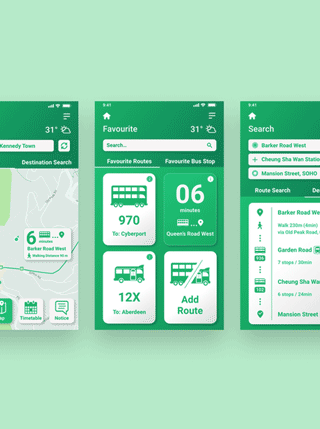
Chen describes himself and his work as follows: "I'm a UX/UI designer from Ürümqi, previously lived in Hong Kong and Ireland, now based in Vancouver. I relish creativity and strategic planning. As a UX/UI designer, my typical day at work includes wireframing, prototyping, visual design, and UX writing for mobile applications and websites. I specialize in designing intuitive and pain-free user experiences and appealing interface that is both functional and engaging... In my own time, I tend to enjoy the little things in life. I have a weakness for the science of the mind, language trivia, standup comedy, classical music, and colour theory."
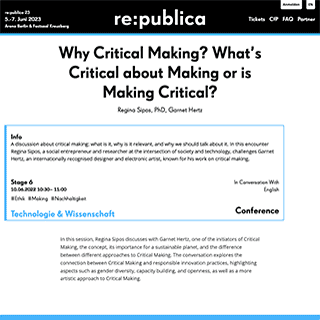
[RE:PUBLICA 23 BERLIN] Speaking in Berlin with Regina Sipos at the RE:PUBLICA 23 CONFERENCE - Stage 6
10.06.2022, 10:30
– 11:00 "A discussion about critical making: what is it, why is it relevant, and why we should talk about it. In this encounter Regina Sipos, a social entrepreneur and researcher at the intersection of society and technology, challenges Garnet Hertz, an internationally recognised designer and electronic artist, known for his work on critical making. In this session, Regina Sipos discusses with Garnet Hertz, one of the initiators of Critical Making, the concept, its importance for a sustainable planet, and the difference between different approaches to Critical Making. The conversation explores the connection between Critical Making and responsible innovation practices, highlighting aspects such as gender diversity, capacity building, and openness, as well as a more artistic approach to Critical Making."
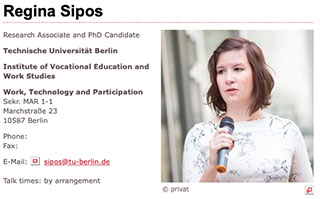
[Technical University of Berlin] Happy to be serving as a doctoral dissertation reviewer at the Technical University of Berlin for Regina Sipos. The dissertation is titled "Critical Technical Practice in Grassroots Innovation. Intrinsic Technology Design in Self-Directed Development Projects". This is scheduled for Spring 2022. A bio on Sipos: "Regina Sipos studied Communications, Dutch Philology and Master of Education in Budapest and Antwerp. She founded and set up the first cooperation platform and incubation program of the United Nations for grassroots social-tech projects. She supported the AshokaFoundation between 2016-17 with their digital fellowship strategy and founded her social startup, the Social-Digital Innovation Initiative in 2016. She is a freelancer supporting the utilization of digital technologies, technology transfer and development cooperation and is a fellow at the Centre for Internet and Human Rights."
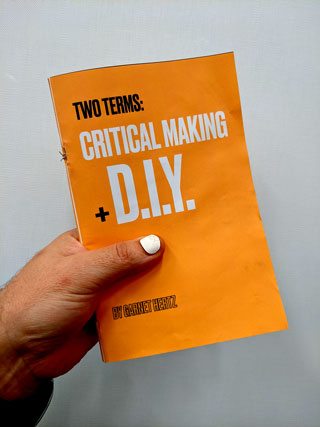
If you would like a handmade hardcopy of this book, mail a physical item - any item at all - to me and I will send you a copy as long as supplies last. Send the item with a note that includes your postal mailing address to:
Garnet Hertz
The Studio for Critical Making, Room C4246
520 East 1st Avenue
Vancouver, BC. V5T 0H2
Canada
The Making Matters Symposium is described as follows:
The three day conference is organized by the workgroup Material Practices (formerly known as Critical Making). Recent years have seen the emergence of a new kind of collective material practices that transgress the classical opposition between theory and practice, or thinking and making. These practices actively engage with our catastrophic times and yield collaborations that connect cultural, technological and more-than-human concerns. They show a potential to develop a comprehensive approach to art, science and technologies, driven by the necessity to fundamentally reimagine the relationship of humans to the world.
The conference brings together practitioners from various backgrounds and disciplines such as artistic research, experimental publishing, visual art, business and performance. These practitioners will share their work in which thinking and making are entangled, and will discuss the critical potential that this entanglement entails.
Through online workshops and presentations, the contributors invite a broad audience of artists, activists, teachers, theorists, students, designers, etherpads and other non-humans, to engage with diverse subjects such as alternative economies, feral ecologies, shared authorship, xeno-biologies, pedagogies, publishing infrastructures and radical collectivities.
[Glasgow International 2020] I am exhibiting in the Glasgow International Biennial, co-curated by Sarah Cook in Glasgow, Scotland 24 April - 10 May 2020. Details TBA.
[Hertz & Ratto in INC Critical Makers Reader] Matt Ratto and I co-authored a chapter titled "Critical Making and Interdisciplinary Learning: Making as a Bridge Between Art, Science, Engineering and Social Interventions" that will be published in The Critical Makers Reader: (Un)learning Technology, published by the Institute of Network Cultures in Amsterdam. This book is edited by Loes Bogers (Amsterdam University of Applied Sciences) and Letizia Chiappini (University of Milan Bicocca) and is the 13th publication of the INC Reader Series. The Institute of Network Cultures is directed by Geert Lovink. Details TBA.
[New Students!] Happy to be advising Kimia Gholami as a graduate student at Emily Carr University in the Masters of Design program.
Kimia explains: "I am an Industrial design graduate from the University of Tehran, where I mainly focused on product development during my studies.
I am currently pursuing a Master’s in Interaction design at Emily Carr University of Art + Design. My graduate work focuses on exploring the potentials Interaction design in investigating the more-than-human space."
[Second Canada Research Chair Term Renewal] Happy to announce that my second 5-year term of Canada Research Chair in Design and Media Arts (Special Tier 2) at
Emily Carr University was awarded for renewal in Spring 2019. This provides a 0/1 teaching load until 2024 among other things. Although most activities are outlined here, some additional information can be found at The Studio for Critical Making which I direct.
[4S 2019] Presented at 4S (Society for Social Studies of Science Annual Meeting) 2019 in New Orleans on a roundtable organized by John Seberger (UC Irvine) titled "Media Theory Meets STS". Discussants included Sebastian Gießmann (University of Siegen), Melissa Gregg (Intel), Heather Wiltse (Umeå Institute of Design at Umeå University) and myself. Here's the abstract: There is much exciting work being done at the intersection between media
theory and STS. As objects become 'smart,' as in the Internet of Things,
smart homes, and smart cities, they will continue to shape our knowledge
of the objectified world we have constructed since at least the 18th century.
Contra McLuhan, but in line with the recent work of John Durham Peters,
the human body becomes medium; and scientific knowledge is dependent
on novel and emerging mechanisms of (prosthetic) sensation and
perception that allow for the observation of phenomena. This panel brings
together scholars working in this emerging area to explore how attention to
media theory can inform STS and how STS can inform the study of media
theory. We invite scholars from the fields of media studies and science and
technology studies to engage in theoretically and empirically informed
dialogues, which investigate and define the relationship(s) between media
formats and the production of knowledge in both contemporary and
historical periods. Our goal in convening this panel is to set an agenda for
the productive mingling of these fields towards an understanding of the
epistemologies and possible practices that are embedded in the media objects with which we engage. In short: to know knowledge-as-mediation,
and mediation-as-knowledge. Each panelist is invited to bring one object
(slide, film clip, written excerpt, piece of technology...) which for them
operates in both media theory and STS. After a short presentation of each
object, a panel discussion will ensue.
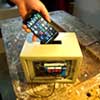
[Phone Safe in Somerset House] Phone Safe 2 was substantially re-engineered and upgraded into Phone Safe 2.1, and is premiering at the major exhibition titled "24/7" at Somerset House in London, England, co-curated by Sarah Cook. The exhibition runs 31 Oct 2019 - 23 Feb 2020.
2019
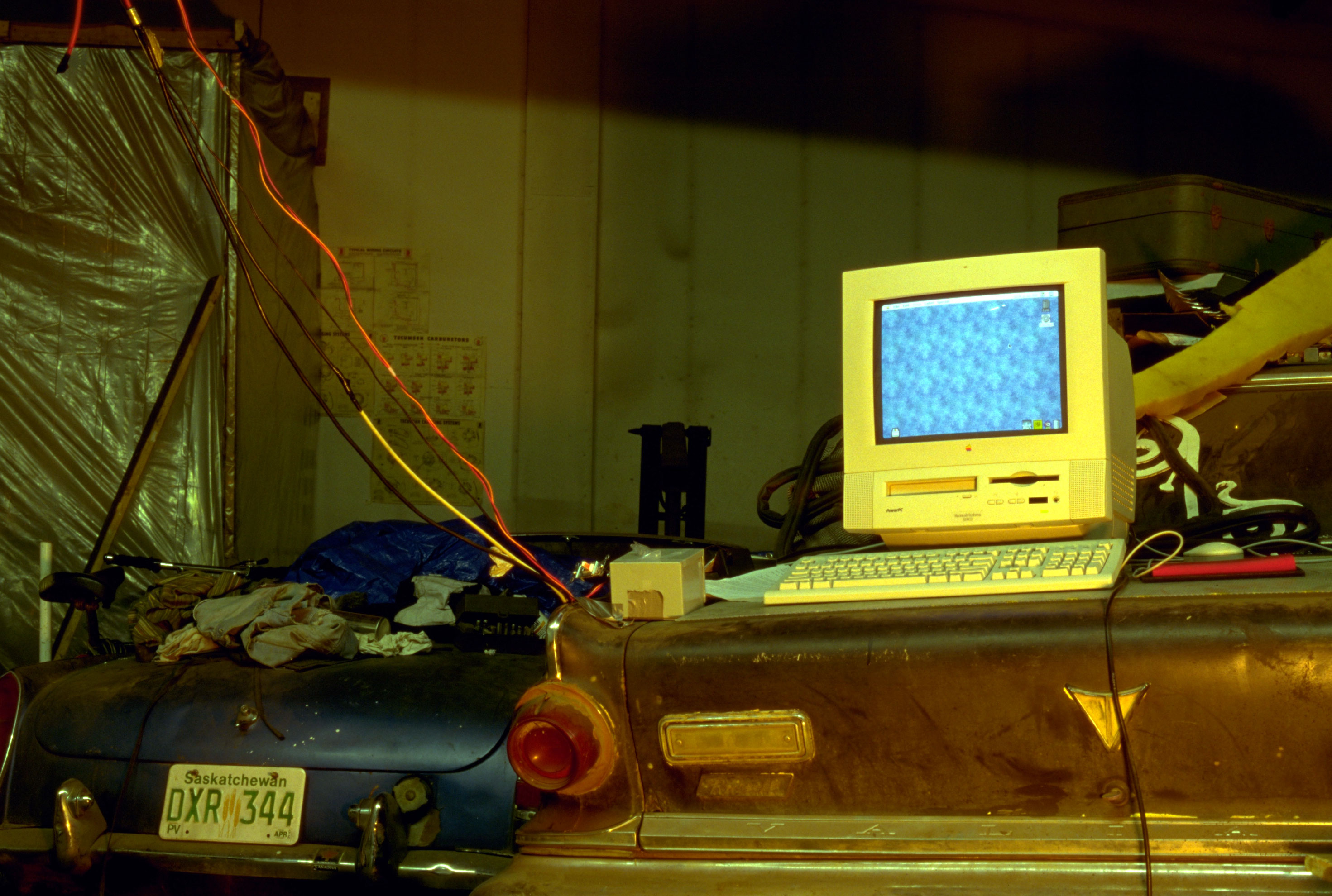
[Clemenceau 2019] Visited Clemenceau, Saskatchewan in August 2019 related to research for my forthcoming book (MIT Press).
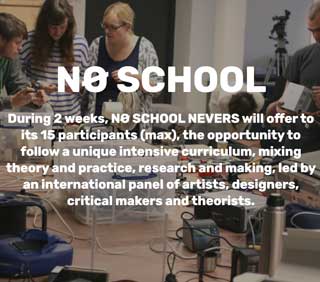
[NØ SCHOOL] I taught at NØ SCHOOL NEVERS in Summer 2019 in Nevers, France. Designed as a hybrid between learning, residency and research, NØ SCHOOL is aimed at students, artists, designers, makers, hackers and educators who wish to further their skills and engage in critical research and discussions around the social and environmental impacts of information and communication technologies. I ran a daily "Critical Making Studio" with the cohort of students with Benjamin Gaulon and Fred Paulino. Other teachers included Ted Davis, Regine Debatty, Martin De Bie, Teresa Dillon, Sarah Garcin, Gijs Gieskes, Dasha Ilina, Ewa Justka, Karl Klomp, Sename Koffi Agbodjinou, Lovid, Alessandro Ludovico, Kris Madden, Nicolas Maigret, Alex McLean, Nicolas Nova, Claire Richard, Antonio Roberts, Maria Roszkowska, Lourens Rozema, Jerome Saint-Clair, Phillip David Stearns, Chris Sugrue, Daniel Temkin, TokTek, ::vtol::, Systaime, Jon Cates, and Janet Gunter.
[Retrash] Worked with Patrick Casey O'Shea, Fred Paulino, Regina Sipos, and Ewa Justka to make the Retrash Stamping Machine at NØ SCHOOL NEVERS in Nevers, France during July 2019.
[Digital Democracies] I presented a workshop at the 2019 Digital Democracies Conference, with Gillian Russell and Craig Badke at Simon Fraser University. The event was organized by Wendy Chun.
[UBC] I presented the season opening lecture at the Designing for People Lecture Series at the University of British Columbia (UBC).
[Harvey Mudd] I presented the season opening talk at the Nelson Distinguished Speaker Series Lecture, at Harvey Mudd College in Pomona, California. After the lecture, I held a workshop titled "Re-Imagining the Now". Here's a description of the event: "At the recent groundbreaking for the new Scott A. McGregor Computer Science Center, HMC community members spoke excitedly about the makerspace it will contain. To prepare for this important space on campus, the Nelson Speaker Series will provide an arena for discussions about promoting maker cultures that are mobile, use living materials, re-make with recycled parts and cross disciplinary boundaries. The first event of the series is a noontime talk and workshop on Friday, Oct. 11, by internationally acclaimed artist Garnet Hertz." Learn more and register at https://www.hmc.edu/calendar/events/nelson-speaker-series-garnet-hertz/.
[Art Center MDP] I gave a lecture to the Media Design Program cohort at the Art Center College of Design in Pasadena, California on October 14th 2019.
[UCLA DMA] I did guest critiques with MFA students in the Design Media Art graduate program at UCLA on October 10th 2019.
[UCI] I gave a guest lecture at UC Irvine on October 10th 2019.
[C&C '19] New paper titled "Unpacking the Thinking and Making Behind a Slow Technology Research Product with Slow Game" (Odom, Bertran, Hertz, Lin, Chen, Harkness, Wakkary) was presented at the 2019 ACM Conference on Creativity and Cognition (C&C '19) in San Diego on June 23-26, 2019. Since 1993, this conference series brings together artists, scientists, designers, educators, and researchers to more deeply understand how people engage individually and socially in creative processes and how computation and other technology can affect creative outcomes. Here's the abstract of the paper: "Motivated by prior work on everyday creativity, we adopt a design-oriented approach seeks to move beyond designing for explicit interactions to also include the implicit, incremental and, at times even, unknowing encounters that slowly emerge among people, technologies, and artifacts over time. We contribute an investigation into designing for slowness grounded in the practice of making a design artifact called Slow Game. We offer a detailed critical-reflective accounting of our process of making Slow Game into a research product. In attending to key design moves across our process, we reveal hidden challenges in designing slow technology research products and discuss how our findings can be mobilized in future work."
[TEACHING: GSMD 510] During Spring 2019 I taught "Graduate Design Studio II (GSMD 510)" which is a core studio course for the first year cohort of the Masters of Design program at Emily Carr University.
2018
[Speculative Design Oct 12 2018] Speculative Design open studio event at The Studio for Critical Making @ 5pm October 12th 2018. I will host, and the event will feature Gillian Russell, Jentery Sayers, Svitlana Matviyenko, Ian Wojtowicz, Noel Rubin and Craig Badke. Open studio events are planned every second Friday @ 5pm at Emily Carr University, Room C4246. (The first event this season was on September 28th 2018.)
[Disobedient Electronics at Nuit Noire 2018] A special edition of Disobedient Electronics: Protest will be exhibited and given away for free in the unauthorized Paris exhibition "Nuit Noire" that takes place in the underground tunnels and catacombs beneath the city. An installation related to the project will also be set up underground - see Le laboratoire souterrain - Nuit Noire for details. The event is on the evening of October 6th 2018.
[TEACHING: How To Find the Meaning of Life] During Spring 2018 I taught "Graduate Design Studio II, or How To Find the Meaning of Life (GSMD 510)" which is a core studio course for the first year cohort of the Masters of Design program at Emily Carr University.
[SLSA '18] I presented at the 32nd Annual Meeting of the Society for Literature, Science, and the Arts (SLSA '18) in Toronto, Canada. The conference was titled "Out of Mind" and was held in Toronto from November 15-18, 2018. The panel was titled "Beyond Making 2: Remaking, Counterfunctionality, and Crapentry" chaired by Marcel O'Gorman, and presenters included Lai-Tze Fan, Marcel O'Gorman (both from University of Waterloo) and myself. The title of my presentation was titled "Beyond Making: DIY Practices in Electronic Art". For more information about the conference, see http://litsciarts.org/slsa18
[RIT Interaction Design Workshop] I presented at the 2018 Interaction Design Workshop at the Rochester Institute of Technology in the College of Art and Design on March 23rd 2018.
[Neural 60: We Need Something Better Than The Maker Movement] I wrote a short piece for Neural magazine ("Critical digital culture and media arts since 1993") titled "We Need Something Better Than The Maker Movement". This is published in Neural Issue 60 (Summer 2018), and is distributed with physical stickers in the print magazine: see the sticker text at makermanifesto.com and the publication at neural.it.
[Sticker: Maker Manifesto] See makermanifesto.com for details - free stickers available.
[New Media Art XYZ] "NEW MEDIA ART XYZ" is a collaborative publishing project that explores ideas about where new media art in the 1990s 'went'. The project seeks submissions from old and young new media artists, curators, festival organizers, writers, electronic artists, media theorists, hackers, haters or others interested in the topic of how new media has shifted, moved and evolved in the art community over the past two decades. Deadline for submissions: December 31st 2018. See http://newmediaart.xyz for details.
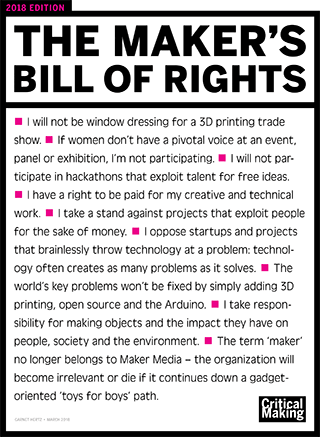
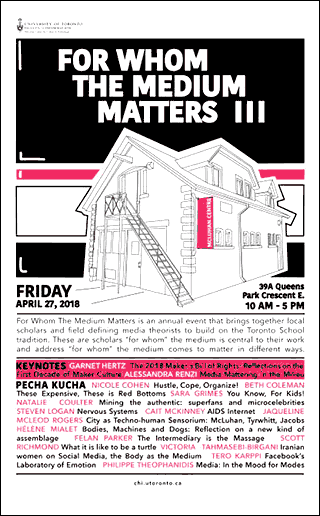
[Keynote: U of Toronto] I gave a keynote lecture titled "The 2018 Maker's Bill of Rights: Reflections on the First Decade of Maker Culture" at the University of Toronto School of Information conference titled "For Whom The Medium Matters III". The event took place April 27, 2018 and was organized by Sarah Sharma, and was held at the historical Marshall McLuhan Coach House. The event also featured talks by Alessandra Renzi, Philippe Theophanidis, Victoria Tahmasebi, Sara Grimes, Cait McKinney, Jaqueline McLeod Rogers, Tero Karppi, Nicole Cohen, Natalie Coulter, Felan Parker, Helene Mialet and Sarah Sharma.
[CHI'18 Paper: Slow Game] Co-authored paper accepted to the CHI'18 conference: "Attending to Slowness and Temporality with Olly and Slow Game: A Design Inquiry Into Supporting Longer-Term Relations with Everyday Computational Objects" - see https://dl.acm.org/citation.cfm?doid=3173574.3173651. The conference ran April 21 - 26, 2018 in Montreal. Abstract: Slowness has emerged as a rich lens to frame HCI investigations into supporting longer-term human-technology relations. Yet, there is a need to further address how we design for slowness on conceptual and practical levels. Drawing on the concepts of unawareness, intersections, and ensembles, we contribute an investigation into designing for slowness and temporality grounded in design practice through two cases: Olly and Slow Game. We designed these artifacts over two and a half years with careful attention to how the set of concepts influenced key design decisions in terms of their form, materials, and computational qualities. Our designer-researcher approach revealed that, when put into practice, the concepts helped generatively grapple with slowness and temporality, but are in need of further development to be mobilized for design. We critically reflect on insights emerging across our practice-based research to reflexively refine the concepts and better support future HCI research and practice.
2017
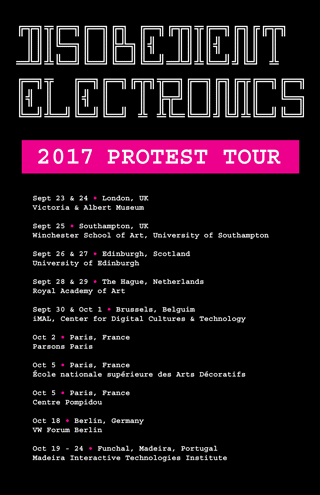
[TOUR: Disobedient Electronics: 2017 Protest Tour] I am doing a 7 country tour related to Disobedient Electronics: Protest during September and October 2017:
Sept 23 & 24 - London, UK - Victoria & Albert Museum
Sept 25 - Southampton, UK - Winchester School of Art, University of Southampton
Sept 26 & 27 - Edinburgh, Scotland - University of Edinburgh
Sept 28 & 29 - The Hague, Netherlands - Royal Academy of Art
Sept 30 & Oct 1 - Brussels, Belgium - iMAL, Center for Digital Cultures & Technology
Oct 2 - Paris, France - Parsons Paris
Oct 5 - Paris, France - École nationale supérieure des Arts Décoratifs
Oct 5 - Paris, France - Centre Pompidou
Oct 18 - Berlin, Germany - VW Forum Berlin
Oct 19 - 24 - Funchal, Madeira, Portugal - Madeira Interactive Technologies Institute
[Grad Students: ECUAD] I am principal advisor for four graduate students at Emily Carr during 2017-2018: Rya Ding (Master of Fine Arts, 2018), Yijun Guo (Master of Fine Arts, 2019), Zexi/Tammy Tan (Master of Design, 2019), and Yufei/Michelle Yao (Master of Design, 2019).
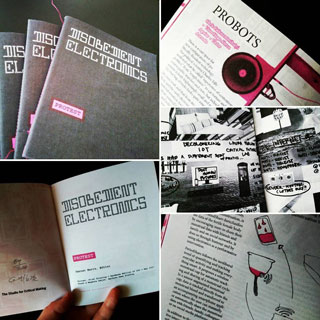
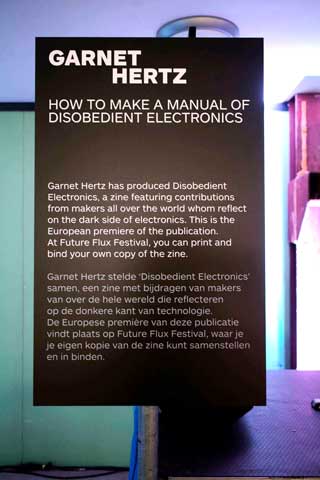
[NEW BOOK: Disobedient Electronics: Protest] Disobedient Electronics: Protest (2017) is a limited edition publishing project that highlights confrontational work from industrial designers, electronic artists, hackers and makers from 10 countries that disobey conventions, especially work that is used to highlight injustices, discrimination or abuses of power. Approximately half of the 25 contributors are academics, while the other half are from the broader maker, tech and art communities. Topics include the wage gap between women and men, the objectification of women's bodies, gender stereotypes, wearable electronics as a form of protest, robotic forms of protest, counter-government-surveillance and privacy tools, and devices designed to improve an understanding of climate change. As an experiment in research dissemination, three hundred handmade copies were produced and were disseminated for free to targeted researchers that wanted to include the book as a part of academic curriculum, reviewers writing critical responses to the publication, libraries and nonprofits, or curators including the book in an exhibition.
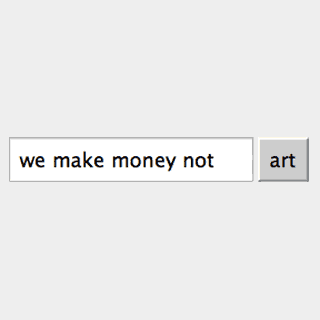
[REVIEW: We Make Money Not Art] Disobedient Electronics: Protest is reviewed at We Make Money Not Art by Regine Debatty: "The booklet's manifesto calls for more design (or art) that gets out of the sleek graduation shows and galleries, confronts sociopolitical issues head-on and bites back. As he sums up, "Design can be how to punch Nazis in the face, minus the punching." Hertz isn't afraid to ruffle a few feathers... Disobedient Electronics is a great starting point for a much-needed discussion about how art, design and creative practices in general can challenge issues such as homophobia, sexism, racism, economic inequalities, political status-quo, etc."
[Powell & Hertz Go Datawalking] Alison Powell (LSE) takes Garnet Hertz (Emily Carr University) on an abridged datawalk while discussing the upcoming workshop "Data Walking Vancouver" on June 7, 2017: https://www.youtube.com/watch?v=X8NtDLufj3M.
[Spring 2017 Masters Graduates] My ECUAD masters students Matt Harkness (MDes) and Scott Mallory (MFA) graduated from Emily Carr in Spring 2017. Also, my advisee Arthur Or graduated with an Masters of Architecture degree from UBC.
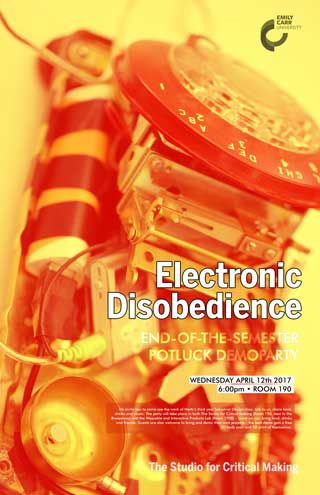
[Event: Electronic Disobedience] Open studio event at The Studio for Critical Making on April 12th 2017. Hertz's third year Industrial Design class - "Critical Making and Electronic Objects: INDD-310-S003 Spring 2017" at Emily Carr University invites you to see live demos of their latest work using a combination of electronics, 3D printing, CNC machining and open source Arduino code. We have built artifacts that explore disobedience and protest through the development of experimental electronic objects - utilizing physical design artifacts as the site of cultural inquiry. We invite you to come see our work, talk to us, share food and music, and discuss the overlaps between design, art and critical studies. Events will take place in both The Studio for Critical Making (Room 190) and the Wearable and Interactive Products Lab (Room 190B). For photos of work done in this class, see https://www.flickr.com/photos/youraccount/albums/72157675274448283. For examples of tutorials built by my students, see The Improved Chopping Machine, Vibration Eye Mask, Hologram Display Projector, Glo Flo, Energy Light, or Collaborative Music Making.
2016
[National Portfolio Day - 4 December 2016] Reviewed portfolios of potential incoming undergraduate students at Emily Carr University.
[Art Center Graduate Graphic Design Program - Nov 2016] Presented at Art Center College of Design (Pasadena, California) on November 1st 2016 in the Graduate Graphic Design Program. Talk title: "Mapping Critical Paths in Contemporary Design Practice: Critical Making, Critical Design, Values in Design, Adversarial Design and Material Speculations". Organized by Matt Manos.
[SFU - Oct 2016] Gave a lecture on Wednesday Oct 12 2016 from 12:30-2:20pm in SUR 5380 in the School of Interactive Art and Technology at Simon Fraser University (Surrey Campus).
[Symposium: Unhanded, Ottawa - September 17th, 2016] Unhanded: Making Under the Influence of Digitalism - this Symposium brings together a range of perspectives from different disciplines to discuss, debate and interrogate what it means to make objects in the 21st century. Through a series of four panel discussions we will explore ideas around language, materials, mistakes, challenges and opportunities when working at the intersection of digital and physical technologies. In this symposium, I addressed the question "What new relationships to materials emerge in the use of digital and mechanical tools?" with Rachel Gotlieb, Joanna Berzowska, and Greg Sims. "In this panel we ask about the variety of new relationships with materials that emerging with the increasing ubiquitousness of digital technologies. With the increased complexity of tools we wonder how do we learn about materials? How do we get to know them? How do we share this knowledge? We can now know the molecular structure of wood or metal without touching it. Is this a more intimate relationship than working directly with our hands? Does it matter? If the objects coming out of digital and mechanical processes are more removed from our handywork, how might they carry the mark of the machine? Should we be able to read the machine in the material?". View the video of Hertz's talk at Unhanded 2016, focusing on the tropes of technological supersession and liberation - and comparing owning a 3D printer to an interpersonal relationship.
[University of Ottawa, Department of Visual Arts - September 16th, 2016] I presented on my recent work at the University of Ottawa Department of Visual Arts on September 16th 2016 and did one-on-one studio critiques with graduate students in the Department. Organized by Catherine Richards.
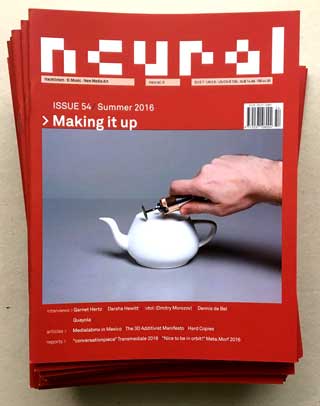
[INTERVIEW: Neural - Summer 2016] Alessandro Ludovico interviewed me in NEURAL 54, MAKING IT UP in the Summer 2016 issue. The issue also features interviews with Darsha Hewitt, Dmitry Morozov, Dennis de Bel and Davide Quayola.
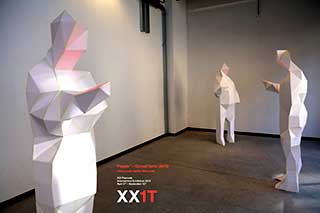
['People' at Triennale di Milano] A new project, titled 'People' was installed at the Triennale di Milano at the Fabbrica del Vapore venue in Italy from May 18th to September 12th 2016. The piece was constructed on site on May 18th, 19th, 20th and 21st 2016.
[Leonardo / SIGGRAPH Art Papers] I was on the selection committee for the 2016 Leonardo / SIGGRAPH Art Papers publication and conference track. Art Papers investigate the roles of artists and the methods of art-making in an increasingly global, networked, and technologically mediated world. Art Papers contribute to our understanding of the history of art, inform contemporary artistic and critical practices, and anticipate and stimulate future trajectories.
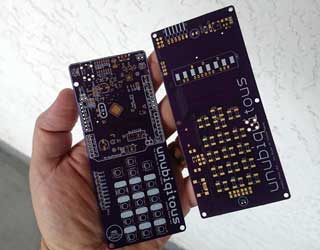
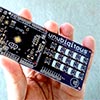
[New Project Prototype: Unubiquitous] Unubiquitous is an open source mobile phone platform based on David Mellis' DIY Cellphone. Ubiquitous communication technologies like smartphones have contributed to the rise of interpersonal interconnections, producing many beneficial results. Yet, at the same time this has led to the public feeling overloaded with pervasive information technologies (Sellen & Whittaker 2010). Our project goal is to build fully-functional design artifacts that critically frame this problem in the digital economy and offer imaginative solutions. We will accomplish this by prototyping and manufacturing "unubiquitous" cellular phone-like devices that, somewhat ironically, help people disconnect from technology and reconnect face-to-face. Our aim is to use these devices as case studies to deliver a clearly articulated framework for 'critical making': building creative technologies as an alternate mode of knowledge dissemination.
[New Project: Faxbook] Faxbook is a fax-based social networking platform. Blurb: "Tired of wasting your entire day on Facebook? Tired of apps and wish you could return to 1986? Faxbook can help. Delete your Facebook account, dust off that old fax machine, and get connected to us on Faxbook: a real, working fax-based social network for social media dropouts. To get started, download the Faxbook profile page, fill it out, and actually fax it to us at +1-604-630-7427.
We look forward to hearing from you." Federico Martelli wrote an article titled Faxbook, il social network per i fax for Motherboard Italy on May 17th 2016.
[Talk: WeMake Milan] Gave a talk at WeMake hackerspace in Milan on May 16th 2016 at their Arduino User's Group.
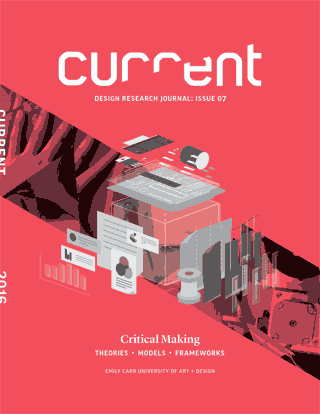
[New Publication: What is Critical Making - Current 07] Current is a multi-platform design journal that exists to showcase creative, practice-based and applied research. Current 07 takes on the theme of "Critical Making: Theories, Models & Frameworks" with articles written around the subjects of critical making, critical use and design, social innovation for sustainability and behaviour change in design.
Our invited authors include Lisa Groccott, from Parsons The New School, contributing "Make Known, Make Possible, Make Shift: the role of designing in behavior change"; Kate Fletcher, founder of the Slow Fashion movement, in a interview by Louise St. Pierre; and Garnet Hertz, Canada Research Chair, contributing "What is Critical Making?"
Emily Carr University faculty also submitted articles to this issue. They include: Keith Doyle, discussing the new research area Material Matters; Helene Day Fraser, presenting a paper on the notion of Critical Use; and Louise St. Pierre, introducing DESIS Lab work at the university. A number of student papers on undergraduate and graduate research projects are also included in this issue.
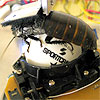
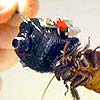
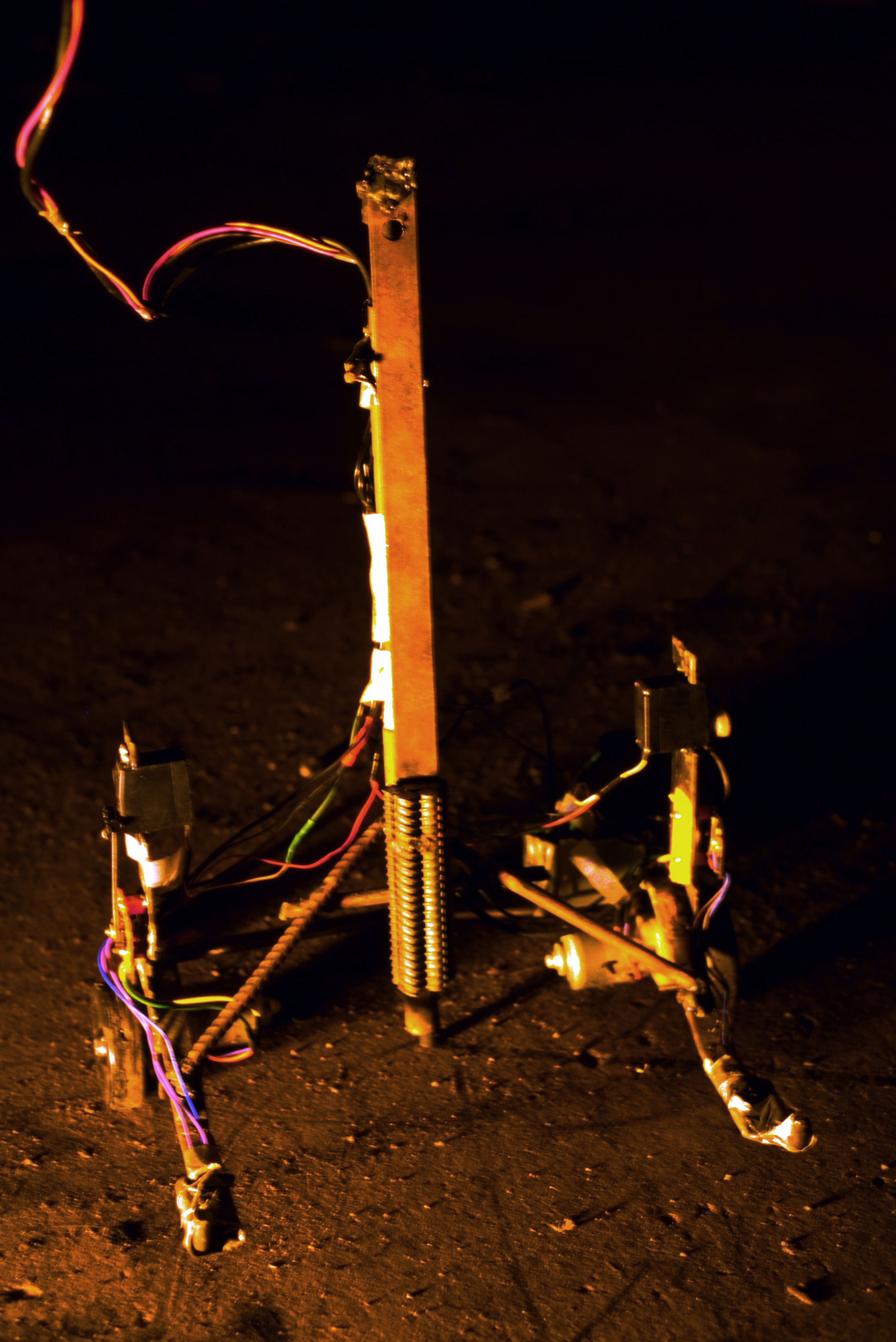
[Exhibition: All Around Us, Wood Street Galleries] Exhibited Cockroach Controlled Mobile Robot at All Around Us curated by Ali Momeni and installed from April 22nd - June 19 2016. For more documentation, see All Around Us - Hertz Flickr Photos.
[Event: The Post-Optimal] Open studio event at The Studio for Critical Making on April 15th 2016. Hertz's second year industrial design class at Emily Carr University invites you to see live demos of their latest work using a combination of electronics, 3D printing, CNC machining and open source Arduino code. These projects explore "post-optimal" design, or design that is concerned with more than just trying to make products easier to use, faster or more convenient. We have built artifacts that explore critical making, or utilizing physical design artifacts as the site of cultural inquiry. We invite you to come see our work, talk to us, share food and music, and discuss the overlaps between design, art and critical studies. Events will take place in both The Studio for Critical Making (Room 190) and the Wearable and Interactive Products Lab (Room 190B) - come on out, bring food and your friends. Guests are also welcome to bring and demo their own projects. Photos here.
[Project: The World is Getting Worse] 3D printed porcelain experiments during April 2016 using depressing data about the world to extrude bottles for collecting tears. Research assistant: Shannon Mortimer. The World is Getting Worse on Flickr.
[Doctoral Committee: Emit Snake-Beings] Was on the doctoral committee for Emit Snake-Beings, who successfully defended his PhD at the University of Waikato (New Zealand) on February 14th 2016.
[Event: Open Studio Feb 2016] Open studio event at The Studio for Critical Making with Ron Wakkary's SFU students on February 4th 2016 - photos here.
[Lecture: HCI@UBC 13 Jan 2016] Lecture at University of British Columbia's (UBC) Computer Science Department in their 2015-2016 HCI@UBC Lecture Series, in a talk titled "Unubiquitous Computing: Critiquing Human Computer Interaction Through Critical Making". Abstract: New communication technologies have contributed to the rise of interpersonal interconnections, but have at the same time led to the public feeling overloaded with pervasive information technologies. Hertz outlines his recent work as Canada Research Chair in Design and Media Art, currently focused on building fully functional technical objects that both highlight this problem and offer imaginative solutions to improve Human Computer Interaction (HCI). Hertz is also working to deliver a clearly articulated framework for the process of integrating creative technologies as an alternate mode of knowledge dissemination, titled 'critical making'."
[Course: DESN211 Critical Making - Spring 2016] I taught "Critical Making" as a second year undergraduate industrial design course at Emily Carr University of Art and Design in Spring 2016. Students in this course will combine critical thinking with DIY and design methods to explore 'critical making'. Students will implement and critique the practice of making through both literature and hands-on studio work. Foundational literature from the fields of design, informatics and the humanities will be explored to provide a context for the field, including reading on the topics of design fiction, speculative design, maker culture, values in design, ludic design and adversarial design. Hands-on studio work will include high and low-fidelity prototyping techniques including sketching, physical prototyping, electronics and physical computing. Students will envision and create devices and experiences that critically explore contemporary social and culturally relevant technological themes such as, agency and presence, community, privacy, intimacy, environments, health, education, economics and activism. See the DESN211 Critical Making Syllabi.
2015
[Jesse Colin Jackson at Studio] Jesse Colin Jackson gave a talk at The Studio for Critical Making titled "Pixels in the Material World: From Frank Lloyd Wright to Marching Cubes" on November 24th 2015.
[Bent] I gave a lecture at VIVO (Vancouver) on October 27th 2015 - photos here.
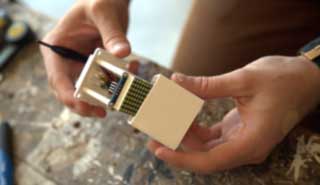
[New Project in Development: Slow Game] I've been collaborating with Will Odom over the past year on a project titled "Slow Game" - a physical video game with a very low frequency of interaction: one move a day. The game exists as a small 5cm cube, with a low resolution display consisting of 64 tiny white lights. The game is based on the classic video game 'snake', where the player manoeuvres a line which grows in length, with the line itself being a primary obstacle. The game is played by physically rotating the cube, which turns the direction that the snake moves. By reducing the feedback loop to a frequency of a day, Slow Game radically challenges our memory, observation and patience. The project was initially inspired by Ishac Bertran and is being worked on by a student research team including Henry Lin (SFU), Sam Beck (ECUAD) and Perry Tan (SFU). We plan on releasing this project in 2017.
[New Paper: Material Speculation] Material Speculation: Actual Artifacts for Critical Inquiry (2015) -- Co-authored paper by Wakkary, Odom, Hauser, Hertz, and Lin presented at "Aarhus 2015: Critical Alternatives" a decennial conference that has been instrumental for setting new agendas for critically engaged thinking about information technology. Paper abstract: "Speculative and fictional approaches have long been implemented in human-computer interaction and design techniques through scenarios, prototypes, forecasting, and envisionments. Recently, speculative and critical design approaches have reflectively explored and questioned possible, and preferable futures in HCI research. We propose a complementary concept - material speculation - that utilizes actual and situated design artifacts in the everyday as a site of critical inquiry. We see the literary theory of possible worlds and the related concept of the counterfactual as informative to this work. We present five examples of interaction design artifacts that can be viewed as material speculations. We conclude with a discussion of characteristics of material speculations and their implications for future design-oriented research." Available from: conceptlab.com/writing/MaterialSpeculation-Wakkary-Odom-Hauser-Hertz-Lin-Aarhus2015.pdf or at ResearchGate.
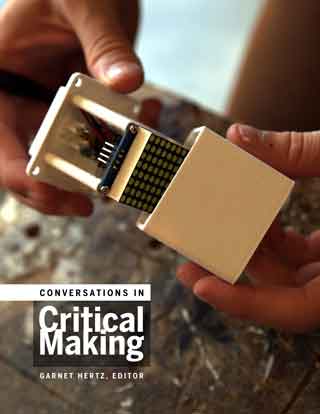
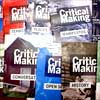
[New Book: Conversations in Critical Making] CTheory released Conversations in Critical Making (Hertz, ed.) in 2015: full book available for free download. Abstract: Against the current of disposable technology and estranged digital devices, critical making brings together individuals working at the intersection of critical thinking and hands-on practice. What follows are a series of interviews with leading theorists and practitioners of critical making. Discussions range from the political implications of critical making to creative reflections on the place of technology in culture and society. Originally released in 2012 by Teleharmonium; revised and updated in 2015 for CTheory Books.
[New Project in Development: Critical Making Design Process Cards] The Critical Making Design Process Cards are a physical card set built as an aid for technology designers to sketch and prototype new designs that are culturally relevant, socially engaged and challenging of current biases in commercial design. They bring together critically-engaged design methods and concepts like critical making (Ratto), critical technical practice (Agre), reflective design (Sengers), near futures (Bleecker), critical design (Dunne & Raby), values in design (Nissenbaum), tactical media (Lovink) and adversarial design (DiSalvo) into a practical brainstorming tool suitable for university classroom or commercial studio use. The cards have been tested at Emily Carr, The New School, Univeristy of Victoria and the University of Copenhagen.
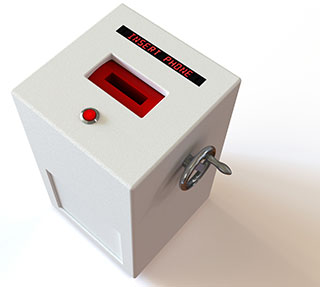
[New Project: Phone Safe 2] New project launched (August 2015): Phone Safe 2 is a public kiosk system built by Hertz for individuals to give up their mobile phones. The system consists of a heavy metal box resembling a bank safe with a slot in the top to put your phone. Pressing a button adds time that your phone will be locked inside and there is no way to reduce your time: you must simply wait until the timer has elapsed. Passers-by can hit the button and add more time. The project features an alphanumeric 16 character LED display that seems to be hungry for more phones, but when the timer has elapsed the door pops open and users can retrieve their handsets from the plush red interior of the device. This project was exhibited in the 21st International Symposium on Electronic Art (ISEA 2015) at the Museum of Vancouver between August 16 - October 12, 2015 in "Lively Objects": a show that brings together artworks "that vibrate with mechanical, digital, and magical forces. In Lively Objects, artefacts do not quietly await appreciation; these enchanted artworks disrupt traditional museum categories and presentation techniques. They start surprising conversations with neighbouring objects and invite visitors to reconsider the museum experience." Lively Objects was curated by Caroline Seck Langill and Lizzie Muller. The exhibition featured works by Wendy Coburn, Steve Daniels, Judith Doyle, Kate Hartman, Garnet Hertz, Simone Jones & Lance Winn, Germaine Koh, and Norman White.
[New Project Prototype: Phone Safe 1] New project prototype (January 2015): Phone Safe 1 - a locked box with a slot in the top to put your mobile phone. Pressing a button adds time that your phone will be locked inside. Phone is not retrievable while in the locked box and there is no way to reduce your time. This version of the project features a four digit 7 segment LED timer that counts down seconds, which triggers an electric solenoid to unlock the door when the time has elapsed.
[Talks: Early 2015] I gave a number of public talks and private workshops in early 2015. Events included:
Emily Carr University: January 27th 2015 (3:50pm) - Jamie Hilder's course "Art Now: Studies in Contemporary Art" (AHIS304).
Art Center: January 29th 2015 (11-11:30) - Critical Frameworks, Media Design Program, organized by Anne Burdick. Skype conversation with Anthony Dunne and Matt Ratto.
The New School: February 9th 2015 (6pm) - School of Media Studies' Spring 2015 Monday Night Lecture Series in the Kellen Auditorium on the ground floor of 66 5th Avenue in NYC.
The New School: February 9th 2015 (2pm) workshop at the Reemergent Media Research Lab.
Emily Carr University: February 26th 2015 (8:30am) - Guest lecture in Katherine Gillieson's Communication Design 4th year core class in SB390.
University of Victoria: March 18th 2015 - The Pacific Centre for Technology and Culture (PACTAC) Lecture titled "Rethinking Technology: Art and Design".
University of Victoria: March 18th 2015 - Workshop titled "Critical Making Design Process Workshop" at the Maker Lab in the Humanities.
[Critical Making - Downloadable] Critical Making is now fully released online as PDFs. Initially, one article per day was released between April 27th and June 27th 2014 via Twitter: @criticalpdfs.
[Material Matters December 2014] A lecture was given at the Material Matters 3D Printing Forum at Emily Carr University on December 11th, 2014.
[Malmö, Sweden October 2014] I gave the opening keynote at The Annual MU-RIT Partnership Symposium, which took place in Malmö Sweden October 1-3, 2014. This symposium between Rochester Institute of Technology and Malmö University aims to further the partnership of the two universities through the following three themes: 1) The Urban Environment and Sustainability 2) Interactive Media, Visual Culture and Digital Humanities 3) Human-Machine Interactions, Software Designs and the Designs of Software.
[Best of CHI 2014] The paper authored by Silvia Lindtner, Paul Dourish and I titled Emerging Sites of HCI Innovation: Hackerspaces, Hardware Startups & Incubators, received a SIGCHI Best of CHI Best Paper Award. Info: "The SIGCHI Best of CHI Awards honor exceptional submissions to SIGCHI sponsored conferences. Receiving a Best Paper Award is an outstanding accomplishment. It indicates that the CHI Associate Chairs and Best Papers committee identified your paper as being among the top 1% of all submission to CHI 2014." The paper will be presented at CHI 2014 on April 28th at 2pm in Room 718B in the Metro Toronto Convention Centre. Read the paper here.
[Critical Machines Exhibition, Beirut] Critical Making is featured in an exhibition at the AUB Byblos Bank Art Gallery titled "Critical Machines" curated by Octavian Esanu. The exhibition runs from March 6 - June 26, 2014. Artists include Art & Language, Burak Arikan, Freee art collective, Janah Hilwé, Khalil Rabah, Vadim Zakharov, André Breton, Critical Art Ensemble, Marcel Duchamp, Andrea Fraser, Heresies Collective, William Hogarth, György Galántai and Júlia Klaniczay (Artpool), Kenneth Goldsmith, Hans Haacke & Pierre Bourdieu, Pablo Helguera, Garnet Hertz, Wassily Kandinsky, Allan Kaprow, Hassan Khan, Andrei Monastyrsky, William Morris, Walid Raad, Ad Reinhardt, Temporary Services, Gregory Sholette, Nasrin Tabatabai and Babak Afrassiabi and others. For more information, see the Critical Machines overview and curatorial statement.
[FutureEverything 2014] I spoke at FutureEverything 2014 in Manchester on the topic of critical making and speculative design. Other speakers included Adam Harvey, Alexandra Daisy Ginsberg, Alexandra Deschamps-Sonsino, Anab Jain, Anthony Dunne, Dan Williams, Eleanor Saitta, Golan Levin, James Bridle, Koert van Mensvoort, Liam Young, Paul Graham Raven, Seb Chan
and Tom Armitage. The event ran from March 27th to April 1st 2014 - more information is available at http://futureeverything.org/.
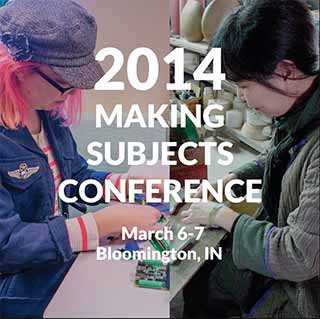
[2014 Making Subjects] I spoke at and hosted a workshop at the 2014 Making Subjects Conference at Indiana University on March 6 - 7 2014. The central objective of this conference is to explicate the ways that individual people inhabit subjectivities of information and how we as researchers can understand, design for, and intervene upon these processes. To ground this work, we focus on a single, important example: the emergence of the maker identity, referring to the practices of hacking, DIY, repair, tinkering, and so forth.
[New Book - Inside Hackerspaces: NYC Resistor] On January 19th 2014, Silvia Lindtner and I led a one day workshop for members of NYC Resistor - a hackerspace in New York City that is best known as the birthplace of the Makerbot - to produce a handmade zine in 12 hours that documented the space and the projects that members were working on. This is a part of the NSF-funded project "How Do-It-Yourself Makers are Reinventing Production, Labor, and Innovation". A video and photos of the zine we produced are available.
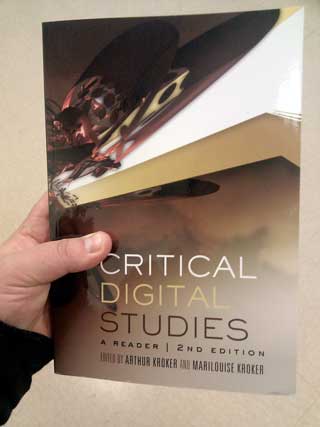
[Critical Digital Studies, 2nd Edition] Now available: Hertz & Parikka "Archaeologies of Media Art" in Critical Digital Studies: A Reader (Second Edition), Kroker & Kroker (eds.) University of Toronto Press - more information at U of T Press website.
[Critical Making in Digital Humanities at MLA 2014] I was invited respondent at the Modern Language Association (MLA) 2014 Conference on the panel "Critical Making in Digital Humanities" on Sunday, January 12th 2014. Roger Whitson, Washington State Univ., Pullman organized the event, with two papers presented by four people: 1. "Theorizing Collaborative Making: Between Writing, Programming, and Development" by Amaranth Borsuk (Univ. of Washington, Bothell) and Dene M. Grigar (Washington State Univ., Vancouver); and 2. "Toward a History of Critical Making in the Humanities" by Kari M. Kraus (Univ. of Maryland, College Park) and Jentery Sayers (Univ. of Victoria).
See the overview, schedule, and archive.
2013
[New NSF Hackerspace Grant] I am Co-PI with Silvia Lindtner on an exciting new project funded by the National Science Foundation, titled "How Do-It-Yourself Makers are Reinventing Production, Labor, and Innovation" (2013-2016) Here's an overview:
The contemporary landscape of information technology production is one that has been profoundly influenced by the emergence of so-called 'maker culture' since the 1960s and 1970s, with the technology landscape full of products that depend upon open source and similar alternative models of production. Society currently finds itself in the middle of a new maker movement through a growing network of 'hackerspaces' or 'makerspaces' that expand ideas and practices of the Web generation into hardware and manufacturing. Hackerpaces are cooperative studios where people develop new approaches to technology design based on the open sharing of software code and hardware designs through the use of technology such as computer controlled laser cutters, 3-D printers, and microcontroller kits. Hackerpaces are places where new models of innovation are explored, where values of openness and participation are re-assessed, and where new relationships between people and technology are forged. To understand these phenomena, this NSF-funded project directed by Silvia Lindtner and myself will conduct one of the first multinational ethnographic research studies of four hackerpaces in the United States and China. The goal of the project is to understand the relationship between cultural and material practices in the maker movement. Accordingly, the focus is on the daily practices in makerspaces, with particular attention to how they experiment with models of social organization, distributed collaboration, and peer production. Through ethnographic investigation, the project will examine the questions of how DIY (Do-It-Yourself) making as a practice, and hackerpaces as physical sites, contribute to the development of new models of technical, economic, and social innovation. This exploration will greatly increase knowledge on non-professional expertise and alternative forms of technical knowledge, distributed collaboration, and inter-cultural exchange of ideas and artifacts. As sites of DIY production, hackerpaces provide an important interface between technological production and the everyday world. At the same time, they may also represent important sites for rethinking contemporary processes of technological and commercial innovation. This research will help to assess and understand these possibilities, support educational developments in this area (such as hackerpaces infrastructures within schools), explore alternative forms of small-scale commercial production, incentivise participation, and develop intellectual property. This project will provide empirical and conceptual material to support social processes around these questions. As a large-scale public practice, DIY production provides an important forum for connecting academic-based and citizen-based models of knowledge production, and the opportunity for outreach into communities in which scientific and technical work is part of their identity.
[New Art Center MDP Students] As of Fall 2013, I am on the Masters committee of Greg Ahn, Ian Besler, Sangwoo Han and Gene Lee who are in the Lab Track of the Media Design Practices Program at Art Center College of Design in Pasadena, California.
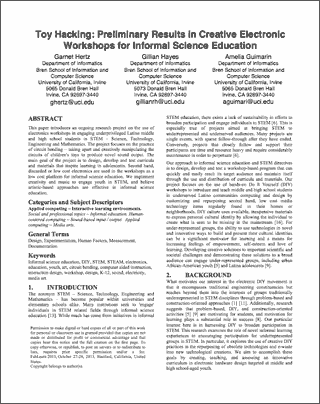
[FabLearn 2013] Newly published, October 2013: Hertz, Hayes & Guimarin. Toy Hacking: Preliminary Results in Creative Electronic Workshops for Informal Science Education. FabLearn 2013 Digital Fabrication in Education Conference Proceedings, Stanford University, published online at http://fablearn.stanford.edu/2013/papers/.
[Santiago, Chile] I was in Santiago Chile at Artek and Santiago Makerspace between August 30th - September 10th 2013. Projects included producing a new book titled "Inside Hackerspaces: Stgo. Makerspace" and a solo exhibition at Artek titled "Santiago: Bicycle Wifi Portrait". Documentation forthcoming.
[Moscow, Russia] I exhibited at the Moscow Art Week 2013 between September 15th - 22nd 2013, and gave a lecture titled "The Cockroach Controlled Mobile Robot and Scientific Research Ethics Boards in the Context of Contemporary Art Practice" and held a masterclass titled "Can Artists Generate Knowledge" at Art Science 3, a conference on art and science. A publication is forthcoming from Lomonosov Moscow State University.
[Ekaterinburg, Russia] I gave a lecture titled "The Cockroach Controlled Mobile Robot and Scientific Research Ethics Boards in the Context of Contemporary Art Practice" in Ekaterinburg, Russia between September 23rd - 25th 2013.
[Critical Making at LimeWharf Gallery in Hackney, London] Critical Making is traveling with the Adhocracy exhibition to the LimeWarf Gallery in Hackney, London for an early September opening. The exhibition will be open during the London Design Festival (14-22 September) with an event tentatively planned for that week. The exhibition was previously at New Museum from May 3, 2013 to July 7, 2013.
[Critical Frameworks course at Art Center MDP] I taught a course titled "Critical Frameworks" at Art Center in the MDP Program during Fall 2013. The course material was an introduction to Science, Technology and Society (STS) for designers. Readings include Sengers, Weiser, Bell & Dourish, Agre, S Wilson, Friedman & Nissenbaum, DiSalvo, Dunne & Raby, Bardzell & Bardzell, Gaver & Martin, The Mentor, Ratto, Chalmers & MacColl, Garcia & Lovink, and Mainwaring.
[Critical Making at 4S Conference] I co-organized an open session titled "Critical Making: Material Practices, Design, and STS" at the 2013 Conference of the Society for the Social Studies of Science ("4S") with Matt Ratto and Peter Asaro. The event ran October 9 - 12, 2013 in San Diego, California. The session is described as: "Increasingly, material production 'making' is part of the repertoire whereby scholars, practitioners, and activists engage critically with technoscience. Whether constituted as participatory, critical, or speculative design, critical technical practice, tactical media, or as artistic intervention, 'critical making' (understood in a general sense) is encouraging researchers to extend beyond purely deconstructive forms of analysis and thereby come to terms in more concrete ways with the material nature of technological and scientific objects. This open panel invites contributors to engage with the question of how hands-on productive work can extends and supplement critical reflection and intervention into technoscience. We particularly invite contributions from individuals working between conceptual and material practice, with an eye towards exploring objectives, outcomes and institutional issues in their hybrid practices. We would also like to encourage multiple forms of contributions to this panel, including 'show and tell' demonstrations of contributor's material work, conceptual exegesis of theoretical issues and extensions, narratives and auto-ethnographic descriptions. We hope the panel will instantiate a more deliberate and reflexive research program on making and its role for STS scholarship and understanding science and technology."
[Notacon 10] I gave a lecture titled "Critical Making" at the Notacon 10 Conference, which ran between April 18th-21st, 2013. My lecture can be seen at http://www.youtube.com/watch?v=9FfmvKq_4b0.
[Canadian Mobile & Social Media Conference]
I spoke at MoSo 2013 - the Canadian Mobile & Social Media Conference on Thursday June 13th 2013 in a talk titled "Inversive Innovations: A Four Step Process in Creative Design". I also hosted an electronics workshop on June 15th.
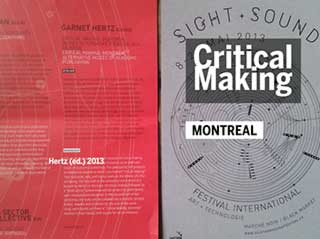
[Fabrication critique: Montreal] I hosted a Critical Making book writing, editing and printing workshop in Montreal on May 26th 2013 as a part of the Sight + Sound 2013 Festival.
This workshop explored the concept of critical making and how handmade books can function as an alternate mode of academic publishing. The workshop produced an additional booklet to Hertz's acclaimed "Critical Making" series of handmade books released in late 2012. Participants wrote, edited, and laid out texts on the theme of critical making, a term coined by Matt Ratto that proposes that hands-on physical work - making - has a clear place in enhancing and extending the process of critical reflection. The first half of the eight-hour workshop consisted of a lecture by Hertz on the topic of critical making followed by a "book sprint" where texts were written by participants, peer reviewed and designed. In the second half of the workshop, the texts will be collated into a booklet, printed, folded, stapled and trimmed. At the end of the workshop, we had a finished hardcopy "Critical Making: Montreal" booklet in our hands, with copies for all contributors.
[Processing Mega-class] Taught a programming class of 105 students at UC Irvine during Spring 2013 titled "Game Technologies & Interactive Media" (ICS62). This course used Processing to teach students about graphics programming, physics engines, and building interactive media.
[Hackerspace Tour Kickoff] I am organizing a Dorkbot SoCal 2013 Hackerspace Tour, with the first event occuring on Sunday May 5th 2013 at Droplabs at 1pm.
[Oblong, Scopely & Nokia Talks] I did artist talks at Oblong Industries on April 18th, Scopely on May 1st, and Nokia Design Center in Calabasas on May 2nd 2013.
[CHI 2013 - Reclaiming Repair: Maintenance and Mending as Methods for Design] I co-organized a workshop at CHI 2013 titled "Reclaiming Repair: Maintenance and Mending as Methods for Design" with Daniela Rosner, Steven Jackson, Lara Houston and Nimmi Rangaswamy. "Technologies inevitably break, degrade, and decline. In response, people mend and maintain what they already have: parts are replaced and software is updated. In this workshop, we propose to explore the fundamental work of repair and its impact on the study of design and technology as important - yet undervalued - forms of innovation. Broadly speaking, we hold the work of repair as acts of sustaining, managing, and repurposing to cope with attrition and regressive change. In order to investigate such processes, this workshop aims to bring together a range of scholars and practitioners from across the world to expand HCI's established views on design, development, and society."
[Critical Making Review - WMMNA]
We Make Money Not Art posted a review of Critical Making released on January 11th 2012. Here's an excerpt: "...Critical Making is also a courageous project. While acknowledging the role and importance of O'Reilly and Make Magazine in popularizing the DIY culture, the publication asks us to look at aspects of the DIY culture that go beyond buying an Arduino, getting a MakerBot and reducing DIY to a weekend hobby. Critical Making thus embraces social issues, the history of technology, activism and politics... Critical Making is not the anti-Make Magazine, it is simply an alternative, a forum for electronic DIY practice to discuss hacking, making, kludging, DIYing in a less sanitized, mass-market way."
[Art Center - Making Critical Making]
I describe the process of building the Critical Making project online at Art Center Media Design Practices - Making Critical Making (Garnet Hertz). This is a background to a course I taught during Spring 2013 titled Critical Frameworks within the program. Here's an excerpt: "...doing something yourself as a non-expert is a crash course in understanding how something actually works, and it is the fastest way to unpack and learn about the things that would normally remain invisible and taken for granted. The process of being humiliated by things that you think are easy or mindless is a valuable experience - I generally think that innovation occurs out of porting your ideas and processes into a field that you're not familiar with, and actually doing this on a regular basis is a crucial part of practicing inventiveness."
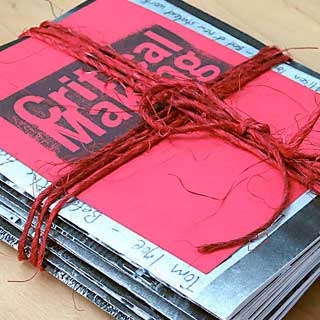
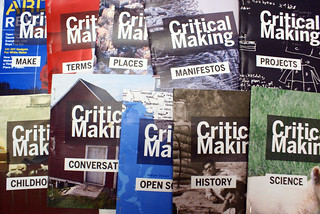
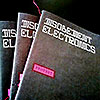
[Critical Making - Book] I have launched a new handmade publication titled (after Ratto) "Critical Making" in the field of critical technical practice and critically-engaged maker culture. Critical Making can be defined as exploring how hands-on productive work - making - can supplement and extend critical reflection on the relations between digital technologies and society. It also can be thought of as an appeal to makers to be critically engaged with culture, history and society. See the call for submissions or a video of the first test print of the publication.
Contributors include: Mitch Altman (Noisebridge), Marie Bjerede, Julian Bleecker (Nokia), Albert Borgmann (U Montana), Jonah Brucker-Cohen (Parsons), Anne Burdick (Art Center), Daniel Charny, Ginger Coons (U Toronto), Chris Csikszentmihalyi (Art Center), Carl DiSalvo (Georgia Tech), Dale Dougherty (Make Magazine), Tim Durfee (Art Center), Peter Flemming (Concordia), David Forbes, Alex Galloway (NYU), Benjamin Gaulon, Reed Ghazala, John Gilbey, Ken Gregory, Esben Hardenberg, Natalie Jeremijenko (NYU), Daniel Joliffe (U Ottawa), Brian Kane, Denisa Kera (National University of Singapore), Leonard Koren, Stephen Kovats, Stacey Kuznetsov (Carnegie Mellon), Golan Levin (Carnegie Mellon), Silvia Lindtner (UCI), Liz Losh (UCSD), Geert Lovink (Hogeschool van Amsterdam), Rafael Lozano-Hemmer, John Maeda (RISD), Roger Malina (Leonardo / MIT Press), Matthew Manos, Richard Maxwell (CUNY), Toby Miller (UCR), Monochrom, Rebecca Niederlander, Mark Pauline (Survival Research Labs), Allison Powell (London School of Economics), Fiona Raby (Royal College of Art), Matt Ratto (University of Toronto), Real Rydaz Lowrider Bicycle Club, RideSouthLA (USC), Niklas Roy, Craig Saper, Phoebe Sengers (Cornell), Michael Shiloh, Jay Silver (MIT), Scott Snibbe, Kristen Stubbs, Josh Tanenbaum (Simon Fraser), McKenzie Wark (New School), Patricia Watts, Norm White, Amanda Williams, and Kaiton Williams (Cornell). Estimated pages: 350. Shipping November 2012.
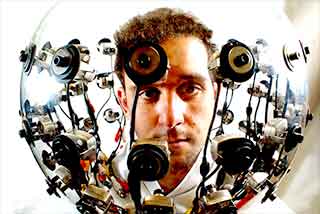
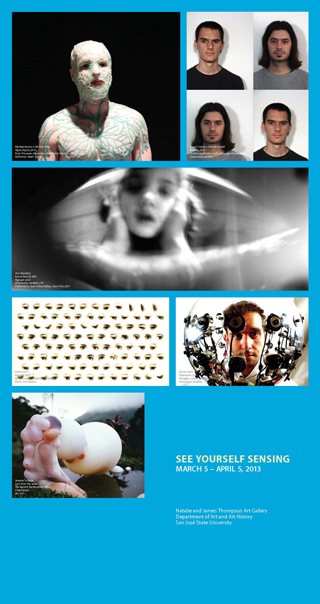
[Videodome in See Yourself Sensing Exhibition] Videodome made its premiere in an exhibition with Ann Hamilton as a part of Madeline Schwartzman's "See Yourself Sensing" exhibition at the Natalie and James Thompson Art Gallery at SJSU's School of Art & Design - March 5 through April 5, 2013. Reception: Tuesday, March 5, 6-7:30 pm.
[Berkeley Institute of Design]
I lectured at the Berkeley Institute of Design on Tuesday Feb 27th 2013 from noon to 1pm. The title of the talk is "How Critical Making is Done" - here's an abstract:
Critical Making can be thought of as an exploration of how hands-on
productive work - making - can supplement and extend critical
reflection on technology and society. It works to blend and extend the
fields of design, contemporary art, DIY/craft and technological
development. It also can be thought of as an appeal to the electronic
DIY maker movement to be critically engaged with culture, history and
society: after learning to use a 3D printer, making an LED blink or
using an Arduino, then what? This talk gives an overview of how Hertz (UC Irvine / Art Center)
edited and produced "Critical Making"
(http://conceptlab.com/criticalmaking/) - a handmade series of ten
booklets with 70 contributors that explores critically engaged maker
culture. After highlighting the publishing project, DIY practice will
be extended as a methodology for revealing and unpacking
infrastructures that normally exist as concealed blackbox systems. Hertz then proposes that the concept of reflective design (Sengers et.
al, 2005), can be ported into a four step design process for critical
making by: 1. identifying core metaphors of a field, 2. recognizing
what the metaphors exclude or marginalize, 3. invert the metaphor to
bring the
marginalized to the center, and 4. build a new alternative that
embodies the inversion. As a physical artifact, the critically made
thing has a tangible legibility, with the potential to act as a
boundary object between different users and communities.
[Teaching - Art Center MDP - Critical Frameworks]
During Spring 2013, I taught SP13 Critical Frameworks with Benjamin Bratton and Shannon Herbert. During my module of the course, students use my Critical Making project as a textbook, with students producing written and visual responses to this work. The module concludes with the class collaboratively producing a "Critical Making: MDP" handmade publication - photos of producing our capstone publication are avaiable on Flickr.
[Geffen at MOCA]
Critical Making was exhibited at Printed Matter's LA Art Book Fair from February 1-3, at The Geffen Contemporary at MOCA in Los Angeles. The opening was held on the evening of Thursday, January 31. The event is Directed by AA Bronson.
[Technology on Affluent Leisure Time]
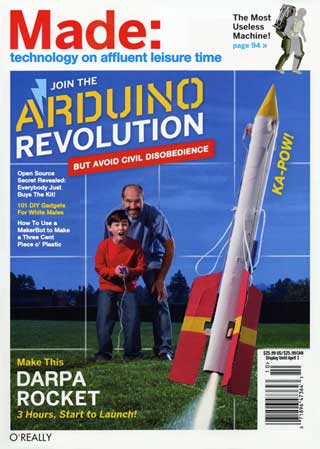
New sticker: Made: Technology on Affluent Leisure Time released in December 2012. Distributed for free with high resolution files available for download. Included as insert in Critical Making first edition.
[We Make Money Not Art Interview]
I did a lengthy interview with We Make Money Not Art which was released on December 7th 2012. Here's an excerpt: "I think circuit bending is a great antithesis to a standardized test. It doesn't have one right answer. It uses your hands. It makes noise and can be dangerous. It can be very simple or incredibly complicated. It involves genuine exploration and discovery. In a nutshell, I think it's a better model for how life works than a test on paper, and I think the United States would be a better place and have a more skilled and creative workforce (and more interesting artwork) if more kids were taught things like circuit bending at an early age."
[Dorkbot SoCal turns 50] The 50th event for Dorkbot SoCal is happened on Sunday, December 16th 2012 at 1pm at Machine Project. Presenters included Michael Kontopoulos, Joy Padiyar and Aaron Rasmussen - and presentations by some new hackerspaces in the Los Angeles area - more info at dorkbot.org/dorkbotsocal/
[UCI Mobile & Ubiquitous Games, Fall 2012] I taught a new course, "Mobile & Ubiquitous Games" in Information and Computer Science at UC Irvine during Fall 2012. Students: if you'd like to register, the course number is ICS163, and the course code is #36725.
[Media Places, Sweden, December 2012] I presented at "Media Places: Infrastructure | Space | Media", a symposium held in Umeå, Sweden, December 5-7, 2012 at HUMlab courtesy of The Peter Wallenberg Foundation. I was on a panel on the topic "Making" with Johanna Drucker (UCLA) and Chris Speed (University of Edinburgh). My talk was titled "Making Critical Making: DIY as Revealing Infrastructure." Abstract: "The maker movement can be described as a do-it-yourself (DIY) subculture interested in the creative exploration of electronics, robotics, 3D printing, and microcontrollers that has been popularized over the last half decade through the publication Make (O'Reilly Media), open source hardware like the Arduino, and collaborative hackerspace studios.
Critical Making is a handmade book project by Garnet Hertz that proposes that makers need to be critically engaged with culture, history and society, and that hands-on physical work - making - has a clear place in enhancing and extending the process of critical reflection. The production process of printing and binding over 100,000 pages in this project also provides a clear example of how DIY practices can be useful in revealing and unpacking infrastructures that normally exist as invisible blackboxed systems."
[Critical Making "Crunch Lunch" at USC Annenberg Innovation Lab] I discussed my new book project, Critical Making, at USC at the Annenberg Innovation Lab on October 2nd 2012 at noon. A video of my talk is at https://vimeo.com/50669744.
[NSF] As of September 2012 I am Principal Investigator on a National Science Foundation Informal Science Education Pathways Grant titled "Repurposing Obsolescence:
Teaching DIY Science, Technology and Engineering Practices to
Adolescents in Underserved Communities."
In this project - which is an extension of my "Toy Hacking" work - I'm particularly interested in reaching out to communities that normally wouldn't have the resources in their schools to explore art or electronics. Hands-on educational programs - like shop, woodworking and art classes - have been removed from many schools, which in my opinion is an incredible disservice. This project will design, develop and test DIY-style workshops to introduce and teach middle
school students in underserved communities technology and design by
customizing and repurposing e-waste technology to make custom musical instruments... in this case, old electronic toys.
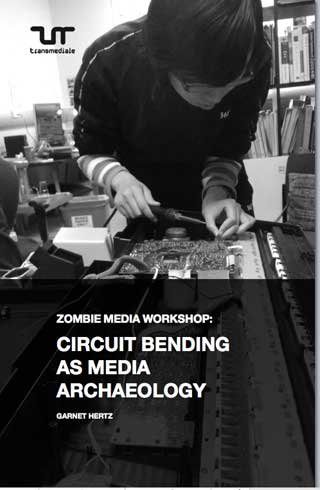
[Zombie Media in Leonardo 45:5] A new paper I co-authored with Jussi Parikka is published in Leonardo 45:5 (MIT Press) as a Theoretical Perspective - Zombie Media: Circuit Bending Media Archaeology into an Art Method. Abstract: This text is an investigation into media culture, temporalities of media objects and planned obsolescence in the midst of ecological crisis and electronic waste. The authors approach the topic under the umbrella of media archaeology and aim to extend this historiographically oriented field of media theory into a methodology for contemporary artistic practice. Hence, media archaeology becomes not only a method for excavation of repressed and forgotten media discourses, but extends itself into an artistic method close to Do-It-Yourself (DIY) culture, circuit bending, hardware hacking and other hacktivist exercises that are closely related to the political economy of information technology. The concept of dead media is discussed as "zombie media" - dead media revitalized, brought back to use, reworked.
[Occidental College, Oct 4] I provided a critical introduction to "The Pleasures of Uninhibited Excess" by Survival Research Laboratories at Occidental College on October 4th at 7pm. My talk discussed the work of SRL through the concept of "re-directed technologies" - technologies that are appropriated for a different use than what they were initially designed for. This is part of a film screenings related to DIY culture organized by Lee (Ari) Laskin.
[USC IML/iMAP, Nov 9] I gave a talk at USC's Institute for Multimedia Literacy on November 9th 2012 at 3pm.
[Co-Director, Values in Design Lab] As of Summer 2012, I am Co-Director of the Values in Design Lab at UC Irvine with Geof Bowker, Cory Knobel and Judith Gregory, who recently came to UC Irvine. We are dedicated to blending rich social theory with design practice in order to produce information systems and technology imbued with strong social and ethical values.
At the VID Lab, we bring together doctoral students, faculty and industry dedicated to making the world more livable and enjoyable using information systems and technology. Our laboratory is a creative space for prototyping and testing information artifacts - from collaborative workspaces to mobile apps to intelligent robots.
[Making = Thinking] I was an invited speaker at 4A's CreateTech2012 conference, themed "Making = Thinking". I gave a talk titled "Critical Making: Moving Beyond Arduinos and MakerBots" at the Leows Santa Monica Beach Hotel, Thursday September 20th 2012 at 1:55pm
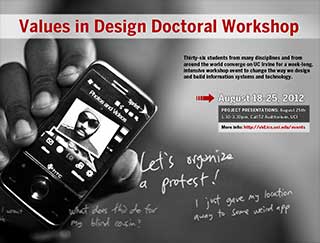
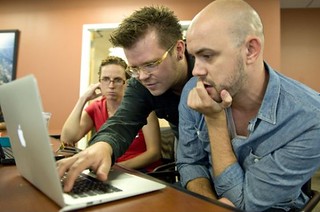
[VID 2012 Doctoral Workshop] I was faculty in the Values in Design 2012 Doctoral Workshop at UC Irvine (August 18-25, 2012) alongside Geof Bowker, Cory Knobel, Judith Gregory, John Crawford, Paul Dourish, Helen Nissenbaum, Carl DiSalvo, Matthew Bietz, Kurtis Lesick and Steve Slota.
The Values in Design Doctoral Workshop was a week-long, intensive event sponsored by the Values in Design Program through the Department of Informatics in the Donald Bren School of Information & Computer Sciences at University of California, Irvine.
We brought together a group of 36 exceptional PhD candidates from a wide range of backgrounds to study and address issues of how human and social values are embedded, built into, influence, and otherwise instantiate themselves in information systems and technologies. By working across the intersections of computer science and engineering, social studies of science and technology, anthropology, policy and law, business, social entrepreneurship, art, design, and information science, the group delved into the theories contributing to (and arising out of) sociotechnical design, as well as spending the week designing and building original information systems and technologies that materialize a set of social values.
I taught "Critical Making" courses and "Interfacing Code with the Physical World: A Crash Course in Processing and Arduino".
See the OC Register's "UCI workshop explores friendlier technology" article or my documentation of the soldering, redesigning, interfacing code or project pitch sessions.
[Korea - First International Robot Art Conference] I gave a lecture at the First International Robot Art Conference in Changwon, South Korea on May 4th 2012. The title of my talk was "Chindogu and the Value of Inversive Design in Robotic Art". See photos fo the First International Robot Art Conference in Changwon.
[Korea - Seoul National / Art Center Nabi / Sejong University] I lectured at Seoul National University on May 7th 2012 and at Sejong University and Art Center Nabi on May 8th 2012.
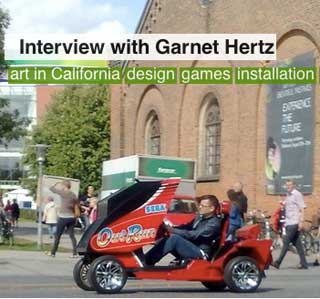
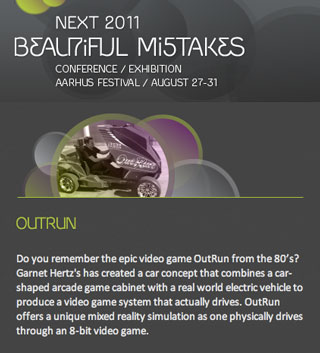
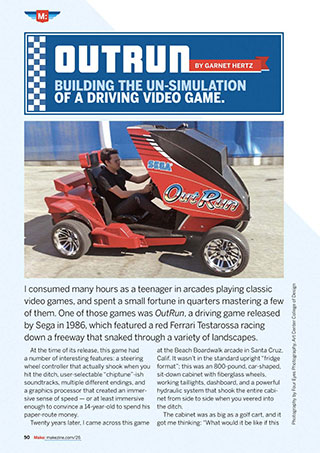
[OutRun on Discovery Channel] OutRun will be featured on Discovery Channel Canada on the program "Daily Planet". Exact air date not known, estimated to be in April 2012. Film date was March 21st 2012 and the producer was Ian Connacher.
[OutRun in Car & Driver Magazine] OutRun will be featured in the June 2012 issue of Car & Driver Magazine with an article written by John Pearley Huffman (photo shoot / interview date was Febraury 29th 2012). The June 2012 issue hits the shelves of North American newsstands in early May 2012.
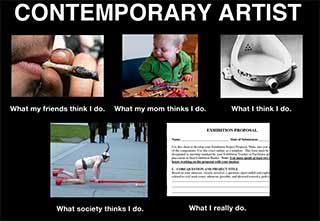
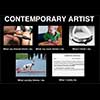
["What I Really Do" Meme] I made an image related to the experience of being a contemporary artist in February 2012 that is attributed as starting the widespread "What I Really Do" meme. This meme was supposedly the most popular meme on the internet during February 2012, and pervasively spread through Facebook to tens of millions of viewers. See Know Your Meme for a context for the meme, and my Hyperallergic interview for the most in-depth discussion I've done on the topic.
[Jeremy Bailey Interview] I interviewed Jeremy Bailey in Vague Terrain 21: Electric Speed. We discuss "post-internet", McLuhan, new media, Canada, and chindogu. Vague Terrain is a web based digital arts publication that showcases the creative practice of a variety of artists, musicians and scholars. Electric Speed is an exhibition curated by Kate Armstrong and Malcolm Levy through the Surrey Art Gallery of works designed for presentation on urban screens. A catalog of the Electric Speed exhibition is available in print or as for free PDF download.
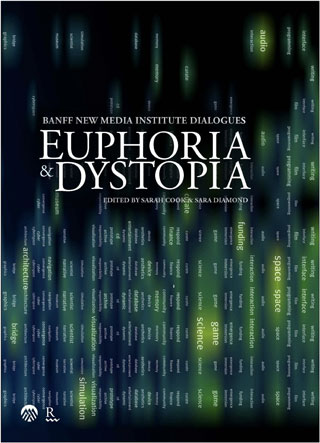
[Utopia / Dystopia] My work is featured in "Euphoria & Dystopia: Banff New Media Institute Dialogues" edited by Sarah Cook and Sara Diamond. Summary: "A compendium of some of the most important thinking about art and technology to have taken place in the last few decades at the international level. Based on the research of the Banff New Media Institute from 1995 to 2005, these essays, transcripts and artists projects celebrate the belief that artists and cultural industries, in collaboration with scientists, social scientists and humanists, have a critical role to play in developing technologies that work for human betterment and allow for a more participatory culture."
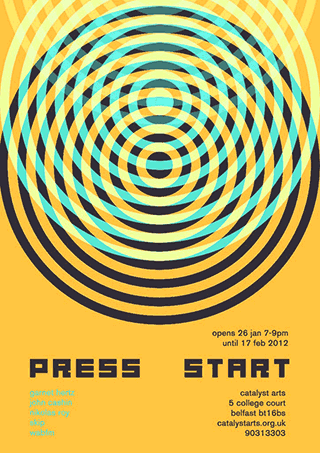
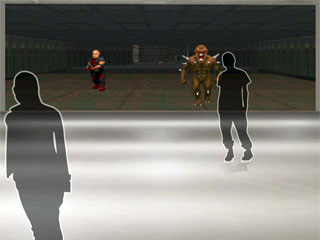
[Belfast Doom] I am showing Doom in Belfast at Catalyst Arts in an exhibition titled "Press Start" that runs from January 27th to February 17th 2012. The opening reception is Thursday January 26th from 7pm-9pm.
2011
[Dorkbot SCI-Arc] Dorkbot SoCal 47 was on Saturday December 3rd 2011 at the SCI-Arc Robotics and Simulation Lab, with an introduction by Peter Testa & Devyn Weiser and demonstrations by Brandon Kruysman & Jonathan Proto.
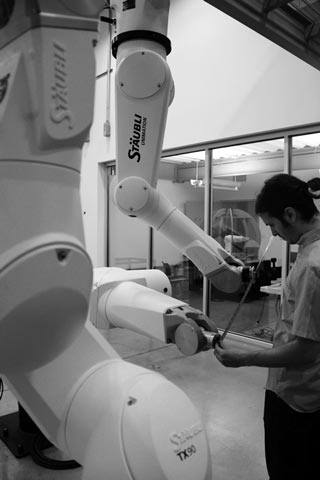
The 1,000 square-foot double height robot cell focuses on multi-robot collaboration and multi-media simulation using 5 state-of-the-art Staubli robot systems: (2) RX160, (2) TX90, and (1) TX90L. The relatively lightweight, six-axis robotic arms are in a range of positions (floor and ceiling mounted) to create a reconfigurable 3D work space with many possible applications. The adjacent simulation lab houses the Staubli TX40 robot where students, along with their instructors, conduct hands-on training and testing. For photos of the event, see http://www.flickr.com/photos/youraccount/sets/72157628302749815/ and for more information on the lab, see http://www.machinators.org.
[Civic & Community Engagement] I am teaching Introduction to Civic & Community Engagement at UC Irvine during Fall 2011. Students - log in at https://eee.uci.edu/11f/87625 (UCI login required).
[Doom] Lots of work being done on the new studio project Doom, where a wall reflects an augmented version of reality where people are evil monsters from the 1993 videogame "Doom".
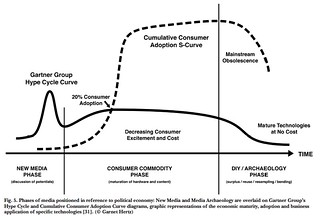
[ACADIA 2011 Keynote] I will be giving a keynote at ACADIA 2011 (Calgary/Banff Canada, 11-16 October 2011). My talk is titled "Arduino Microcontrollers and The Queen's Hamlet: Utilitarian and Hedonized DIY Practices in Contemporary Electronic Culture". In this talk, I pull together concepts of utility-driven do-it-yourself (DIY) culture and pleasure-oriented DIY practice to investigate a significant trend in contemporary computing culture, the maker movement, typified by an interest in building personalized and handmade electronic devices with sensors, motors and lights, usually controlled by microcontrollers like the Arduino. My argument is that maker culture has been co-opted by consumer hobby culture, but this is not necessarily detrimental because it provides an important outlet for personal exploration, increases an understanding of how electronic media actually works and assists individuals to be actors in a culture that is increasingly complex, technological and digitized.
[Banff R.I.P.] I was at The Banff Centre from July 8, 2011 - July 15, 2011 for R.I.P. - Recycling Pervasive Media, Intervening in Planned Obsolescence (Blog) / (Official Event Website), an event that
will tackle the issues of recycling, art making, and sustainability practices. Artists, researchers, practitioners, academics, municipal workers, community leaders, and professionals were invited to come explore new ways of working with municipal waste management facilities to reclaim "good garbage". Over the course of this three-part, seven-day program, we discussed ideas, createed new work, and presented projects related to sustainable practice. I worked on my Pixel VGA project.
[Toy Hacking] A lot of circuit bending workshops have been given in Southern California in March 2011, and our curriculum guide has been completely redesigned and translated into Simplified Chinese and Spanish. Hackear Juguetes!
[OutRun at MADE UP] OutRun was live and at Art Center on Jan 29th 2011 in the MADE UP: Design's Fictions exhibition. The car made an appearance at the reception and drove through the gallery - see the video clip. The car and documentation of the project will stay in the show until March 20th 2011. MADE UP: Design's Fictions presents the work of major and emerging international practices that forecast, hypothesize, muse, skylark, role-play, put-on-airs, freak-out or otherwise fake-it to produce work that is relevant to our increasingly confusing and accelerated world. FEATURING WORK BY: Aeolab, Agency, Juan Azulay, Stuart Bailey / Frances Stark, Juliette Bellocq, Commonwealth, Design I/O, Hernan Diaz Alonso, Andrew Friend, Justin Gier, Garnet Hertz, Thomas Hillier, Ben Hooker / Shona Kitchen, Ingrid Hora / Daniel Salomon, Coy Howard, Ed Keller / Yuval Borochov / Lisa Ekle / Danil Nagy, Perry Kulper, The Planning Center, Keiichi Matsuda, Maywa Denki, Syd Mead, Metahaven, Microsoft, MOS, Oblong Industries, Sascha Pohflepp, Rojkind Arquitectos, Eddo Stern, Noam Toran, Julia Tsao, Jackson Wang, Chris Woebkin / Natalie Jeremijinko.
[Transmediale Circuit Bending Workshop] I taught a circuit bending workshop titled "Zombie Media Workshop: Circuit Bending as
Media Archaeology" at Transmediale in Berlin on Friday 04 February 2011 from 10:00-14:00 at the HacKaWay Zone. Abstract: "With their essay Zombie Media, Garnet Hertz and Jussi Parikka approach media archaeology with the aim of making it into an art methodology. Following a presentation of their ideas, the Vilém Flusser Theory Award nominees invite participants to enact the process of circuit bending: Participants will disassemble battery powered devices such as toys to subsequently perform with their customised instruments."
[Artist in Residence, UCI Informatics] As of December 1st 2010, I have a two year contract as Artist in Residence / Research Scientist at UCI in the Department of Informatics. I will continue to develop new projects, texts, and will continue to advise students. I am working with Paul Dourish and Gillian Hayes. As a part of this appointment, I will be directing a project-based lab/studio in collaboration with the Laboratory for Ubiquitous Computing and Interaction and the Social & Technological Action Research Group.
[OutRun, Ben Maltz Gallery] The OutRun project made its Southern California debut at the Ben Maltz Gallery on October 2nd 2010, and was on exhibition until December 4th 2010. A live demonstration of OutRun - in other words, driving through city streets - was given on Saturday November 6th at 11am, followed by lunch at a local eatery.
[UCI Informatics] Presented "The Seamful and Perversive Roles of Artwork in Interdisciplinary Research" at UC Irvine's Informatics Seminar November 5th 2011. Abstract: "Garnet Hertz launches a discussion into the role of artwork in interdisciplinary research through the presentation of three of his projects - a mobile robot controlled by a living insect (http://conceptlab.com/roachbot/), a videogame arcade cabinet that is redesigned to actually drive (http://conceptlab.com/outrun/), and a taco truck that is customized into a lowrider mobile lab to teach children about electronics (http://conceptlab.com/circuitbending/). Like many contemporary art projects, these systems are intentionally designed to be poetic or humorous. This work will be discussed within the framework of interdisciplinary research in informatics: how novel work in design can develop more creative and conceptual approaches to innovation and presentation. Several terms related to design theory will also be introduced, including wabi-sabi (Koren, 1994), chindogu (Kawakami, 1995), perversiveness (Lozano-Hemmer, 1996), and seamfulness (Chalmers, 2002)." Lecture slides are also available.
[OutRun premiere at 2010 01SJ Biennial] The OutRun project made its debut at the 2010 01SJ Biennial in San Jose California on September 2010. The project was in the Out of the Garage and Into the World event from September 4-14th and the Green Prix on Saturday September 18th. I also gave an artist talk on Saturday September 11th.
[OutRun at IndieCade] OutRun was at IndieCade in Los Angeles on October 9th 2010. OutRun will be operating live on Saturday, October 9th from 9:00pm to Midnight at the IndieCade Village across from Culver City Studios. Video documentation of OutRun at night is available by Technologizer.
[CTheory] New interview out, April 2010: Resetting Theory - Archaeologies of Media Art - Jussi Parikka in conversation with Garnet Hertz. CTheory is an electronic academic journal published since 1996. It is an international peer-reviewed journal focusing on technology and media theory, technology, and culture, publishing articles, interviews, book reviews and "event-scenes." It is edited by Arthur and Marilouise Kroker.
The editorial board includes
Paul Virilio, Bruce Sterling, Siegfried Zielinski, Stelarc, DJ Spooky, Timothy Murray, Lynn Hershman Leeson, Stephen Pfohl, Andrew Ross, Andrew Wernick, Maurice Charland, Gad Horowitz, Shannon Bell and R.U. Sirius.
Until his recent death, the editorial board also included Jean Baudrillard.
[Roachbot Aarhus Denmark NEXT Festival] Cockroach Controlled Mobile Robot was shown at NEXT 2010 in Aarhus Denmark in September 2010.
[FDG2010] I presented a new paper titled "OutRun: Perversive Games and Designing the
De-Simulation of Eight-Bit Driving" at The 5th International Conference on the
Foundations of Digital Games at the
Asilomar Conference Grounds, Monterey, California, USA from June 19-21, 2010 (Conference Program). The paper provides an overview and context for the development of the OutRun project to date. Abstract:
"This paper outlines the development process of a mixed reality
video game prototype that combines a classic arcade driving game
with a real world vehicle. In this project the user, or player,
maneuvers the car-shaped arcade cabinet through actual physical
space using a screen as a navigational guide which renders the
real world in the style of an 8-bit video game. This case study is
presented as a "perversive game": an attempt to disrupt the
everyday by highlighting and inverting conventional behavior
through humor and paradox."
[Circuit Bending USC] I held a circuit bending workshop at the Institute for Multimedia Literacy in the School of Cinematic Arts at USC on August 5th 2010. I was commissioned to create a custom instructional zine for this event (similar to the booklet made for Art Center, pictured below). The workshop is being held as part of "Broadening the Digital Humanities", which designed to foster innovative multimedia research. Sponsors include The University of California's Humanities Research Institute, USC's Institute for Multimedia Literacy and the electronic journal Vectors.
[Design Dialogues] I gave a guest lecture on March 19th 2010 at Art Center in the Design Dialogues speaker series, which was guest curated by Norm Klein. Other speakers this term include Stan Douglas (artist), Kari-Rae Seekins (sound designer and composer), Carole-Ann Klonarides (independent video art curator, Britt Salvesen (curator, Los Angeles County Museum of Art) and Erkki Huhtamo (media historian and collector).
[Circuit Bending] I taught a workshop titled "Hardware Basics: A Rough Introduction to Circuit Bending" at Art Center on January 24th 2010. A sixty page zine-like booklet was produced for the event. Photo and video documentation is available at http://conceptlab.com/circuitbending/.
[Doctor Hertz] I completed my Ph.D. in Visual Studies at the University of California Irvine on November 10th 2009. Thanks to Mark Poster (co-chair), Peter Krapp (co-chair), Cecile Whiting and Robert Nideffer who served on my doctoral committee.
[Faculty, Art Center Media Design Program] I am pleased to announce that I am now Faculty in the Media Design Program at the Art Center College of Design in Pasadena, California starting October 2009. I am a Thesis Advisor and currently serving on four Masters Committees.
[Dorkbot SoCal 40] Dorkbot SoCal 40 was on Saturday May 22nd 2010 at 1pm at Machine Project in Los Angeles. Presenters included:
Brett Doar - Brett discussed the mechanics behind the recent Rube Goldberg machine he built for the Colbert Report. Brett was also involved with SynnLabs in the Rube Goldberg machine for OK Go's viral video "This Too Shall Pass". During this event, local hackerspaces were also showcased, with presentations about their capabilities, membership, culture, and recent projects, including Crashspace in Culver City represented by R. Kevin Nelson, and Nullspace in downtown LA represented by M.
[Art Center] Four of my grad students graduated from the Media Design Program at the Art Center College of Art & Design with their outstanding thesis work at the public event "4 Hours Solid". The event will also include campus-wide presentations (Art Exhibitions, Broadcast Cinema Screenings, and Industrial Design Presentations) with a panel discussion on Screen/Culture: panelists include Kevin Mack, McKenzie Wark, Scott Watson, and Anne Bray. Katherine Hayles (pictured below, talking to my student Hyun Ju Yang) also game to a graduation event on Saturday night.
[Guest Lectures] In March 2010 I've given lectures at University of North Texas, University of North Texas at Dallas, and Penn State University.
2009
[DAC09] I gave a plenary lecture at Digital Arts and Culture 2009 (DAC09) on December 14th 2009 titled "Methodologies of Reuse in the Media Arts: Exploring Black Boxes, Tactics and Archaeologies." Other presenters at the plenary included Nick Montfort, Ian Bogost, Conor McGarrigle and Jason Farman.
[AFI Mentor] In fall 2009 I served as a mentor at the American Film Institute Digital Content Lab in Hollywood, California. The project I've advised was demoed on November 4th 2009 at the Chinese Mann Theater in Hollywood. Here's a video overview of the AFI Digital Content Lab.
[Dorkbot SoCal 38] Saturday, October 31, 2009 at 1pm at Machine Project, featuring Micha Cárdenas /
Chris Head / Elle Mehrmand presenting in the Freephone Project,
D.V. Rogers will be presenting documentation of the Parkfield Interventional EQ Fieldwork, and Owen Gerst will be showing his work as Stolon Design. More information at Dorkbot SoCal.
[Milan, Italy] A solo exhibition titled "In Memory of the Dead Media Handbook" was at Studio D'Ars in Milan, Italy, opening October 20th 2009 at 6:30pm (Via Sant'Agnese 3, 20123 Milano, Italia). Exhibition images can be seen at the In Memory of the Dead Media Handbook (Flickr set). More information can be seen at conceptlab.com/problems/milan/.
The press release is as follows:
“In Memory of the Dead Media Handbook”
Installazione del vincitore del XXV Premio Oscar Signorini - 2008
Mostra n° 575
a cura di: Cristina Trivellin e Martina Coletti
inaugurazione martedì 20 ottobre 2009 ore 18:00-23:00
Studio D’Ars, Via Sant’Agnese 12/8, Milano
Presso lo Studio D'Ars di Milano sarà allestita la mostra personale di Garnet Hertz, vincitore della XXVa edizione del Premio Oscar Signorini. La mostra sarà l’occasione per presentare per la prima volta al pubblico The Dead Media Project, il progetto di Hertz nato sulla scia dell’idea di Bruce Sterling di catalogare in un unico libro i media obsoleti e gli errori commessi in campo tecnologico. L'installazione di Hertz inviterà i visitatori della galleria ad esprimere il proprio concetto di Dead Media Handbook: come dovrebbe presentarsi un libro sulle tecnologie di comunicazione obsolete, a chi potrebbe essere destinato, cosa dovrebbe contenere e come potrebbe essere organizzato. Ai primi dieci spettatori che collaboreranno al progetto scrivendo le proprie idee, verrà rilasciata una copia del libro firmata dall’artista.
Il Premio Oscar Signorini, istituito nel 1984 in memoria del fondatore di D'Ars, Oscar Signorini (1910-1980), si rivolge annualmente ai giovani artisti under 35. Come ogni anno il Premio propone una sfida volta alla comprensione e alla divulgazione di temi strettamente legati alla cultura e alla società contemporanee e per questa XXV edizione è stato dedicato all’Arte Robotica, ovvero alla tematica della tecnologia robotica impiegata in ambito creativo e artistico, chiamando in causa una giuria di rilievo internazionale, composta da teorici e artisti affermati presieduta da Pier Luigi Capucci.
Il lavoro artistico di Garnet Hertz (www.conceptlab.com) esplora i temi del progresso tecnologico, della creatività, dell'innovazione e dell'interdisciplinarietà. Ha esposto il proprio lavoro in diverse importanti sedi internazionali, tra cui Ars Electronica, DEAF e SIGGRAPH, ed è stato insignito del Premio 2008 Oscar Signorini dedicato all’arte robotica. Presso l'Università della California Irvine, Hertz è un membro del Laboratory for Ubiquitous Computing and Interaction presso il Dipartimento di Informatica, ha conseguito un dottorato in Arts Computation Engineering e segue il dottorato in Visual Studies (Humanities). E fondatore e direttore del Dorkbot SoCal, un mensile di Los Angeles DIY sull'arte elettronica e il design. La sua ricerca è ampiamente citati in pubblicazioni accademiche e il suo lavoro è stato recensito da importanti riviste tra cui The New York Times, Wired, The Washington Post, NPR, USA Today, NBC, CBS, TV Tokyo e CNN Headline News.
[Projects in Ubicomp] In Fall 2009 I advised undergraduate students in the course "Informatics 148: Projects in Ubiquitous Computing" in the Department of Informatics at UC Irvine. Students worked on alternative software approaches to the development of the OutRun project.
[OutRun Interns] Over Summer 2009, the OutRun project has had five interns from the University of California Irvine working on the development of the system:
[The Imaginary Twentieth Century] A quick studio sketch of Grand Restaurant Automatique au XXe Siécle (The Grand Automated Restaurant of the 20th Century) from Norman Klein's archive of "The Imaginary Twentieth Century" project. Laser printed on paper, cutout, raised and glued into a two-and-a-half dimension construction, in the style of vue d'optique / decoupage / papier tole. August 2009.
[Beyond design: cybernetics, biological computers and hylozoism] See Andrew Pickering's "Beyond design: cybernetics, biological computers and hylozoism" in Synthese (2009) 168:469-491 published by Springer for an interesting overview of some of my work in relation to the history of cybernetics.
"Hertz' robots show that there is another and much simpler way to achieve comparable ends without the detour. We can see two different stances towards matter in play here: the conventional one that involves penetrating black boxes through knowledge, and the cybernetic one that seeks to entrain boxes that remain black into our world. And we could understand this contrast ontologically and epistemologically. Cybernetics centres itself on a world of performative black boxes and their interrelations, whereas the Modern paradigm emphasises an intrinsically cognitive relation to matter."
[Art Center College of Design] I was guest critic for final reviews in the graduate Media Design Program at the Art Center College of Design on Tuesday, April 14th 2009: "The Media Design Program (MDP) turns ambitious designers into leading thinkers and makers within emerging communication contexts. Three concepts help us navigate the flux: hybridity, emergence, and discovery."
[Dorkbot SoCal 37]
***** Saturday, July 11, 2009
***** 1:00pm
***** Machine Project
***** 1200 D North Alvarado Street
***** Los Angeles, CA 90026
Heather Knight http://www.marilynmonrobot.com/
A newbie Angelino and recent alumnus from the Personal Robots Group at the MIT Media Lab, Heather is a Social Roboticist who works at the Jet Propulsion Lab. She has two degrees from MIT in Electrical Engineering and Computer Science and a minor in Mechanical Engineering, working in Robotics since 2002 under Professor Cynthia Breazeal. This dorkbot she will present her work enabling robots to understand nonverbal human gestures and talk about the potentials for interactive technology incorporated into everyday objects, such as clothing.
Jody Zellen http://www.jodyzellen.com/
Jody Zellen is an artist living in Los Angeles, California. She works in many media simultaneously making photographs, installations, net art, public art, as well as artists' books that explore the subject of the urban environment. She employs media-generated representations of contemporary and historic cities as raw material for aesthetic and social investigations.
Xuan "Sean" Li http://www.way2sky.com/portfolio/
Xuan "Sean" Li creates works that merge concepts and ideas from different disciplines into new digital and electronic expression. He has worked in the areas of web design, game level design, product design, and 3D rendering and animation. His most recent work attempts to expand the role of information visualization as an art form through a novel combination of physical sensors with generative visuals, exploring new aesthetic possibilities by expressing the nature of the wireless data flow.
[Hertz, Durfee, Klein] I organized this event as a follow-up to conversations with Tim Durfee and Norm Klein at Art Center: Design Algorithms: Skeuomorphs, Spandrels & Palimpsests (June 20th 2009, Machine Project, Los Angeles, 1pm).
This event will explore how cultural objects shift over time, with each of us exploring a single term related to patterns of cultural change: I will be discussing skeuomorphs, Tim will be discussing spandrels, and Norm will be discussing palimpsests.
[8-bit Economic Meltdown Game Mod] Play the economic crisis of 2009 in Debt Hole - a game mod by Garnet Hertz. Move your financial
assets through the colon of debt,
avoiding bankruptcy and foreclosure
on either side of you. Hitting the
brown-colored wall will result in
you losing your house. Game modification programmed in MOS 6502 8-bit microprocessor assembly code, as seen on the Apple II, Commodore Vic 20 and the Nintendo Entertainment System.
[Dorkbot SoCal 34] Dorkbot SoCal 34 was on Sunday, March 8, 2009 at 1pm at Machine Project at 1200 D North Alvarado Street, Los Angeles. Photos of the event can be seen on Flickr. Speakers included:
Dan Goods - Dan is the "Visual Strategist" for NASA's Jet Propulsion Laboratory at CalTech where he develops creative ways of communicating science. He recently has done artwork with aerogel and on a team to develop a 108-foot long data driven sculpture at the San Jose airport.
Brian O'Connor - Arduino + Chumby = Fun! The Chumby is an open-source, ambient Internet device running Linux while the Arduino is an open-source prototyping platform. Brian will show how to connect an Arduino to the Chumby and develop a simple application that monitors the environment.
Eric Gradman and Brent Bushnell - Eric and Brent will present ArtFall: a dynamic physical simulation by drawing on a whiteboard.
[PBS Vermont - Technology of Social Sciences] My work was featured on "Emerging Science" (Episode: "Technology of Social Sciences") which is sponsored by the National Science Foundation (EPSCoR). The episode originally premiered on February 10th 2009 at 9pm.
[BIL2009 CSULB] I spoke on a panel on the topic of "Where is my Cyborg Self?" at California State University Long Beach for the BIL2009 conference on February 7th/8th 2009. Other panelists included neural computation researcher / hacker Virgil Griffith from CalTech (and WikiScanner), Isa Gordon, bioengineer KV
Fitzpatrick from USC, roboticist Eric Gradman from Applied Minds,
and AGI researcher Peter Voss from AdaptiveAI.
[Sci-Q] My work recently seen (Jan 2009) on Discovery Channel's "Sci-Q" show.
2008
[Won 25th Oscar Signorini Prize] Notified on December 11th 2008 that I won the 25th Oscar Signorini Prize (Fondazione D'Ars Oscar Signorini Onlus). Victoria Vesna won the award in 1998. Documentation of my work was shown at Studio D'Ars in December 2008, and I will have a solo show in 2009 at Studio D'Ars Milan.
Noema (Tecnologie e Società) has published special information on the prize at http://www.noemalab.org/sections/specials/xxv_signorini_prize_robotic_art/main.html.
A summary is as follows:
This XXV edition of the Prize is focused on robotic art, that is the use of robotic technologies in the arts. The Prize yearly proposes a competition aimed at understanding and spreading topics which are strictly connected to the contemporary culture and society.
The Prize aims at raising a reflection on contemporary topics through the main viewpoint of contemporary arts, in their newest, most emblematic and international forms. This is the reason why the Oscar Signorini Prize on robotic art has an international jury with renowned theoreticians and artists. The jurors are Pier Luigi Capucci (president), Eduardo Kac, Riccardo Notte, Luigi Pagliarini, Laura Sansavini, Pavel Smetana and Franco Torriani.
[Stephen Wilson Interview - Ethology of Art & Science Collaborations] I've uploaded Garnet Hertz interviews Stephen Wilson (09-30-2002), a 13.6M MP3 file. We discuss a number of issues related to interdisciplinary arts practice, including art & science collaborations, artists producing knowledge, and research ethics boards and contemporary art practice.
[Dorkbot SoCal 32]
Dorkbot Socal 32 is on November 1st 2008 at World Power Systems Headquarters. Tom Jennings is declaring that it's time for a regime change in his studio, so he's selling mountains of his equipment. This isn't just ordinary stuff, though. It's a hand-picked selection of some of the finest and most obscure technologies from the Cold War and the history of computing: nixie tubes, antique computing, wind-up tape machines, transistors older than you, gyroscopes, flip-dot displays, nixie assemblies, one-plane numeric displays, radiation detectors, new (in 1950) aluminum project cabinets, weird knobs, dials, switches, old (nice!) radios, ancient (working!) oscilloscopes, bubble [magnetic] memory, tiny cathode ray tubes, weird instrumentation. Most things will be one dollar. Bring some cash and come on out.
[Snelgrove - Sept 15th 2008] I will be in Saskatoon, Canada from September 9th through 16th 2008, and will be giving a lecture on Monday, September 15th 2008 from noon until 1pm at the University of Saskatchewan in the Department of Art & Art History in the Snelgrove Gallery (Room 191, Murray Building). This is the university I did my undergrad degree at, and the talk will be "From Farm to DIY Culture: This lecture will provide an overview of Hertz's work, tracing a line between the farmyard scrap pile of his childhood in Saskatchewan and his current work and research in art that engages with and questions technology."
[Moscow International Film Festival] My work was featured at the Media Forum program of the 2008 Moscow International Film Festival in
Moscow, Russia (June 25 2008) and at the National Centre For Contemporary Arts in
Kaliningrad, Russia (July 2008). The show was titled "Evolution Haute Couture: Art and Science in the Post-Biological Age" and was curated by Dmitry Bulatov.
[Dorkbot SoCal 29]
Dorkbot Socal 29 is on May 29th 2008 at Machine Project. Hear the gut-wrenching tale of four plucky men and a crappy car who made a foolish fantasy into a foolish reality! Earlier this year, Make: magazine agreed to sponsor Jason Torchinsky in fielding an entry into the 2008 24 Hours of Lemons motor race: an endurance race for cars valued at $500 or less. Jason gathered the best people in the field of enough free time and some interest in racing a shitbox: Tom Jennings, Brett Doar, and Sloan Fader. A 1993 Ford Escort LX was purchased for $300, and the work began. In the end, The Make:Way car came in 33rd out of nearly 90 entries-- a far better result than ever hoped for. Come see what the team did, how they did it, and see the 33rd-place-winning car itself!
[HASTAC II] I was at HASTAC II May 22-24 2008 at University of California Irvine and University of California Los Angeles - the event focused on exploring the multiple ways in which place, movement, borders, and identities are being renegotiated and remapped by new locative technologies. HASTAC is the Humanities, Arts, Science, and Technology Advanced Collaboratory and is committed to new forms of collaboration across communities and disciplines fostered by creative uses of technology.
To engender discussion among participants from different departments who might not otherwise interact.
To discuss issues involved in pursuing research that crosses disciplinary boundaries or does not fit exclusively into an established discipline.
To explore possibilities for connections or collaborations between participants from different disciplinary backgrounds.
[Pedagogical Fellowship @ UCI 2008/09] I've been awarded a Pedagogical Fellowship through UC Irvine. This will include training incoming teaching assistants at UCI, and also includes workshops on course design, pedagogy, mentoring, job talks, tenure, etc. For an overview, see this video by Shaun Longstreet.
[Video Games at Art, Culture & Technology] For the second academic year, I am teaching discussion sections of Video Games at Art, Culture & Technology at University of California Irvine with Peter Krapp, Bill Tomlinson and Dan Frost. Students: you can find my 2007-2008 lecture notes at http://conceptlab.com/uci/us12a/, http://conceptlab.com/uci/us12b/, and http://conceptlab.com/uci/us12c/
[Photostereosynthesis: New Project Proposal] I have a freshly minted research proposal online for a new photography-based imaging/hardware project, tentatively titled Photostereosynthesis. No robots or animals. It's whitewall-gallery-ish and displayed without electricity. Here's the one sentence blurb:
Research and development of a custom microprocessor-based digital camera focus controller in the style of Louis Lumiere's 1920s-era layered photographic technology, Photostereosynthesis.
[McKenzie Wark] As a follow-up to Galloway, McKenzie Wark gave a guest lecture in US12C on Thursday, April 10, 2008 from
11:00 AM - 12:20 PM. He discussed GAM3R 7H30RY and 1. can we explore games as allegories for the world we live in? and
2. can there be a critical theory of games?
[Alex Galloway] Alex Galloway gave a guest lecture in US12C on Thursday, April 3, 2008 from
11:00 AM - 12:20 PM. His talk was titled "The Game of War." RSG is currently working on a new project: a computer-based version of "The Game of War," a board game designed and fabricated in 1978 by the French Situationist Guy Debord. During this talk, he discussed details of Guy Debord's wife, Alice Becker-Ho, legally threatening him.
[Dorkbot SoCal 28 - 1pm Sat April 5, 2008 @ Machine - Seeley, Lotan & Edwards + Make Magazine] Guest hosted by Thomas Edwards, former Dorkbot DC overlord. Presenters were Damon Seeley,
Thomas Edwards and Gilad Lotan. There was also be a presentation by the Make Magazine race car team to solicit projects for their car.
[Dorkbot SoCal 27 - Make:Way Meet-The-Car Event] This event happened on Saturday, March 29, 2008 from
4:00 PM - 5:00 PM at Tom's place. Make:Way is Make Magazine's entry into the 2008 24 Hours of LeMons race -- an endurance race where each car must be $500 or less. The Make:Way team will be transforming a $300 1993 Ford Escort LX into a screaming brute of a racecar.
[At the Trailing Edge of New Media] As an offshoot of my paper "At the
Trailing Edge of New Media:
Interdisciplinary Arts Practice & Institutionalization" for CAA2008, I've been starting to interview people in the media arts community. This is partially in response to Geert Lovink's "In Search of the Cool Obscure" and Dietz & Cook's "Formerly New Media" (which I participated in).
[Book launch - Quebec City Feb 5th, Montréal Feb 13th 2008] Some older work of mine is included in the book "L'Image ramifiée: Le Photographique du Web" edited by Élène Tremblay with
writings by Thierry Bardini, Vera Frenkel, Arthur & Marilouise Kroker, Joanne Lalonde and Valerie Lamontagne. "Une vingtaine d'artistes et six auteurs issus du domaine des arts visuels, des communications et des sciences humaines proposent une analyse de la place occupée par la photographie dans l'art Web." The press, Éditions J'ai VU is holding two book launch parties - and although I won't be there - some other interesting folks will be. Here are the specs:
À Québec, le mardi 5 février 2008 á 17h
au CAFÉ L'ABRAHAM-MARTIN DE MÈDUSE 595 Saint-Vallier Est
À Montréal, le mercredi 13 février 2008 á 18h
á la LIBRAIRIE OLIVIERI DU MUSÈE D'ART CONTEMPORAIN 185 Sainte-Catherine Ouest
[CAA2008 - Texas] I will be presenting a paper titled "At the
Trailing Edge of New Media:
Interdisciplinary Arts Practice & Institutionalization" at CAA2008, the College Art Association's 96th Annual Conference in Dallas - Fort Worth Texas in February. The panel is Electronic and Emergent Media Art and Their Relationship to Culture, Society, Identity, and Politics
Wednesday, February 20, 2:30 PM-5:00 PM,
Dallas Ballroom D1, 1st Floor, Adam's Mark Hotel. This panel will be chaired by Max Kazemzadeh and will include Laura Richard Janku, David Nunez, and Golan Levin. I will also be participating in the Leonardo education forum on Thursday, February 21 from 12-2.
2007
[Dorkbot SoCal 26 - LA Geek Dinner Blind Date] This event was planned with Heather Vescent and Mark Allen on Tuesday, January 15, 2008 from
8:00 PM - 11:30 PM and at Machine Project. See the invitation here
[Dorkbot SoCal 25 - Saturday Dec 1st 2007] Dorkbot SoCal 25 - Bullock (HDR Photography), Hoetzlein (Intelligent Things), Hertz Sr. (Supermileage Vehicles) - Machine Project, December 1st 2007, 1pm. For more info, see http://dorkbot.org/dorkbotsocal/
[Dorkbot SoCal 24 - Mister Jalopy - Oct 13th 2007] After a long summer slumber, Dorkbot SoCal is back on October 13th 2007 at 5pm with a special studio visit/event with Mister Jalopy of http://hooptyrides.blogspot.com/ and Make Magazine. This event took place at Mister Jalopy's secret studio hideout, and was limited to 30 people. There are several interesting guests coming out, including Douglas Repetto (founder of Dorkbot), Eliot Phillips (hackaday.com), Mark Frauenfelder (Boing Boing), and Coop (artist). As it turns out, the event was also covered by Wired and Boing Boing TV.
[UCSB Text Encoding Seminar - 19-21 Sept 2007] I was sponsored to attend the Text Encoding Seminar & Workshop at UC Santa Barbara from September 19-21, 2007. This seminar was led by Julia Flanders and Syd Bauman, and was hosted by the UC Transliteracies Project and the UCSB Early Modern Center, with
funding from the National Endowment for the Humanities. Thanks to Alan Liu for the invite.
[CBC Interview - 29 Aug 2007] I did an interview with CBC for a new program on CBC Radio One, titled Search Engine on 29 Aug 2007. This interview aired nationally in Canada on Thursday September 20th 2007 at 11:30am.
[PhD Advancement to Candidacy - 13 June 2007] I successfully advanced to candidacy in the Visual Studies PhD Program at UCI on June 13th 2007.
[GSFIR Panel 11 May 2007] I presented at the third annual UCI Graduate Student Forum on Interdisciplinary Research on May 11th 2007: CalIT2 Room 3008 at 1:30 pm. My lecture slides/videos are online: Thoughts on Early Cinema, Economic Models & the Humiliation of Interdisciplinarity. The talk starts with "The main point to realise is that all knowledge presents itself within a conceptual framework adapted to account for previous experience and that any such frame may prove too narrow to comprehend new experiences." (Niels Bohr, 1958). The other people on the panel / roundtable included Samantha Lane, Amanda Williams, and Michelle Cho.
[Rotterdam in April] I was in Rotterdam (Netherlands) between April 6th to 11th for The Dutch Electronic Art Festival: DEAF07... It was a good show and got to meet some old friends and make some new. I also got done the installation a day ahead of schedule and had the chance to take a quick trip to Paris.
[Dorkbot SoCal 22 - March 10] Dorkbot SoCal 22 was at Machine Project on Saturday March 10th at 1pm, and was on the theme of 3D/stereo imaging. Some of these devices had been informally demo'd already at previous events: see the PS2 Stereo Movie Viewer or another view of the "Steampunk viewfinder". Ray Zone will be presenting - I recently saw a talk he gave at USC, and it was top-notch. Check the Dorkbot SoCal website for more info...
COMPLETE: Installing Experiments in Galvanism in San Luis Obispo (California) Jan 12-14th. Exhibition titled "Emergent Reaction" w Casey Reas, S Penny, Peter Cho. Show runs January 19th to February 17th 2007 at the UAG.
COMPLETE: Opening in San Luis Obispo Jan 19th, although I won't be there. The opening can be viewed indirectly through my project, though. Lots of people (300+) came to the opening.
COMPLETE: Gave a talk at University of California Digital Arts Research Network "Epicenter" event on Jan 26-27th at UC Riverside. My lecture is during the "Social Considerations" panel between 2:30 - 4:30PM on Friday Jan 26th in Screening Room #335, 3rd floor.
My talk was entitled Theories of Media Change and how this relates to media arts practice. My UCDARnet slides are available here.
TORONTO INSTALL: Going to Toronto from Sunday Jan 28th to Monday Jan 29th to install for a show at InterAccess.
MONTREAL LECTURE: I am giving a public lecture in Montreal at Concordia University on Wed Jan 31 at 7pm: 1515 Ste. Catherine, Concordia EV Building, 5th Floor, Room 615, Visual Arts side. The poster for the lecture is here. The talk is organized by Concordia's IMCA in conjunction with Hexagram, CIAM, CDA, and UC Irvine.
Please join us for a special opening reception on Friday February 2, 8:00 pm at InterAccess Electronic Media Arts Centre, 9 Ossington Avenue. Artist talks will take place prior to the reception at 7:00 pm. Live demonstrations of "Cockroach Controlled Mobile Robot #3" will take place at the opening reception, as well as on Saturday, February 3 from 12:00 to 5:00 pm.
[Dorkbot SoCal 21 - Feb 3] Dorkbot SoCal 21 was the much-anticipated "Dorkbake" event at Machine Project on Saturday Feb 3rd.
[Dorkbot SoCal 20 - Jan 6] Dorkbot SoCal 20 was at Machine Project on Saturday Jan 6th at 1pm... and was a triple event: Bob Blackstock from Laminar Sciences gave a "Streaming birefringence" demo, some Open Hack socialization happened, and the "Dorkbake" Contest was announced. The Dorkbake winner of the contest will win a prize and be in Make Magazine. Check http://www.dorkbot.org/dorkbotsocal/ for details. Some recent Dorkbot SoCal pics on Flickr give an idea of what went on.
2006
[Dorkbot SoCal 19 - Dec 2] Dorkbot SoCal 19 was at Machine Project on Saturday December 2nd at 5:30pm... it was a packed launch party for the new issue of MAKE Magazine, with guest presentations by
Simon Penny and Mr Jalopy. Mr Jalopy's talk was especially good.
["Theories of Media Change" slides online] I gave a public lecture on Tuesday November 7th 2006 at Calit2, and uploaded my slides: Theories of Media Change: Graphing Revolutions in Telecommunications & Information Technology. This presentation uses a positioning statement of the institute - the California Institute for Telecommunications & Information Technology - as a reference point to discuss general theories of media change. Exponential models of growth, like Moore's Law (1965), are explained and questioned. Gartner's Hype Cycle Theory (2005) is then proposed as a model for articulating unrealistic expectations of new media. Paul Duguid's Futurological Tropes (1996) of transparency and supercession are introduced within the context of hype, and Hype Cycles are problematized as being consumer-product-centric. Lastly, McLuhan's Tetrads (1989) are introduced as a model for the analysis of media research & development.
[Vida 9.0 Win] I won honorable mention at Vida 9.0. Here's the call for participation:
"VIDA 9.0 is the eighth edition of an international competition created to reward excellence in artistic creativity in the fields of Artificial Life and related disciplines. We are looking for artistic projects that address the interaction between "synthetic" and "organic" life, as well as innovative projects that further develop the field of Artificial Life. In previous years prizes have been awarded to projects that included autonomous robots, avatars, recursive chaotic algorithms, knowbots, cellular automata, computer viruses, virtual ecologies that evolve with user participation, and works that highlight the social side of Artificial Life."
[Technological Slowness] In an attempt to be funny in 2000, I had bought a few domains and posted some content to them: slowsoftware.com and slowporn.com. I let these domains expire a while ago, but recently put the work back online. Warning: these are only one-line jokes that were funnier within the context of Apple's "Think Different" campaign and dialup internet access.
[Discovery Channel / Science Channel] I did an extensive video shoot with a Toronto crew from Discovery Channel on Tuesday Oct 3rd 2006. I've been through this routine a few times, and Doug Crosbie (producer) and Jay Kemp (camera) seemed to do a way-above-average job. This will air in Canada on Discovery Channel and in the US of A on the Science Channel. This video is viewable on YouTube.
[YouTube Madness] About half a year ago in April, Jonah did an interview with me for Gizmodo, and he uploaded a video of the roachbot to YouTube. At the time I didn't give it a lot of contemplation - I had just sort of thought that it would be a cheap place to host the clip. For whatever reason, the video - that was never really intended for a big audience - has sort of gone viral on YouTube since then.
[Aug 12th Dorkbot SoCal - Make Magazine Issue 7 release party] Dorkbot SoCal 16 is scheduled to happen on Aug 12th 2006 (Saturday) at 8pm at Machine Project. This was a special event presented by Dorkbot SoCal & Machine Project: Make Magazine's Issue 7 Release Party. Jed Berk talked about autonomous flocking behaviour in robotic blimps, Make editor and internet superstar Mark Frauenfelder introduced the new issue and chatted about general makery, and Make Issue 7 (Back Yard Biology) was be there for you to peruse and purchase, which includes an article on making a home mushroom growing lab by our friend Phil Ross.
[See you at ISEA] I'll be at ISEA 2006 from the evening of Tues Aug 8th to the morning of Sat Aug 12th. I will for sure be at the SRL show on August 11. The ISEA2006 Symposium Schedule is here.
Got an 2006-2007 Emulex Fellowship from Calit2 (My studio/lab space is behind the small square windows of the live Calit2 UCI webcam). Thanks!
Dorkbot SoCal 15 was on Sunday, July 2nd 2006 at 1pm at Machine Project. This was another successful and packed "open hack deconstruction" event, with the entire event consisting of people ripping apart (and indirectly learning about) discarded technology.
Presented to Paul Dourish's research group at UCI on June 1st 2006 about my new work related to Dead Media and how this relates to the dynamics of media change and theory/history of information technology.
Gave a demo to the president and faculty of Orange Coast College on 15 March 2006.
I gave a lecture at UCSD's Interdisciplinary Computing and the Arts 2006 Lecture Series on April 27th 2006 from 6 to 8pm. This lecture series is organized by Brett Stalbaum of C5. Other speakers in the series include
Sabine Himmelsbach, Anne-Marie Schleiner / Luis Hernandez,
Miller Puckette, Achim Mohnè,
Heather Raikes, Steve Durie,
Rachel Clarke, and Sheldon Brown.
Dorkbot SoCal 13 was on Saturday, May 6th 2006 at 1pm at Machine Project. This event was "Open Hack" format, with people bring something to completely dissasemble - which was a really successful event. Tom Jennings and others were there. Bradley Pitts was visiting from the Rijksakademie in Amsterdam, and gave a talk about several of his projects, including his spacesuit-based work.
Dorkbot SoCal 12
was on Saturday, April 1st 2006 at 1pm at Machine Project. The theme of the event was "Visualizing the Invisible", and featured presentatations by Mark Daggett, Naomi Spellman / Brandon Stow, and Michael Lew. Mark Daggett, most well-known (perhaps) as being part of the Radical Software Group that won a Golden Nica at Ars Electronica 2002, presented "Balance Bar" - a browser extension programmed to allow any user to editorialize any web page anywhere on the Internet. Naomi Spellman & Brandon Stow from 34 North 118 West showed "Interpretive Engine for Various Places on Earth", a system that uses outdoor wireless network connections to design a custom-built narrative specific to geographical location, including factors like weather conditions, the physical environment, nearby locales, and historic events. Michael Lew presented an April Fool's joke that included someone collapsing to the ground and flailing around in a siezure: he's a media artist and research engineer that primarily works on expanding cinema, and has a background in electrical engineering, artificial intelligence, performance and filmmaking.
I will be in the 2nd edition of the DVD
Art et biotechnologies by Louise Poissant and Ernestine Daubner (published by UQAM). Submitted documentation of the roachbot on 01 March 2006, but not sure when the DVD is coming out.
Dorkbot SoCal 11 happened on Saturday, March 4th 2006 at 1pm. The "Open Hack" event had several folks bring out an array of interesting projects: it was a great event. I also gave a "how to solder" workshop, although it was really a collaborative demo significantly contributed to by Tom Jennings.
Gave guest lecture/demo in Lisa Naugle's class at UCI on Feb 27 at 1:30pm.
Was interviewed by Georgina Born from University of Cambridge (UK) on 23 February 2006. She is doing a sociology-based research project on the intersections of art, science & technology.
Attended "New Media, Technology and Humanities" at UCI on Feb 17th 2006. Manovich and Huhtamo gave good talks, with Erkki's "topoi" an interesting concept worth exploring... (a post-event overview can be seen here)
Gave a guest lecture/demo in Beatriz da Costa's EECS129 class at UCI on Feb 13th 2006.
Real-world-simulacra is stranger than fiction: the roachbot was demo'd to an advisor of Arnold Schwarzenegger's at Calit2 on Feb 9th 2006.
I have a 3 year contract to have lab/studio space in the freshly-built Calit2 building at UCI starting Feb 2006. The Media Arts lab is a 3000 square foot facility, and at this point I think I'm the only person occupying the space on a permanent basis. Thank-you to Lisa Naugle, Albert Yee and the folks at Calit2 for their positive attitude and support. The building can be seen via webcam - my studio space has small square bunker-style windows and is on the 2nd floor. (Calit2 UCI Floorplan)
I did an informal interview with Three D World Magazine (AU) on 06 Feb 2006. This included some of my thoughts on Ray Kurzweil.
I have been awarded some funding to work on the Transliteracies Project. People involved with this project include a bunch of folks: Kevin C. Almeroth, Bruce Bimber, Sue-Ellen Case, Sharon Daniel, Mark Goble, Judith Green, N. Katherine Hayles, Tobias Höllerer, Yunte Huang, Peter Krapp, George Legrady, Alan Liu, Peter Lyman, Mark Meadow, John Mohr, Christopher Newfield, Robert Nideffer, Lisa Parks, Carol Braun Pasternack, Mark Poster, Rita Raley, Ronald E. Rice, Mark Rose, Warren Sack, James Tobias, Matthew Turk, Noah Wardrip-Fruin and William B. Warner.
Dorkbot SoCal 10 happened on Feb 4th 2006 (1pm) in a packed-completely-full Machine Project. The topic for the event was http://hardware.processing.org, with an introduction by Casey Reas. Two physical computing initiatives related to Processing were presented: Osman Khan showed the Arduino project and Sean Dockray presented the Wiring project. In addition, two recent Arduino/Wiring projects developed at UCLA were demonstrated. Thanks to the presenters for a great show and to everyone that came out.
I was interviewed on 93.9 FM (KZLA) in regards to Dorkbot SoCal on Friday, February 2nd 2006.
Dorkbot SoCal 09 happened on Jan 7th 2006, 1pm as an "Open Hack" Event in where a number of people brought projects to show, demo, and get feedback on... as well as get tidbits of technical help. Mark Allen, Tom Jennings and I acted as informal hosts. The meeting concluded with a presentation by Jonah Brucker-Cohen who was visiting from NYC/Dublin. Press about this event was in the Thursday February 2nd 2006 issue of the L.A. Times.
2005
Roachbot #3 appeared in a documentary on TV Tokyo on November 28th 2005. The crew - including director Ryo Nishida - came from Japan to shoot the robot in action on October 29th 2006.
I presented demos of Cockroach Controlled Mobile Robot #3 in conjunction with
the IEEE International
Conference on Sensors on Tuesday November 1st 2005. The IEEE (Institute of Electrical and Electronics Engineers) conference was at UCI, with demos occuring at the California Institute for Telecommunications and Information Technology.
I participated in the BioTech Art Workshop from October 10th to 14th 2005 with Symbiotica at UC Irvine. The description is as follows: "Artistic Director Oron Catts and key scientific collaborator Gary Cass from the Faculty of Natural and Agricultural Sciences at the University of Western Australia will run a five day intensive workshop where the tools of modern biology are demonstrated through artistic engagement, which in turn gives voice to the broader philosophical and ethical exploration into the extent of human intervention with other living things. The practical components of the workshop include DNA extraction and fingerprinting, genetic engineering, selective breeding, plant and animal tissue culture and basic tissue engineering techniques.
" My photos of the Symbiotica BioTech Art Workshop can now be seen at http://www.conceptlab.com/photos/symbiotica2005/.
I installed "Experiments in Galvanism: Frog w/ Implanted Webserver" at Banff's Walter Phillips Gallery. The project is available at http://conceptlab.com/frog/ until October 23, 2005. The project is part of "The Art Formerly Known As New Media", curated by Sarah Cook and Steve Dietz, which opened at the Walter Phillips Gallery (WPG) September 17 (2pm). "The Art Formerly Known As New Media" is an exhibition on the occasion of the 10th anniversary of the Banff New Media Institute. The exhibition includes works by Shu Lea Cheang, Francesca da Rimini, Sara Diamond, Garnet Hertz, irational.org, Michael Naimark, Greg Niemeyer, radioqualia (Honor Harger / Adam Hyde), Catherine Richards, Marek Walczak / Martin Wattenberg, and Maciej Wisniewski. The show will be producing a major catalogue. I also give an artist talk at 1 p.m on Saturday, September 17th.
I am doing doctoral research in the Visual Studies program at UCI (starting Fall 2005). I've been digging through a number of different areas and have started making notes of this process at http://www.conceptlab.com/uci/phd/ - although this is likely out of date.
Press about the roachbot has spread through the OC Register, OC Weekly, Associated Press, MSNBC, Make
Magazine (twice), Wired, and The New York Times (with the article
reprinted in a dozen other papers).
I helped out a bit in this year's Siggraph CyberFashion
show: I did
some demos in conjunction with the show last year, and got to know (and
be friends with) Janet Hansen and Isa Gordon. At one point, they asked
me to model... but luckily they didn't need me. I
also ran into some folks during the conference: Eddie Shanken, Cheryl
L'Hirondelle, Steve Dietz, Jonah Brucker-Cohen, Katherine Moriwaki and
others.
I have discontinued using my yahoo.com and vividworks.com email
addresses: my new email is my firstnamelastname@gmail.com (actually with
my first name - Garnet - and last name - Hertz - together as one
word).
Cockroach-Controlled
Mobile Robot was shown at ArtBots
2005 from July 15-17, 2005 in Dublin, Ireland. The ArtBots curators
for 2005 are: Douglas Repetto (Columbia University Computer Music
Center), Michael John Gorman (Stanford/The Ark), and Marie Redmond
(Trinity College Computer Science). The show was one of the best
show-type experiences I've ever had, and my machine was lucky enough to
win a prize as the audience's favorite project.
I presented a paper titled
"The Animal-Machine: Biorobotics, War
and Animalized Technologies" in the conference "Defense: Models,
Strategies, Media" at UCI, sponsored by UCI's Visual Studies, Humanities
Center, and Critical Theory Institute (7-9 March 2005). The talk was
essentially a survey of biomimetic weapons in a critical/cultural
context. Speakers at the conference include Etienne Balibar (UCI),
Wendy Hui Kyung Chun (Brown), Beatriz da Costa (UCI), James Der Derian
(Brown), Garnet Hertz (UCI), Eva Horn (Frankfurt/Oder), Natalie
Jeremijenko (Yale/UCSD), Julian Klein (Berlin), Peter Krapp (UCI),
Trevor Paglen (Berkeley), Claus Pias (Essen), Mark Poster (UCI),
Laurence Rickels (UCSB), Philipp Sarasin (Zurich), Felicity Scott (UCI),
Jens Schroeter (Siegen), Jennifer Terry (UCI), Eugene Thacker (Georgia
Tech), and Brigitte Weingart (Cologne).
Details of my Masters coursework etc. at UCI can be viewed at http://www.conceptlab.com/uci/
- watch the slow motion blow-by-blow drama. I don't think it's a
standard MFA program: look at the link and decide. My thesis-related
work can be seen at http://turing.ace.uci.edu/~ghertz/
("Control and Communication in the Animal and the Machine")
I don't quite understand why I'm still getting a lot of
traffic. During 2004, this domain saw 3.72 million page views per
month: that's around 120,000/day.
Guest artist presentation at UCSD
in Ben Benjamin's ICAM101 / VIS140
class on 19 May
2004.
2003
Living in California pursuing graduate research under the auspices
of the interdisciplinary Arts/Computation/Engineering Graduate Program
at the University of California Irvine, supervised by Simon Penny.
Supported by UCI, the Fulbright Scholar Program, the Saskatchewan Arts
Board, and a Research Fellowship at the California Institute for
Telecommunications and Information Technology.
Fly was featured on
Slashdot on 04 March 2003, which resulted in a record day in some
respects: 1,773,829 hits - 34,963,157,475 bytes - 78,892 visitors in 24
hours. This didn't break the previous record of 2,203,241 hits and
1,097,900 pageviews the last time my work was featured on Slashdot (15
Mar 15 2002). (View the
stats...)
2002
Participating in ArtSci2002, New York City 06-08 December 2002.
Within this conference, I will be acting as a mentor to consult with
other scientists/artists regarding interdisciplinary collaborations.
For more information about this event, visit http://www.asci.org/artsci2002/
or for more information about ASCI, visit http://www.asci.org.
Presenting "Ethology of Art and Science Collaborations: Research
Ethics Boards in
the Context of Contemporary Art Practice" at Crossing Over: Negotiating
Specialization in an Interdisciplinary Culture. University of Regina,
Canada. October 25 - 27, 2002. For more information about this
conference, visit http://uregina.ca/crossing_over/
Presented at the Bridges II Consortium, October 4 to 6, 2002.
Location: Banff, Canada. Bridges is an international consortium for
the study and exploration of interdisciplinary collaborative processes
in art, culture, science and technology. (More consortium information:
Bridges II
Website, with Chat
and Forum.)
I co-presented this with T. E. S. Dahms from the Department of Chemistry and Biochemistry, University of Regina, Canada.
Developing embedded webservers on miniature surface-mount
microprocessors, and am using it as a tool
to look the physical nature of digital activity and interactions. This
includes the
implanting of these servers into small physical objects, and configuring
the servers to be
able to trigger physical movement/activity in the physical objects.
This work is based on code and schematics from Frederic White's
"World's Smallest Webserver" webACE project. For my video documentation of this process, see World's Smallest Server.
Artist In Residence at Soil Digital Media Suite (Regina,
Canada) for a sixteen month term until July 1st 2002. During this time,
a new project Experiments
in Galvanism: Neutral Ground Webcasts was produced with the support of the Canada
Council for the Arts, the Saskatchewan Arts Board and Soil Digital Media
Suite. This project included live webcasts every week
(Saturdays, 1pm to 3pm CST [GMT-6]).
Project managing a collaborative 3D realtime environment project
for artistic collaboration, funded by CANARIE (Canada's Advanced
Internet Development Organization), utilizing high speed networking
(CA*Net 3).
---------------------------------------- BIO
----------------------------------------
Garnet Hertz is Canada Research Chair in Design and Media Arts, and is Associate Professor of Design at Emily Carr University. His art and research investigates DIY culture, electronic art and critical design practices. He has exhibited in 18 countries in venues including SIGGRAPH, Ars Electronica, and DEAF and has won top international awards for his work, including the Oscar Signorini Award in robotic art, a Fulbright award, and Best Paper Award at the ACM Conference on Human Factors in Computing Systems (CHI). He has worked as Faculty at Art Center College of Design and as Research Scientist at the University of California Irvine. His research is widely cited in academic publications, and popular press on his work has disseminated through 25 countries including in publications like The New York Times, Wired, The Washington Post, NPR, USA Today, NBC, CBS, TV Tokyo and CNN Headline News. More info: http://conceptlab.com/
Experiments in Surveillance Capitalism [current]
New studio work in development features a large array of Google Home smart speakers and a custom-built robotic device to speak to them. The system, which consists of a modified cathode-ray-tube television from the 1990s melded with custom electronics and robotics, spins around a large circular arrangement of speakers that resembles a form of technological séance. The system emulates a person speaking into a smart speaker, but programmatically inputs information as a tool to reverse engineer how personal data profiles are constructed and shaped by companies like Google.
Reimagining the Now [current]
A card set designed with Gillian Russell and Craig Badke to highlight how existing technological infrastructures can be re-imagined and re-designed around different sets of cultural values. This card set is a continuation of Hertz's Critical Making Design Process Cards merged with the workshop methods of Russell and Badke.
Phone Hammer [2019]
A hammer for smashing your mobile phone, with an integrated cable cutter.
Maker Manifesto: The 2018 Maker's Bill of Rights [2018]
This is a sticker that was made to comment on the current state of the maker movement. This design is based off of The Maker's Bill of Rights, published in Make Magazine in 2005 (Issue 4). This 2018 update is an argument for hackerspaces and makerspace initiatives to pay more attention to social issues and less to technologies. Related to this, "We Need Something Better Than the Maker Movement" was released as a one-page written document to further contextualize the sticker and was published by the Italian publication Neural (Issue 60, Summer 2018) who distributed the physical sticker in the centre of the essay as a pasted-in insert in the magazine.
Disobedient Electronics: Protest [2017]
Disobedient Electronics: Protest is a limited edition publishing project that highlights confrontational work from industrial designers, electronic artists, hackers and makers from 10 countries that disobey conventions. Topics include the wage gap between women and men, the objectification of women's bodies, gender stereotypes, wearable electronics as a form of protest, robotic forms of protest, counter-government-surveillance and privacy tools, and devices designed to improve an understanding of climate change.
Slow Game [2015-2017]
Slow Game is a physical video game with a very low frequency of interaction: one move a day. By reducing the feedback loop to a frequency of a day, Slow Game radically challenges our memory, observation and patience. The project is a collaboration between Hertz, Odom (SFU), Wakkary (SFU), and Ishac Bertran. The project is currently in field study deployments during 2017.
People [2016]
"People" examines the contemporary connection between individuals and their mobile phones. The project consists of a series of low-polygon figures resembling life-sized white origami humans, with a hand that softly glows red like a slowly scrolling screen. The project premiered at the XXI Triennale di Milano in Summer 2016.
Faxbook [2016]
Faxbook is a fax-based social networking platform. Blurb: "Tired of wasting your entire day on Facebook? Tired of apps and wish you could return to 1986? Faxbook can help. Delete your Facebook account, dust off that old fax machine, and get connected to us on Faxbook: a real, working fax-based social network for social media dropouts. To get started, download the Faxbook profile page, fill it out, and actually fax it to us at +1-604-630-7427. We look forward to hearing from you."
The World is Getting Worse [2016]
3D printed porcelain experiments during April 2016 using depressing data about the world - like increases in income disparity and global temperatures - to construct bottles for collecting tears.
Conversations in Critical Making [2015]
Against the current of disposable technology and estranged digital devices, critical making brings together individuals working at the intersection of critical thinking and hands-on practice. What follows are a series of interviews with leading theorists and practitioners of critical making. Discussions range from the political implications of critical making to creative reflections on the place of technology in culture and society. Published by CTheory.
Critical Making Design Process Cards [2015]
A physical card set built as an aid for technology designers to sketch and prototype new projects that are culturally relevant, socially engaged and challenging of current biases in commercial design. They bring together critically-engaged design methods and concepts like critical making (Ratto), critical technical practice (Agre), reflective design (Sengers), near futures (Bleecker), critical design (Dunne & Raby), values in design (Nissenbaum), tactical media (Lovink) and adversarial design (DiSalvo) into a practical brainstorming tool suitable for university classroom or commercial studio use.
Phone Safe 2 [2015]
Phone Safe 2 is a locked box with a slot in the top to put your mobile phone. Pressing a button adds time that your phone will be locked inside, and phones are not retrievable while in the locked box. Premiered at ISEA2015 in the Museum of Vancouver in the exhibition "Enchanted Objects".
Phone Safe 1 [2015]
Phone Safe 1 is a locked box with a slot in the top to put your mobile phone. Pressing a button adds time that your phone will be locked inside. Phone is not retrievable while in the locked box. This version of the project features a four digit 7 segment LED timer that counts down seconds, which triggers an electric solenoid to unlock the door when the time has elapsed.
Videodome [2013]
This project uses a large number of miniature video cameras to create an analog virtual reality system. Premiering March 5th 2013 at the Natalie and James Thompson Art Gallery at SJSU's School of Art and Design in the exhibition "See Yourself Sensing" curated by Madeline Schwartzman.
Toy Hacking: Technology and Community Outreach (T.A.C.O.) [2010-2015]
This project uses the breaking apart and modifying of battery powered toys as a platform for teaching people about electronics. This curriculum currently exists as a zine/booklet, and it is proposed that a taco truck be customized and outfitted as a lowrider mobile electronic lab to help bring this workshop to diverse communities.
Critical Making [2012]
A handmade book project in the field of critical technical practice and critically-engaged maker culture. 350+ pages, with 70 contributors including Altman, Bleecker, Borgman, Burdick, Csikszentmihalyi, DiSalvo, Dougherty, Durfee, Galloway, Ghazala, Jeremijenko, Levin, Losh, Lovink, Lozano-Hemmer, Maeda, Malina, Monochrom, Pauline, Powell, Raby, Ratto, Snibbe, and Wark.
Doom [2011]
A wall reflects an augmented version of reality, where people are evil monsters from the 1993 game "Doom".
Pixel VGA [2011]
This is a group of projects that reuse old computer monitors and transforms them into a large low resolution video installation. Each VGA monitor displays a single color at a time; each screen is a single pixel.
OutRun [2010-2011]
This project combines the real world and OutRun, an arcade driving game from 1986. This project features a cabinet/car that actually drives. The screen, which is in front of the driver, renders the real world as the 8-bit video game.
Debt Hole [2009]
Play the economic crisis of 2009 in Debt Hole, a game mod programmed in MOS 6502 8-bit microprocessor assembly code, as seen on the Apple II, Commodore Vic 20 and the NES. Move your financial
assets through the colon of debt,
avoiding bankruptcy and foreclosure
on either side of you.
Experiments in Galvanism: Frog with
Implanted Webserver [2003 -
2004]
A bionic/golemic/galvanic frog with a miniature networked computer node
and custom electronics within its body. Installed as part of "The
Uncanny: Experiments in Cyborg Culture" (Grenville) and at DEAF2007.
Posthuman System #1: Cockroach with
Wireless Video [2003]
Rethinking "the posthuman" through a Madagascan hissing cockroach equipped with a miniature wireless videocamera, microphone and 2.4GHz transmitter.
Experiments in Galvanism: Neutral Ground Webcasts [2002]
A series of ten webcasts consisting of electro/biological experiments in the spirit of Luigi Galvani's concept of animal electricity, circa 1780.
Taking galvanism as a starting point, web-controllable physical avatars were built using nitinol, small-scale web servers, custom electronics and preserved specimens.
World's Smallest Server [2002]
Video documentation of building a webserver about the size of a match head. Supported by Soil Digital Media Suite and Neutral Ground Gallery & Artist Run Centre.
Coretext
[2001 - 2002]
Editor, online publication with Mark Jones (Cyberstage).
Coretext is about the linkages and tensions between art, electronic culture and the world in which it exists. In it, we feature artists who use electronic media in their work and the surrounding discourse of art and technology within its socio-political environment.
Fly (http://139.142.46.159)
[2001]
Fly with implanted webserver, as exhibited at the Mendel Art Gallery
(Canada) from June 1 to September 3rd, 2001.
Coredump [2000]
Telerobotic markmaking machine project, with the primary goal of outputting raw physical gestures actuated by viewers on the net.
The Simulator
[1997]
HTML-based work of a banal 'interactive' day. Featured as an 'Easter
Egg' at ask.com, and seen
globally in the press: CNN Headline News,
International Design
Magazine, SPIN Magazine, The
Washington Post, etc.
Desktop [1997]
Desktop user interface as visual object. These images were part of
'DESKTOP.IS' organized by
Alexei Shulgin, a collaborative internet project which has since been analyzed by writers as a key
work in the history
of the "net.art movement." Seen in The New York Times, Artforum and Rachel Greene (2004).
Cathedral
[1997]
Documentation of a collaborative CDROM project between Garnet Hertz and
Mike Misanchuk. QuickTime VR-based, interactive video-pieces, and
sketches of digital space. Programmed in mTropolis. Conceptual themes: body / digital /
architecture.
Interface
[1995 - 1996]
Documentation archive of telerobotic webmachine project. Includes
writings on 'Reality Interface', 'Technological Correctness' and
telerobotics. Documents include machine control interface, process
information, and images of the web-controlled robot system.
Big URL [1995]
Documentation of a gallery installation consisting of a 16-foot-wide
lightbox, and a webcam and speaker controlled by custom software.
Emporium [1995]
Documentation of a gallery installation consisting of several hundred
TV-based images. Subject : advertisements with 1-800 numbers;
Media : xerox.
Luminous Experiment
[1995]
Documentation of a site-specific installation: a basement excavation
[jackhammered basement floor],
with dirt, ambient groundwater, and powered television parts.
TV + Beans [1995]
Powered television parts used in conjunction with growing organisms
[mung beans].
Documentation includes photos, video clips of the installation, and
interviews with the experiment's 'Control Group'.
Surrogate
[1995]
Influenced by Nam June Paik's "The Moon is the Oldest Television" (1965-67) this timelapsed VHS video explores the modern attraction to TV as a primal human hunger for light.
Information
Superstation [1994]
Hypertext, initially done as a text/Lynx-based piece, and later adapted with images to Mosaic and Netscape. Uses a pseudo-classified-ad / personal homepage format, explores linking and mailto: tags. "The details of my life lay bare to you at your computer terminal."
Speed/Growth
[1994]
Fast-paced and highly distorted, this VHS video explores the medium of television as a communication format that is biased to be a better communicator of speed than the concept of growth. This video is influenced by McLuhan's "Understanding Media" (1964) and Jerry Mander's "Four Arguments for the Elimination of Television" (1977).
E.A.T. Information Booth
[1994]
This project was built to provide information on Experiments in Art and Technology (1967, NY) by building a small booth that was in the style of the work being produced by members of the group in the 1960s. A telephone-booth-sized room had one side lined with mirror on wall, ceiling and floor with small lights positioned to have the appearance of an endless vertical wall of lights.
Icon
[1994]
A 4x8 ft lightbox that was produced from an image taken at a 3-minute b/w photo booth, with the image enlarged and processed through several generations of xeroxes.
The Examined Life
[1993]
Influenced by Krzysztof Wodiczko's projections. Dual-80-Carousel Syncronized Slide Projection with cross-dissolve unit with data on cassette tape.
Unubiquitous [2015]
Unubiquitous is an open source mobile phone platform that, somewhat ironically, helps people disconnect from technology and reconnect face-to-face.
"What I Really Do" Meme [2012]
I made an image related to the experience of being a contemporary artist in February 2012 that is attributed as starting the widespread "What I Really Do" meme, supposedly the most popular meme on the internet during February 2012, which pervasively spread and adapted through Facebook to tens of millions of viewers.
The World's Largest Easter Egg (miniaturized) [2011]
Making a traditional easter egg, or pysanka, modelled after the world's largest easter egg in Vegreville, Alberta, Canada that was built in 1978 for the Queen and Duke of Edingurgh.
Grand Restaurant Automatique au XXe Siécle [2009]
A series of images from Norman Klein's archive of "The Imaginary Twentieth Century" laser printed on paper, hand cut, raised and glued into a two-and-a-half dimension construction, in the style of vue d'optique / decoupage / papier tole.
Dead Media Research Lab [2009]
The problem: How to creatively repurpose and reuse electronic waste.
Montréal Photostereosynthesis: L'arrivée d'un train à La Ciotat, [2008]
Production & installation sketch - site specific art production and installation concept, researching the location of the first film screening in Canada on June 27 1896 in the Palace Theatre on the corner of Boul. Saint Laurent and Viger in downtown Montréal.
Repositioning of La Sortie de l'Usine Lumière à Lyon (1895) [2008]
Video Sketch - Repositioning of La Sortie de l'Usine Lumière à Lyon (1895). This is thought of as being similar to ViewFinder (Naimark et al, 2008) but focused on repositioning historical films.
Extruded still from La Sortie de l'Usine Lumière à Lyon (1895) [2008]
3D Java Applet Sketch - Programmed in Processing. Extruded still from La Sortie de l'Usine Lumière à Lyon (1895). Conversion of a frame from the "first film" into spatial data points, extruded by levels of brightness.
25 Bipeds [2005]
A short animation test applying motion capture data to 25 bipeds in Autodesk 3D Studio Max.
Symbiotica Workshop [2005]
A five day intensive workshop with Oron Catts and Gary Cass from Symbiotica. The practical components of the workshop included DNA extraction and fingerprinting, genetic engineering, selective breeding, plant and animal tissue culture and basic tissue engineering techniques.
Font Week [2002]
Experiment making typefaces as quickly as possible, one font per day over the course of a week. Total time spent creating the seven typefaces was 222 minutes.
Audio Laser Experiments [2001]
Video of audio-modulated laser experiments, made as prototypes for Andres Ramirez Gaviria for an installation that measured and visualized sound within a specific physical environment. The laser image vibrated (changes patterns) in direct relation to the amount of sound created within the exhibition space.
Crash Buddha [2001]
I owned wangchung.com at one point, and proposed the "Crash Buddha," a hardware product as a good omen that fends off hangs, crashes, and bugs. If your computer crashed, however, the device was proposed to laugh at you through an embedded audio circuit.
64 [2000]
Concept for a net-actuated matrix of 64 lights to make
network/tele/activity visible through
the input of up to 64 simultaneous users. These sketches were done as background to the Coredump project.
Topologies
[2000]
Making network topologies and operating system architectures visible.
Simple, hand-sketched
diagrams. Conceptual references include I/O/D's Web Stalker.
Slow Porn
[1999]
The first proposed product/content line of slowsoftware.com: a website that is very, very slow. This project makes more sense with a 28.8K dialup internet connection, circa 1999. Featured on CBC Radio One.
Slow Software
[1999]
A dotcom business model in which a company's sole product line
consists of slow-running, inconvenient, sloppy-source, bloated software.
This freestyle-programming project is accepts source code
and executable submissions to be
distributed under this brand.
e-Beggar
[1999]
An online e-commerce begging system which allows users to donate money to an e-commerce transaction engine with no content or product.
torture.mov
[1995]
This QuickTime clip works with the ability of the viewer to stretch and manipulate the digital video frame while it is played in a loop: a yelling individual with outstretched arms and legs.
Garnet Hertz - Teaching Documents [2008]
My fields of expertise include network art, digital imaging, computer based installation, electronics, robotics, visual studies, and the history and theory of new media. My teaching experience includes studio production courses, computer programming, digital imaging, 3D environments, writing & English composition, and history & theory of electronic art. Teaching related materials are as follows:
US12C: Computer Games as Art, Culture & Technology [Spring 2007 & Spring 2008]
University of California Irvine
Role: TA (Discussion Sections) with Krapp, Tomlinson & Frost. Overview: First year interdisciplinary writing and production course investigating computer games as artistic, cultural, and technological phenomena. Course includes the development of a team-built game project with an extensive design document.
US12B: Computer Games as Art, Culture & Technology [Winter 2007, Winter 2008 & Winter 2009]
University of California Irvine
Role: TA (Discussion Sections) with Krapp, Tomlinson & Frost. Overview: First year interdisciplinary writing and production course with lectures covering art practice, 3D worlds, software engineering, 3D animation and modeling, HCI, music & sound, and game politics. Course includes two essay assignments and development of a team-built game project in Second Life.
US12A: Computer Games as Art, Culture & Technology [Fall 2006 & Fall 2007 & Fall 2008]
University of California Irvine
Role: TA (Discussion Sections) with Krapp, Tomlinson & Frost. Overview: First year interdisciplinary writing and production course with lectures covering the history of computer games, game mods, machinima, interactivity, and character design. Course includes two essay assignments and a team-built game project developed in Java.
Dorkbot SoCal 11: How to Solder Workshop [2006]
Machine Project, Los Angeles
Role: Instructor. Overview: In keeping with a Dorkbot/DIY mindset, this informal workshop taught individuals the basics of soldering electronics. Co-taught with Tom Jennings.
Film 208: Introduction to Digital Media [Fall 2002]
Department of Media Production & Studies, University of Regina
Role: Adjunct Lecturer. Overview: Production course for senior film and media studies students, providing instruction in Photoshop, HTML, and digital video. Used Manovich's "Language of New Media" as a conceptual framework for studio assignments.
HTML Code: Learn to Build the Web the Old Fashioned Way [2002]
Soil Digital Media Suite, Neutral Ground Gallery, Regina
Role: Instructor. Overview: Two week workshop on the fundamentals of web development, focusing on HTML code.
Desktop Publishing Using Adobe Photoshop [2000]
Saskatchewan Institute of Applied Science and Technology, Kelsey Campus
Role: Instructor. Overview: Digital imaging course, focusing on Adobe Photoshop.
Introduction to Adobe Photoshop [1997]
The Photographer's Gallery
Role: Instructor. Overview: Two week digital imaging workshop, focusing on Adobe Photoshop.
Guest Lectures [2000 - present]
Art Center College of Art and Design, Concordia University,
University of California San Diego,
University of California Irvine,
California State University Long Beach,
University of Saskatchewan,
University of Regina.
The Godfather of Technology and Art: An Interview with Billy Klüver [1995]
Billy Klüver (1927-2004) was an electrical engineer at Bell Telephone Laboratories who founded Experiments in Art and Technology in 1967 as an interdisciplinary matchmaking organization between artists, engineers and scientists to work on collaborative projects.
Working in collaboration with artists Jean Tinguely, Robert Rauschenberg, John Cage, Jasper Johns, and Andy Warhol, Klüver was at the forefront of the "Art and Technology" movement of the late 1960's.
Still directing Experiments in Art and Technology after thirty years, Klüver (in 1995) explains the inspiration, formation, and operation of the group -- and shares some of his views of technology and art.
(Republished in Linda Candy and Ernest Edmonds, eds. Explorations in Art and Technology. London: Springer-Verlag, 2002.)
Beyond the Realm of Humans: A Discussion with Mark Pauline of Survival Research Laboratories [1995]
Leading the San-Francisco-based Survival Research Laboratories, Mark Pauline has distinguished himself as one of the pioneers of large-scale machine-based performance. Since starting S.R.L. in 1978, Pauline has directed nearly fifty shows (as of 1995) -- scavenging and incorporating technology from the Silicon Valley into a massive spectacle of steel, hydraulics, flame, power, and fear.
Interview: Steve Dietz [2002, 304K PDF File]
Steve Dietz is the founding Director of New
Media Initiatives at the Walker Art Center
in Minneapolis, Minnesota. As one of the ten
most visited art centres/museums in the US (as of 2002),
the Walker boasts a multidisciplinary
approach to its programming, which includes
new media, visual arts, film/video, and the
largest museum-based performing arts program
in the United States.
(Published in BlackFlash, The Canadian Journal of Photo-based and Electronic Art Production, Issue 19-3 in 2002.)
Ethology of Art & Science Collaborations: An Interview with Stephen Wilson [2002, 13.6M MP3 Audio File]
Stephen Wilson is author of Information Arts (MIT Press, 2002) and is Professor of Conceptual Information Arts at San Francisco State University. During this audio interview, we discuss a number of issues related to interdisciplinary arts practice, including art & science collaborations, artists producing knowlege, and research ethics boards and contemporary art practice.
(Excerpts originally presented at the Bridges II Conference, Banff New Media Institute, in "Ethology of Art and Science Collaborations: Research Ethics Boards in the Context of Contemporary Art Practice" in 2002.)
Methodologies of Reuse in the Media Arts:
Exploring Black Boxes, Tactics and Archaeologies
PhD Program in Visual Studies, University of California Irvine.
Abstract: This research investigates what motivating factors drive contemporary media artists
to use obsolete information technology hardware and electronics in their work, and
articulates what they accomplish by reusing and repurposing outdated communication
devices. Three themes of reuse are proposed and explored through the examination of
works by artists Reed Ghazala, Natalie Jeremijenko, Tom Jennings and Paul DeMarinis and
through conversations with theorists Geert Lovink and Jussi Parikka. Reuse is explored
as a method of uncovering the concealed mechanisms of consumer electronics, tactical
reuse is developed as a tactical method for political change, and archaeological reuse is
expatiated as a historiographical intervention.
Completed: November 2009.
Advisors: Mark Poster and Peter Krapp, with committee members Cecile Whiting and Robert Nideffer.
Emerging Sites of HCI Innovation: Hackerspaces, Hardware Startups & Incubators (2014, paper by Silvia Lindtner, Garnet Hertz & Paul Dourish, CHI 2013)
In this paper, we discuss how a flourishing scene of "DIY makers" is turning visions of tangible, mobile and ubiquitous computing into products. Drawing on long-term multi-sited ethnographic research and active participation in DIY maker practice, we will provide insights into the social, material, and economic processes that undergird this transition from prototypes to products. The contribution of this paper is three-fold. First, we will show how DIY maker practice is illustrative of a broader "return to" and interest in physical
materials. This has implications for HCI research that
investigates questions of materiality. Second, we shed light
on how hackerspaces and hardware start-ups are
experimenting with new models of manufacturing and
entrepreneurship. We argue that we have to take seriously
these maker practices, not just as hobbyist or leisure
practice, but as a professionalizing field functioning in
parallel to research and industry labs. Finally, we end with
reflections on the role of HCI researchers and designers as
DIY making emerges as a site of HCI innovation. We argue
that HCI is positioned to provide critical reflection, paired
with a sensibility for materials, tools and design methods. (Download the paper: Emerging Sites of HCI Innovation: Hackerspaces, Hardware Startups & Incubators, CHI 2014)
Zombie Media: Circuit Bending Media Archaeology into an Art Method (2012, paper by Garnet Hertz & Jussi Parikka, Leonardo 45:5, MIT Press)
There is always a better camera, laptop, mobile phone on the horizon: new media always becomes old. We approach this phenomenon under the umbrella term of media archaeology and aim to extend the media archaeological interest of knowledge into an art methodology. Hence, media archaeology becomes not only a method for excavation of the repressed, the forgotten, the past, but extends itself into an artistic method close to Do-It-Yourself (DIY) culture, circuit bending, hardware hacking, and other exercises that are closely related to the political economy of information technology, as well as the environment. Media embodies memory, but not only human memory; memory of things, of objects, of chemicals, and circuits that are returned to nature, so to speak, after their cycle. But these can be resurrected. This embodiment of memory in things is what relates media archaeology to an ecosophic enterprise as well. (Download the paper: Zombie Media: Circuit Bending Media Archaeology into an Art Method, Leonardo 45:5, pp. 424-430, 1.5MB PDF, 2012)
Five Principles of Zombie Media (2011, exhibition catalog essay by Garnet Hertz & Jussi Parikka)
Zombie media addresses the living deads of media culture. As such, it is clearly related
to the earlier calls to investigate "dead media" by Bruce Sterling and others: to map
the forgotten, out-of-use, obsolete and judged dysfunctional technologies in order
to understand better the nature of media cultural development. And yet, we want to
point to a further issue when it comes to abandoned media: the amount of discarded
electronic media is not only the excavation ground for quirky media archaeological
interests, but one of the biggest threats for ecology in terms of the various toxins they
are leaking back to nature. A discarded piece of media technology is never just discarded
but part of a wider pattern of circulation that ties obsoleteness to recycling centers,
dismantling centres in Asia, markets in Nigeria, and so forth - a whole global political
ecology of different sorts where one of the biggest questions is the material toxicity of
our electronic media. Media kills nature as they remain as living deads. (Download the exhibition catalog essay: Five Principles of Zombie Media 349K PDF - or the entire exhibition catalog:
DeFunct/ReFunct Exhibition Catalogue, South Dublin Arts Centre, RUA RED, 13.3MB PDF, 2011)
Arduino Microcontrollers and The Queen's Hamlet: Utilitarian and Hedonized DIY Practices in Contemporary Electronic Culture (2011, keynote lecture ACADIA 2011)
In this talk, I pull together concepts of utility-driven do-it-yourself (DIY) culture and pleasure-oriented DIY practice to investigate a significant trend in contemporary computing culture, the maker movement, typified by an interest in building personalized and handmade electronic devices with sensors, motors and lights, usually controlled by microcontrollers like the Arduino. My argument is that maker culture has been co-opted by consumer hobby culture, but this is not necessarily detrimental because it provides an important outlet for personal exploration, increases an understanding of how electronic media actually works and assists individuals to be actors in a culture that is increasingly complex, technological and digitized. (Download the paper: Arduino Microcontrollers and The Queen's Hamlet: Utilitarian and Hedonized DIY Practices in Contemporary Electronic Culture, 692KB PDF, 2011)
OutRun: Building the Un-Simulation of a Driving Video Game (2011, article)
A description of building the OutRun project in Make Magazine for the electronic DIY community. (Download the article: OutRun: Building the Un-Simulation of a Driving Video Game, 970KB PDF, 2011) The Seamful and Perversive Roles of Artwork in
Interdisciplinary Research (2010, lecture)
Garnet Hertz launches a discussion into the role of artwork
in interdisciplinary research through the presentation of three of his
projects - a mobile robot controlled by a living insect
(http://conceptlab.com/roachbot/), a videogame arcade cabinet that is
redesigned to actually drive (http://conceptlab.com/outrun/), and a
taco truck that is customized into a lowrider mobile lab to teach
children about electronics (http://conceptlab.com/circuitbending/).
Like many contemporary art projects, these systems are intentionally
designed to be poetic or humorous. This work will be discussed within
the framework of interdisciplinary research in informatics: how novel
work in design can develop more creative and conceptual approaches to
innovation and presentation. Several terms related to design theory
will also be introduced, including wabi-sabi (Koren, 1994), chindogu
(Kawakami, 1995), perversiveness (Lozano-Hemmer, 1996), and
seamfulness (Chalmers, 2002). (Lecture slides: The Seamful and Perversive Roles of Artwork in
Interdisciplinary Research, 2010)
OutRun: Perversive Games and Designing the De-Simulation of Eight-bit Driving (FDG '10 Proceedings of the Fifth International Conference on the Foundations of Digital Games)
This paper outlines the development process of a mixed reality video game prototype that combines a classic arcade driving game with a real world vehicle. In this project the user, or player, maneuvers the car-shaped arcade cabinet through actual physical space using a screen as a navigational guide which renders the real world in the style of an 8-bit video game. This case study is presented as a "perversive game": an attempt to disrupt the everyday by highlighting and inverting conventional behavior through humor and paradox. (Download the paper: OutRun: Perversive Games and Designing the De-Simulation of Eight-bit Driving (or through ACM Digital Library), 3.1MB PDF, 2010)
Art After New Media: Exploring Black Boxes, Tactics and Archaeologies (In press with Leonardo Electronic Almanac, MIT Press)
This paper discusses three methodological themes employed by
contemporary media artists who reuse obsolete information technology
hardware in their work. Methodologies include the exploration of the
hidden "blackboxed" layer of technology by circuit bending artists
like Reed Ghazala, the tactical use of technologies to bring social
change by artists like Natalie Jeremijenko, and the archaeological use
of outdated technologies to intervene in history by artists like Tom
Jennings. These themes are presented as useful tools to construct a
language of reuse which serves a valuable function in a culture
increasingly confronted by electronic waste and assists in critiquing
assumptions of obsolescence, technological progress and understanding
digital culture primarily within the framework of "new media."
Gramophones, Films, Typewriters & The Dead Media Handbook: Kittler's paradigm of winners and the secret histories of losers (2006, paper)
The Dead Media Project is a stockpile of fragmented silences in the archive of media history. This paper begins to tackle this archive, and reveals how The Dead Media Project, as a conceptual theme and distributed research initiative, fits alongside and against contemporary work in media theory and history. Specifically, this paper pushes two works of Friedrich Kittler - Discourse Networks 1800/1900 and Gramophone, Film, Typewriter - directly into collision with The Dead Media Project. In the process, the debris reveals potential weaknesses in Kittler's texts and hints at how The Dead Media Handbook could be literally constructed.
The Commodore 64: Perspectives from Art History, Cultural Anthropology and Film & Media Studies (2005, illustrated paper experiment)
Within this document, I try to look at the Commodore 64 from a few different perspectives - many of which I'm not an expert in. This is partially done to look at the disciplines of Art History, Cultural Anthropology, and Film & Media Studies by trying to get inside of the language and methodologies of each. Hopefully this shows some links to the vintage C64, and also highlights some disciplinary biases. I conclude the document by trying to figure out what this all means, launching a short critique toward "visual studies" and finish with a thought on the concept of "media archaeology".
Remnants of Virtuality: Contemporary Embodiment Beyond Posthumanism (Encountering the Hybrid: Posthumanism, Embodiment and Frissonic Value, Part 1) (2005, paper)
Although N. Katherine Hayles re-addresses the topic of embodiment within "How We Became Posthuman" her embrace of concrete embodiment is distanced by the influence of virtuality: in particular, a worldview popularized in the 1990s that envisioned computer-created, simulated, or transferred information as becoming increasingly real. Although she mounts a formidable attack against the Moravecian "bodiless exhultation" of human minds being eventually extracted, transported and saved on computer disc, she falls short of envisioning embodiment in its simple, concrete state: it is interpreted through the lens of metaphor. The legacies of virtuality and literature are helpful, of course, to lay foundations for considering embodied reality within the narrative of becoming posthuman. However, if embodiment is the core of our being, as Hayles argues toward, it would be logical to begin from the visceral body; embodied exegesis as opposed to virtual eisegesis. (Slides from related lecture: On Embodiment: Posthumanism, Computationalism and Definitions of Intelligence, 2004)
Beyond Flickering Signifiers: Frissonic Value and Shifting Boundaries in the Context of Contemporary Hybridity (Encountering the Hybrid: Posthumanism, Embodiment and Frissonic Value, Part 2) (2005, paper)
In "Virtual Bodies and Flickering Signifiers" N. Katherine Hayles proposes the term flickering signifier to refer to the linguistic and psychodynamic experience of the human confronting the posthuman; the point at which the individual confronts the concept that humanity is no longer the most important figure of the universe - that information, technology and machines are the reference point to which humanity now views its reflection. Hayles' concepts, however, do not delve deeply into the psychodynamic mechanics of the moment of encountering the posthuman, and are significantly influenced by the heritage of the "virtual". In other words, her explanation of flickering signifiers focuses on positioning the concept within the frames of communication theory, literature, informatics and the internet - as opposed to the psychological experience of the individual, and why the symbolic moment creates unexpected metamorphoses, attenuations and dispersions. Hayles is on the right path and lays necessary bridgework for exploring the human/posthuman encounter but does not give voice to the embodied, personal implications of it. As such, this paper: 1. Seeks to clarify the dynamics of the exact point of confrontation of the human with the posthuman 2. Strives to articulate this confrontation beyond the heritage of virtuality, and 3. Begins to develop a framework in which this confrontation experience can be viewed within the larger contexts of consciousness and meaning.
The Animal-Machine: Biorobotics, War and Animalized Technologies (2005, lecture) MP3 Audio Recording
Animals inspire the development of technological systems by providing clever solutions to embodied, complex environments. Biomimetic systems - technologies that mimic biology - are exploited in the context of war because they augment military force with animal-machine instinct, durability, and controllability without the risk of losing "life". The 20th Century has embraced the animal-machine within the context of war, with current American biorobotics research funded by DARPA continuing and expanding this trend. This presentation will provide a visual survey of 20th Century animal-machine systems, focusing on mechanical-computational weapons that have been developed as animal-like entities. Critical and theoretical questions will be raised toward the basis of bioinspired technological development within this context: between war and the media of animal-machine hybrids. (Slides from related lecture: Animals/Machines: Explorations in Control and Communication, 2004)
Chess, Violence and Embodiment: Pervasive Computing and DARPA's Dream of the Cyborg Soldier (2004, paper)
This paper explores a super-human ideal: a fighting machine whose undesired cognitive and embodied traits have been replaced via technological abstractions of cognition, embodiment and violence. In particular, contemporary DARPA-funded work in pervasive computing and biorobotics is explored. This mechanized cyborgian soldier indicates a larger thread in western society: mind and body are not only split, but the mind is managed and the body is technologized. In many ways this concept is a continuation of the ideals of chess: intelligence is seen as a cerebral strategy, with embodiment pulled into abstraction through technological obfuscation.
Ethology of Art and Science Collaborations: Research Ethics Boards in the Context of Contemporary Art Practice (2002, interviews, lecture, website) Lecture Notes (58K PDF File, 10 pages) Presentation Slides (25.6M Flash File)
Frameworks for ethical review of scientific research are well established and documented; however, many interdisciplinary artists and art institutions are unfamiliar with these policies and procedures, as well as the potential benefits this process offers within emergent areas of collaborative research. In this paper, we will examine currently established models for ethical review of scientific research as they would apply to interdisciplinary fields. Using the Canadian system as a basis for discussion, a practical overview of its guiding principles, conducts, application processes, terms of approval and liabilities will be presented. Issues covered will include tissue culture, animal use, genetic modification and transgenics. Relevant highlights will be presented from the Interagency Advisory Panel on Research Ethics (PRE), the Canadian Institutes of Health Research (CIHR), the Natural Sciences and Engineering Research Council of Canada (NSERC), the Canada Council of Animal Care (CCAC) and the Social Sciences and Humanities Research Council of Canada (SSHRC). Examples of contemporary artworks will be explored as specific case studies in relation to the ethics review process. Proper navigation of these processes may offer guidance to artists and institutions that engage controversial subjects, use scientific facilities, or attempt to access funding traditionally oriented to scientific research.
This project consisted of interviewing Adam Zaretsky, Eduardo Kac, Stephen Wilson, and Natlie Jeremijenko on the topic of institutional research ethics boards within the context of contemporary arts practice. Excerpts from their interviews that were used in the talk are as follows:
Dorkbot SoCal http://www.dorkbot.org/dorkbotsocal/
Dorkbot SoCal is a monthly meeting of Southern Californian electronic/media artists, hackers and theorists. Recently, events are being held in Los Angeles. Presenters have included Tom Jennings (World Power Systems), Mark Allen and Sky Frostenson (c-level / Waco Ressurrection), Beverly Tang (Rhizome.LA / Sublimina), Lucas Kuzma (UCLA), Paul Yarin (Blackdust / RealSimSystems), Perry Hoberman (USC), Dan Novy (Flash Film Works), Spot Draves (Electric Sheep), Doug Goodwin (Reactive System), Ryan Schoelerman (elint arts lab), Annina Ruest (t-t-trackers.net), Schoenerwissen/OfCD, Andreas Schlegel, Daniel Sauter, Janet Hansen (Enlighted Designs), Brett Stalbaum (UCSD), Paula Poole (paintersflat.com), Neil Kearns, Marcos Novak (UCSB), August Black (UCSB), Dan Overholt (UCSB), Julian Bleecker (USC), Peter Brinson (USC), Phil Stearns (CalArts), Jay Mark Johnson ("Hollywood"), Jonah Brucker-Cohen (Trinity College Dublin / MIT Media Lab Europe), Casey Reas (UCLA / Processing), Osman Khan (UCLA), Sean Dockray (UCLA), Mark Daggett (Radical Software Group), Naomi Spellman (34 North 118 West / UCSD), Michael Lew (MIT Media Lab Europe), Samuel Coniglio (Space Tourism Society), Jennifer Silbert (3form Architectural), Tod E. Kurt (Hacking Roomba), Mark Frauenfelder (Boing Boing / Make Magazine), Jed Berk, Phil Ross, Suzanne Stefanac (Digital Content Lab at the American Film Institute), Allison de Fren (Ammerman Center for Arts & Technology), Greg Elliott (UCI), Simon Penny (UCI), Mr. Jalopy (Hooptyrides / Make Magazine), Bob Blackstock (Laminar Sciences), Eric Kurland, Ray Zone (ray3dzone.com), John A. Rupkalvis (StereoScope International), Dave Bullock (eecue), Rama Hoetzlein (UCSB), Damon Seeley (Electroland), Thomas Edwards, Gilad Lotan (ITP), Steven Gentner (RoboRealm), Gil Kuno, (unsound.com), Brett Doar (UCI), Jerrold Ridenour & Anthony Magnetta (Nerd Droid), Tom Koch (univac), Kevin Mack, Deborah Aschheim, David Guttman, Brian Evans (Metropolitan State College of Denver), Brian O'Connor, Eric Gradman / Brent Bushnell (Mindshare Labs), and Dan Goods (NASA Jet Propulsion Laboratory), Jeremy Douglass (playpower.org), John Arroyo (remixin.com), Norman Klein (CalArts / Art Center), Tim Durfee (Art Center), Xuan "Sean" Li (UCSD), Jody Zellen, Heather Knight (Personal Robots Group, MIT Media Lab), Todd Margolis (UCSD), Joachim Gossmann (UCSD), Dane Picard (danepicard.com), MluM (Long Beach / Singapore).
Email: (current as of 22 January 2015)
myfirstnameandmylastname@gmail.com (not literally this - substitute in "garnethertz")
Studio and Mailing Address:
Garnet Hertz
The Studio for Critical Making
Emily Carr University of Art + Design
1399 Johnston Street #190
Vancouver, BC, Canada V6H 3R9
(604) 630-7427
---------------------------------------- SOME PHOTOS & VIDEOS
----------------------------------------
In addition to the work hosted at conceptlab.com, I have photos and videos scattered around the web. I've recently caved in and started storing sets of photos at Flickr - all of my photos hosted on Flickr can be found here.
Mr.
Net Art 97/98 [DEC 19
1997] Jury: Rachel Baker, Natalie Bookchin, Josephine Bosma, Sandra
Fauconnier, Rachel Greene, Olia Lialina, Vesna Manojlovic, Diana
Mccarty, Kass Schmitt, Cornelia Sollfrank, Barbara Strebel, Keiko
Suzuki, Carey Young Jury
Proceedings -
rhizome.org threaded discussion Mister Net Art Contest - there are
conflicting facts as to
whether this was Mister Net Art '97 or '98. Other participants included
Joao Da Silva, etoy
(Nicolas), Alexei Shulgin, Danny Hobart, Pit Schultz, Luka Frelih,
Michael "Zuper"
Samyn, Murph The Surf, Valery Grancher, Heath Bunting, Vuk Cosic,
Ricardo Echevarria, Andrej
Tisma, and Mr Superbad (Ben Benjamin). I/O/D's Web Stalker software
application won. Some of my notes about this happening can be found at http://www.conceptlab.com/mr/.
Homework [DEC 03
1997] Natalie Bookchin
In this project an international group of net artists appropriated a
real homework assignment
- a part of the Introduction to Computing in the Arts (VA40) course at
the University of
California, San Diego, taught by Natalie Bookchin. Artists were asked
to: build a site which
uses outside links as an integral part of its identity and construction;
construct a faux
documentary or appropriate an official interface to convey subjective
content (i.e. to use the
official language of an institution to subvert an aspect of dominant
culture); and to build a
site which is new-media specific - something that would not work as well
or at all in any
other medium. Each project was graded and evaluated along with the
students in the class, A-F
(F for Fail) by Prof. Bookchin. The project, says Bookchin, 'shows how
institutional
constraints/boundaries as well as identities are easily blurred and
manipulated on the net as
well as demonstrating the easy movement of artists on the net in
radically alternative
contexts'. Role: Homework submitter. I don't remember what I
submitted exactly.